
U17 Vietnam entered the semi-finals of U17 Southeast Asia 2026 with a stable foundation after the group stage. Coach Cristiano Roland's team won the top spot in Group A with 7 points, scoring 14 goals and not conceding.
Not only stopping at numbers, but the way U17 Vietnam maintains the squad structure is also well shown. The defensive system operates tightly, while the midfield plays the role of regulating the pace and connecting the playing style. The draw against Indonesia in the context of great pressure shows the ability to maintain organization and competitive psychology of young players.
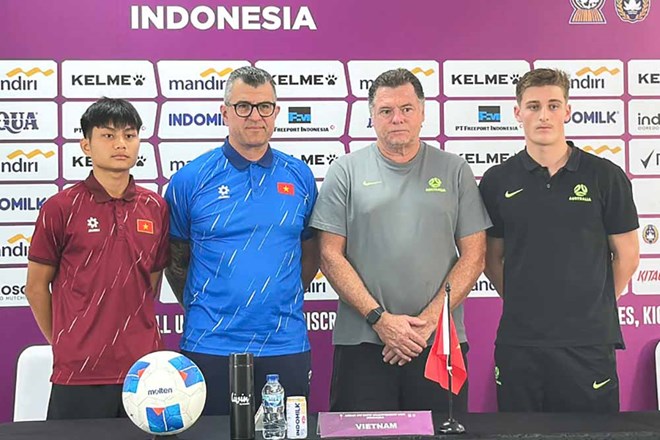
The opponent of coach Cristiano Roland's team is the top team of Group C - U17 Australia. The kangaroo team also impressed with 3 consecutive wins in the group stage, with 15 goals and never having to pick the ball out of the net.
Compared to opponents, U17 Vietnam's journey is more competitive. Facing Malaysia and Indonesia helps the team accumulate experience against opponents with high competition intensity. This is an important factor when entering the knockout round.
Conversely, U17 Australia had a more favorable group stage. They encountered some disarray against Singapore or Cambodia, but still promptly corrected their mistakes in the match against Brunei.
U17 Australia approached the match in a direct way, taking advantage of physical strength and fitness to gain an advantage in the dispute, while deploying the ball quickly with long passes or high crosses. Aerial duels and second ball situations were the main options to put pressure on the opponent's defense.
On the other side, U17 Vietnam maintained the style of controlling the ball and group coordination. The deployments often originated from the midfield, then expanded to the two wings to stretch the opponent's formation.
The ability to move without the ball and coordinate in narrow spaces is a strength that helps Sy Bach and his teammates create many opportunities. However, when facing a high-intensity opponent like Australia, maintaining pace and limiting ball loss in midfield will be decisive.
The midfield area therefore becomes a key position. If U17 Vietnam controls well and is not caught up in direct duels, the game will be kept stable. Conversely, when losing the ball in a transitional state, the team will have to face quick attacks and dangerous high balls from the opponent.
Another factor to consider is fitness. U17 Australia has a longer break before entering the semi-finals. This forces U17 Vietnam to distribute their strength reasonably, especially in the second half. Maintaining concentration and limiting personal errors is a mandatory requirement against opponents who are good at taking advantage of opportunities.
Opportunities are still wide open for U17 Vietnam. The draw against Australia at the Asian tournament 1 year ago showed that Mr. Roland's team can adapt when under pressure. The problem lies in the efficiency of handling in decisive situations, because the number of chances created against this opponent may not be many.
Expected lineup:
U17 Vietnam: Xuan Hoa, Hoang Viet, Manh Cuong, Dang Khoa, Anh Hao, Quy Vuong, Minh Thuy, Nguyen Luc, Van Duong, Dai Nhan, Sy Bach.
U17 Australia: Lachlan, Winston, Fraser, Oliver, Amile, Georgio, Akeem, Max Court, Luka, Achnaff, Josef.


