
On the morning of April 22, in an exchange with Lao Dong Newspaper, Colonel Nguyen Xuan Son - Deputy Political Commissar of Gia Lai Provincial Military Command - said that the unit had cordoned off the area where the tank wreckage surfaced at Quy Nhon beach, not allowing people to swim in the sea to access it to ensure safety.
The unit is developing a salvage plan and will deploy it today. If the tank wreckage is still relatively intact and qualified, it will be taken for display. In case it is heavily damaged, it must be disposed of," Colonel Nguyen Xuan Son informed.
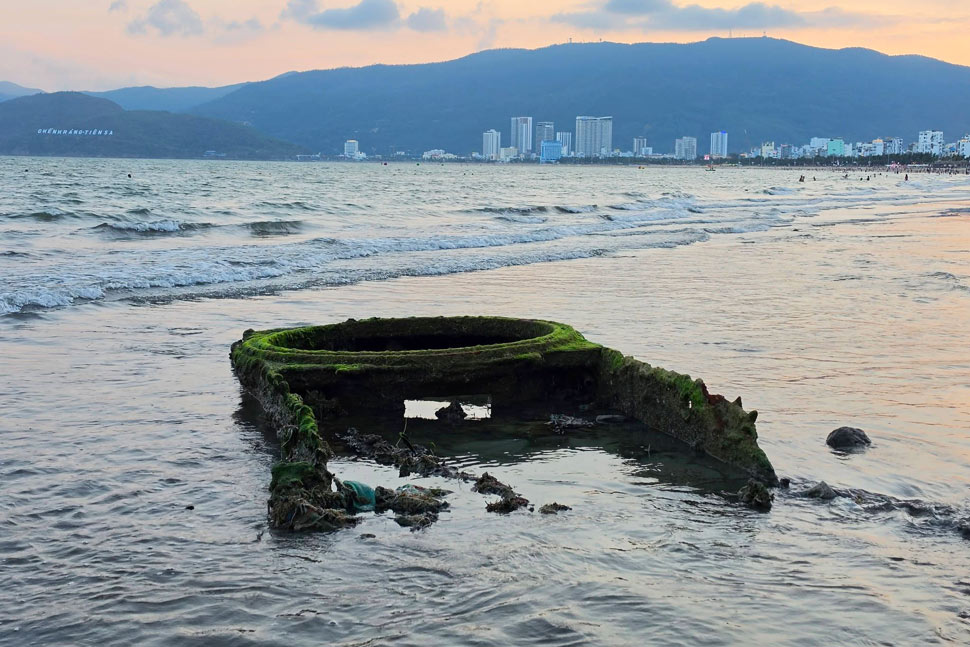
According to the Deputy Political Commissar of Gia Lai Provincial Military Command, through observing the metal tip exposed on the beach, it is possible that this is an M113 tank of the US puppet army. However, this is only the initial assessment, it is necessary to salvage it to accurately identify it.
Previously, functional forces had salvaged some tank parts in this area but they were all rotten due to being soaked in seawater for a long time. In 2000, one was brought back to the traditional house, but after a short time it rusted, was damaged and had to be removed.
Also according to Colonel Nguyen Xuan Son, during the war period, when our troops deployed offensive spearheads, the Republic of Vietnam army ran away along the Quy Nhon beach area, leaving behind many tanks to swim out to sea and board the US ships waiting a few nautical miles from the shore.
As Lao Dong newspaper reported, in recent days, social networks have spread images believed to be a part of a tank rising up at Quy Nhon beach, attracting the attention of the online community.
Mr. Luong Quoc Cuong (31 years old, Quy Nhon ward) confirmed that he was the person who discovered and photographed this strange object and posted it on social networks. He said that the photos were taken on the afternoon of April 17 in the beach area at the beginning of Xuan Dieu street.
At this time, the tide receded deeply, so the strange object surfaced onto the beach and was easily seen.
Mr. Cuong said that through observation, he noticed that the exposed part was very similar to a tank part, heavily rusted. When he approached, he discovered that this detail was also connected to another part that was buried deep under the sea sand.


