
Tet used to be a default pressure
“Before, every December, I started to get stressed,” said Ms. Hue (38 years old, Nghe An).
Her family has both paternal and maternal relatives living nearby, so every Tet is crowded with guests. The entire task of cleaning, shopping, preparing the New Year's Eve offering tray and meals, and the first offering trays of the year is mostly undertaken by her. "My husband works all year round, so he thinks Tet is a time for rest. And I switch to another shift," she recounted.
In fact, Ms. Hue also works as a worker, taking Tet holiday according to regulations like her husband. In the days leading up to Tet, she takes advantage of cleaning the house until late at night, goes to the market early in the morning, and goes to the kitchen at noon. After each crowded meal, there is another washing of dishes lasting for hours.

Ms. Lan Anh (42 years old, Hanoi) said that her situation is similar. Every morning, she has to wake up early with her mother-in-law to clean the house, prepare offerings for ancestors, and breakfast for the family.
Men in the house rarely participate in cooking. Not because they don't love their wives, but because they think it's something women should do, getting used to it better should be faster these days," she said.
Many families still maintain the traditional concept: men take care of social affairs, women take care of housework. During Tet, when the workload increases significantly, the burden is therefore heavier on the shoulders of the wife and mother.
From that reality, the images of women busily working in the kitchen during Tet once became a topic of debate on social networks. Many people frankly believe that Tet is sometimes not a holiday, but a "peak season" of housework for women.
Change in many young families
Changes have appeared in recent years, when family members started to divide housework during Tet.
Ms. Hue's husband was in charge of cleaning the living room, wiping tables and chairs, washing dishes after crowded meals. The 6th grade son was assigned to arrange trays, fetch water, arrange bowls and chopsticks, and the 4th grade little daughter helped her mother arrange flowers and decorate Tet peach branches.
When the whole family joins hands, work is done faster, and the family atmosphere also becomes harmonious and happy. My husband proactively divides housework, so that children know how to share, understand that housework is not just anyone's business and help the family," Ms. Hue said.
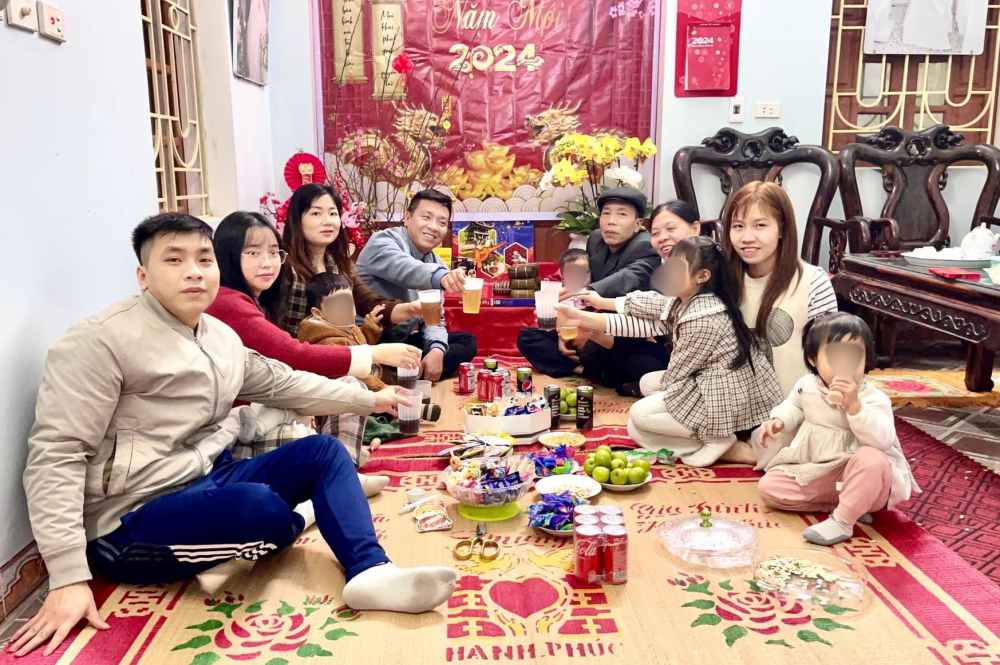
Mr. Cong Hau (32 years old, Hung Yen) said that he and his wife agreed on the point of view right from the time they got married. "My wife also works all year round. If Tet is left for her to do everything, it is not fair," he said.
From daily work, Mr. Hau and his wife share cooking, washing dishes to washing clothes, cleaning the house. When Tet comes, the couple has their own house and young children, so they take advantage of preparing a New Year's Eve offering at home before sending their children to their paternal hometown.
Mr. Hau takes on cooking some main dishes, his wife prepares the offering tray. Both husband and wife take turns taking care of 2 young children of preschool age. "Dividing work to work faster and for everyone to have time to rest," he shared.
This change comes from many factors. Women are increasingly deeply involved in the labor market, contributing economically equivalent to men. At the same time, awareness of equality in the family is also being raised.
According to research by the Pew Research Center in the US, housework sharing is in the top three factors that determine a successful marriage - this is only second to fidelity and sublimated sex life.
In this survey, 62% of adults said that sharing housework is very important. This view is not disparate in men and women, older and younger people, or between married people and single people.
According to Master of Psychology Nguyen Thi Lanh, women do not need to "endure" to make their families happy, but need to learn to "be together".
When a woman knows how to take care of herself, she becomes peaceful, soft and full of energy. That state makes the family change in a positive direction. A cheerful mother makes her child feel secure, a happy wife makes the family warm," the expert said.
Instead of spending the whole day doing housework and taking care of husbands and children, women need more time to take care of themselves from appearance to soul. Because to keep the family fire burning, first of all, you must keep the fire burning for yourself.
However, the change does not happen uniformly everywhere. In some families, women are still the ones who shoulder most of the Tet preparation work. But compared to before, the image of mothers busily working alone from morning to night has become less common.
Sharing housework not only helps reduce pressure on women but also contributes to building a more equal family environment. Children growing up in that atmosphere will have a clearer awareness of shared responsibility.
Tet, therefore, is gradually returning to its true meaning as a time for rest and family reunion for the whole family. When work is reasonably divided, no one has to silently shoulder everything behind the reunion meal.


