
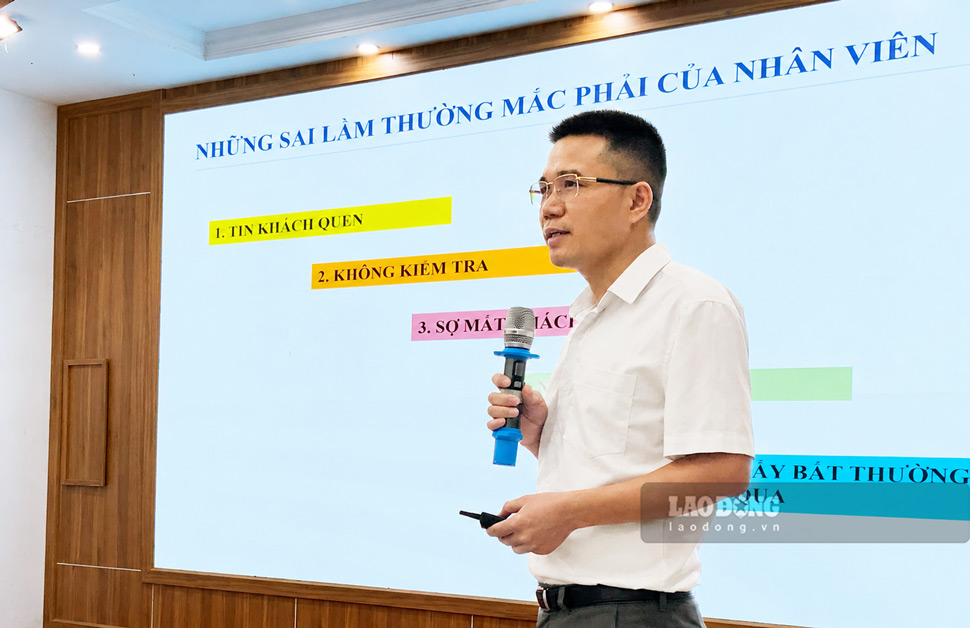
At the policy communication conference on the draft Law on Posts (amended), held on the morning of August 18 in Hanoi, Mr. Le Van Chung - Chief Specialist of the Postal Department (Ministry of Science and Technology) shared about the current situation, signs of risk and skills in handling unusual mail.
E-commerce creates more loopholes
According to Mr. Le Van Chung, the development of e-commerce is increasing the number of unfacing transactions in postal activities. Senders can create orders through applications, automated points or multiple intermediaries without directly contacting postal staff.
Meanwhile, sender information may be missing, inaccurate, or signs of forgery. The postal network has many acceptance, transshipment, and delivery points, making the control of the entire journey of a postcard more complicated.
The form of delivering goods and collecting money for others can also create a distance between the sender, transaction and cash flow. According to Mr. Chung, violators may take advantage of these characteristics, while dividing goods into smaller portions, changing information or transport routes to reduce the possibility of being detected.
Some risk signs summarized at the conference include the disguise of goods in food, confectionery, tea, coffee, cosmetics or common items. Goods can also be hidden in electronics, toys, empty compartments or structures inside items.
Subdividing goods into many packages, sending them consecutively or sending them to different locations is also considered a sign to note. In some cases, information from others or names, addresses, and phone numbers that are difficult to verify may be used.
Other signs include changes in the recipient, recipient location or itinerary during transportation; taking advantage of the form of delivery to collect money for others or combining multiple methods to conceal information.
However, Mr. Chung noted that these signs are only input for risk assessment. Businesses should not conclude that a postcard violates the law based only on a single manifestation.
The assessment needs to be carried out on the overall sender information, postal characteristics, transaction history, transportation journey and related abnormal signs.
Identifying risks from senders to postal journeys
According to the content shared at the conference, postal businesses can systematize the identification of postcards with risk signs into 6 groups.
The first is the sign from the sender. Anxious, hasty attitude, avoidance of the camera or inconsistent answers about the goods may be information that needs to be noted.
Second is information. Incomplete names, addresses, phone numbers that are difficult to verify or cannot be contacted can increase the level of risk.
Third is the characteristics of the package. Postcards that are overpacked or have declared content that is not commensurate with the weight and shape also need to be checked according to the procedure. Unusual odors used to cover up other odors are also a sign to note.
Fourth is a physical sign. Leaking, heat emission, vibration, noise, chemical odor or abnormal condition of the package may pose a risk to the person in contact and the mining area.
Fifth is transaction history. Sending and receiving frequency, COD activity, transaction timing, or unusual changes in behavior can be used to assess risk.
Finally, there is a comprehensive assessment, which considers the transport route, the change of recipients, warnings from functional agencies and the combination of many different signs.
Mr. Le Van Chung emphasized that risk identification is not intended to replace the verification and handling activities of competent authorities. This is the basis for businesses to detect abnormal cases early and implement the correct procedures.
When suspicious signs appear, the principle of handling is calmness, safety, within authority and in accordance with the law. The process needs to be shifted from judgment to the steps of detection, assessment, application of appropriate measures and coordination of handling.
For senders who refuse to provide necessary information or do not meet the acceptance conditions according to the company's regulations and procedures, employees need to clearly explain the request. Do not ignore the procedure just because of acquaintances or pressure to retain customers.
In particular, for postcards with physical hazard signs such as chemical leaks, heat emissions, abnormal odors or fire and explosion risks, the top priority is to ensure safety for people and the exploitation area.
Employees are not allowed to arbitrarily perform operations that may increase the risk. Instead, it is necessary to report to the management agency and coordinate with competent authorities according to regulations.
In case of suspicion related to illegal acts, nghiệp vụ data such as sender information, transaction history, postal journey, camera images and related information need to be preserved in accordance with regulations to serve verification, traceability and coordination of handling.
The collection, storage and provision of these data must also comply with the provisions of law on data and personal data protection.
In the context of rapidly increasing postal output and the development of e-commerce, the requirement to ensure postal safety and security is therefore not only in the stage of goods control. This is also a problem of information management, data, postal routes and the ability to coordinate between businesses and functional agencies.


