
In the days leading up to Tet, in the space of every Vietnamese family, the five-fruit tray always occupies a solemn position on the ancestral altar. Not as brilliant as flowers, not as elaborate as a feast, but the five-fruit tray carries many layers of spiritual and cultural meaning, clearly reflecting the Vietnamese people's belief in heaven - earth - people in the moment of New Year's transition.
Few rituals during Tet are as close to life and contain such a deep belief as arranging a five-fruit tray.
Five fruits - symbol of New Year's wishes
According to folk beliefs, the five-fruit tray symbolizes the desire for fullness, reproduction and peace in the new year. The number "five" is associated with the theory of the five elements - metal, wood, water, fire, earth - reflecting how the ancients perceived the universe as a harmonious whole. Five types of fruits, with different colors and shapes, are placed next to each other as a prayer for balance between humans and nature.
Each type of fruit not only carries material value, but also sends wishes: round fruits symbolize fulfillment, fruits with seeds represent proliferation, fruits with fragrance evoke purity. Although the interpretations are different, the common point is still the aspiration for a good new year.
Each region has a five-fruit tray, sharing a common belief
The special thing about the five-fruit tray is that there are no fixed molds nationwide. In the North, the five-fruit tray often has green bananas as a background, combined with grapefruit, orange, tangerine, persimmon... The banana bunch is considered as a hand to support, shelter, and wrap other fruits - symbolizing reunion and affection.
Meanwhile, the five-fruit tray in the Central region reflects harsher natural conditions. Fruits are not too fussy about names or forms, mainly choosing readily available, fresh and delicious types, expressing the concept of "give whatever you have", valuing sincerity more than form.
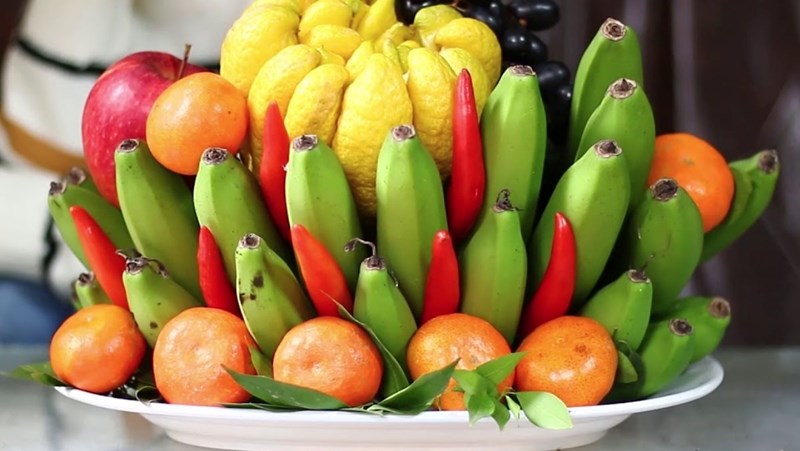
In the South, the five-fruit tray has a clear symbolic meaning through the wordplay: custard apple - sung - coconut - papaya - mango, sending the wish "pray for just enough for use". This choice shows folk thinking is flexible, close and practical.
Although different in form, five-fruit trays in all regions aim for the same value: offering ancestors the most quintessential things of heaven and earth, with the wish for blessings for the family.
Not just offerings, but connection
The five-fruit tray is not simply a worshiping offering. It is also a connecting thread between generations in the family. Choosing fruits, washing fruits, and arranging trays often take place in the last days of the year, when adults guide their children and grandchildren on how to arrange and explain the meaning of each type of fruit. Through this, cultural knowledge is transmitted naturally, without needing to be didactic.
In many families, the five-fruit tray is also a manifestation of family tradition. Not placing much emphasis on fuility, but focusing on neatness, balance and freshness. The arrangement of high and low fruits, inside and outside, front and back all expresses the concept of order and harmony.
When the five-fruit tray enters modern life
Today, along with the pace of urban life, the five-fruit tray also has changes. Many families add imported fruits, focusing on color and form to make the fruit tray more beautiful. In some places, the five-fruit tray becomes a part of Tet decoration.
However, this change does not lose its core meaning. Whether it is green bananas or foreign apples, the important thing is still sincerity and spirit towards the roots. Many young families simplify the number of fruits, but still maintain the habit of arranging five-fruit trays as a way to maintain connection with tradition.
In the context of modern society, preserving the five-fruit tray does not necessarily have to follow old customs. The important thing is to understand the value behind the ritual: gratitude to ancestors, respect for nature and aspiration for a peaceful new year.
A simple five-fruit tray, carefully arranged and placed in a cozy family space, still carries full of sacred meaning. When those values are still preserved, the five-fruit tray will not only be a familiar image every Tet holiday, but also a persistent symbol of Vietnamese beliefs and culture in the flow of time.


