
Ms. N.L. A (in Thai Nguyen) asked: My husband and I got married in 2015. Because my husband is the only child, since we got married, we have lived with my parents-in-law. My family life can be said to be harmonious and happy with 2 children, both male and female.
My family's economy is quite stable, because my parents-in-law have pensions, and both husband and wife have good incomes. Last year, we discussed with my parents-in-law to demolish the old house to build a spacious villa. Neighbors and neighbors all praised me for being "lucky" to marry a husband who makes money, and my husband's family has a lot of land. I also always feel satisfied with my happiness.
But in life, no one can read all the doubts. 6 months ago, I discovered that my husband was still seeing his ex-girlfriend. The two have been seeing each other for 6 years, since she divorced her husband. What shocked me even more was that they have a daughter who is almost 5 years old this year.
Indignant at being betrayed, living in deception for so many years, I proposed to break up with my husband. My husband agreed without hesitation. Even my husband said that if his ex-girlfriend had not been forced by her family to marry someone else that day, it would not be my turn to be his wife. Hearing my husband say that, I no longer had any nostalgia and wanted to break up as soon as possible.
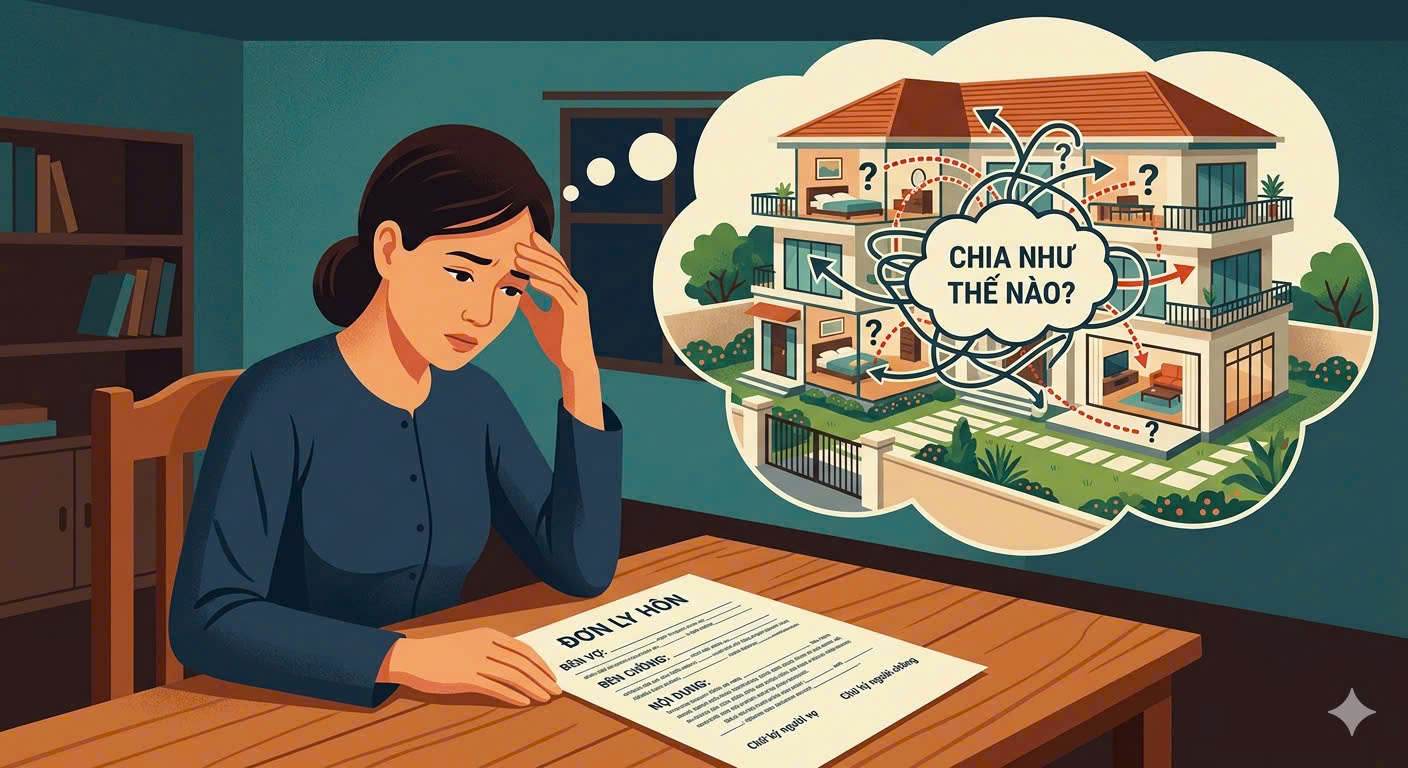
However, because we live with my parents-in-law, I don't know how the property of my husband and I will be handled after breaking up. In addition to the car and savings book in my husband's name, from building a house to buying furniture, there is a contribution from both my husband and my parents-in-law. Will I be required to divide the property of my husband and wife in that property? I would like to have my lawyer advise me.
Regarding the legal issue you asked, lawyer Duong Thu Hien - Thanh Lam Law Company Limited - advises as follows:
Article 61 of the Law on Marriage and Family in 2014 (amended and supplemented in 2025), stipulates:
Article 61. Division of assets in cases where husband and wife live with the family
1. In case husband and wife live with the family but divorce, if the property of husband and wife in the common property of the family cannot be determined, the husband or wife is entitled to share a part of the common property of the family based on the husband and wife's contributions to creating, maintaining, and developing the common property as well as the common life of the family. The division of a part of the common property is agreed upon by husband and wife with the family; if no agreement can be reached, they request the Court to resolve it.
2. In case husband and wife live together with the family and the property of husband and wife in the common property of the family can be determined by portion, then when divorcing, the property of husband and wife is deducted from that common property to be divided according to the provisions of Article 59 of this Law.
Article 59 of the Law on Marriage and Family 2014, stipulates:
Article 59. Principles for resolving property of husband and wife upon divorce
1. In case the property regime of husband and wife is prescribed by law, the settlement of property is agreed upon by the parties; if no agreement is reached, at the request of husband, wife or husband and wife, the Court shall settle according to the provisions of Clauses 2, 3, 4 and 5 of this Article and Articles 60, 61, 62, 63 and 64 of this Law.
In case the property regime of husband and wife is agreed upon, the settlement of property upon divorce is applied according to that agreement; if the agreement is incomplete and unclear, the corresponding regulations in Clauses 2, 3, 4 and 5 of this Article and in Articles 60, 61, 62, 63 and 64 of this Law shall be applied for settlement.
2. Common property of husband and wife is divided in half but taking into account the following factors:
a) Family and spouse circumstances;
b) The contribution of husband and wife to the creation, maintenance and development of common property. The labor of husband and wife in the family is considered as income-generating labor;
c) Protect the legitimate interests of each party in production, business and occupation so that the parties have conditions to continue working to generate income;
d) The fault of each party in violating the rights and obligations of husband and wife.
3. Common property of husband and wife is divided in kind, if it cannot be divided in kind, it is divided according to value; whichever party receives the property in kind with a value greater than their own share, they must pay the other party the difference.
4. Private property of husband and wife is owned by that person, except for cases where private property has been incorporated into common property according to the provisions of this Law.
In case there is a merger or mixing between separate assets and common assets and the husband and wife request property division, they are entitled to pay the value of their assets contributed to that asset block, unless the husband and wife have other agreements.
5. Protect the legitimate rights and interests of the wife, minor children, and adult children who have lost civil act capacity or are unable to work and do not have assets to support themselves.
6. The Supreme People's Court shall preside over and coordinate with the Supreme People's Procuracy and the Ministry of Justice to guide this.
In your case, if it is possible to clearly determine the property of husband and wife in the common property of the family, then that part will be separated to be divided according to the general regulations on property when divorce.
If it cannot be determined, you still have the right to request property division and must prove your contribution to creating the common property of the family. If no agreement is reached with your husband's family, you can completely request the Court to divide according to legal regulations.
The above is the advice of the lawyer. I hope you have a basis to solve your problems.
Legal advice
Please share your problems with us for lawyer advice via email address: toasoan. laodong@gmail. com


