
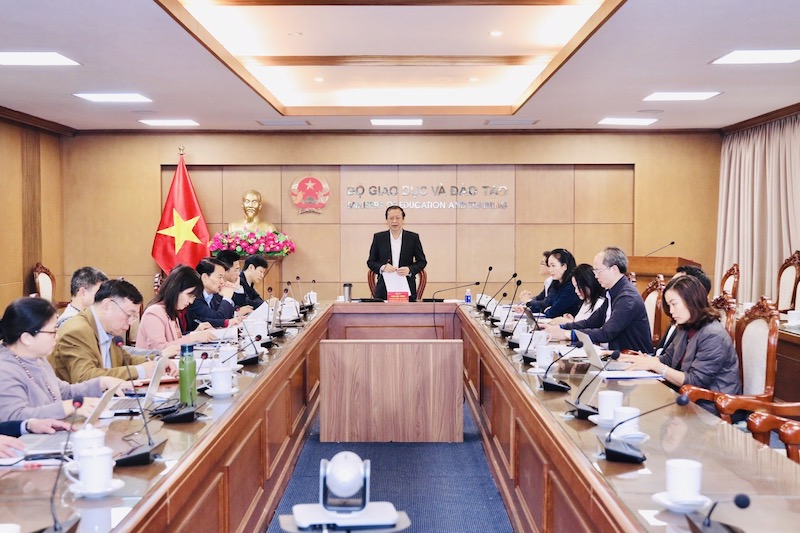
On December 19, the Ministry of Education and Training (MOET) held an online conference with localities on the arrangement and organization of public preschool, general education, and continuing education institutions.
Most localities will keep kindergartens, primary schools, secondary schools, and high schools unchanged in 2025
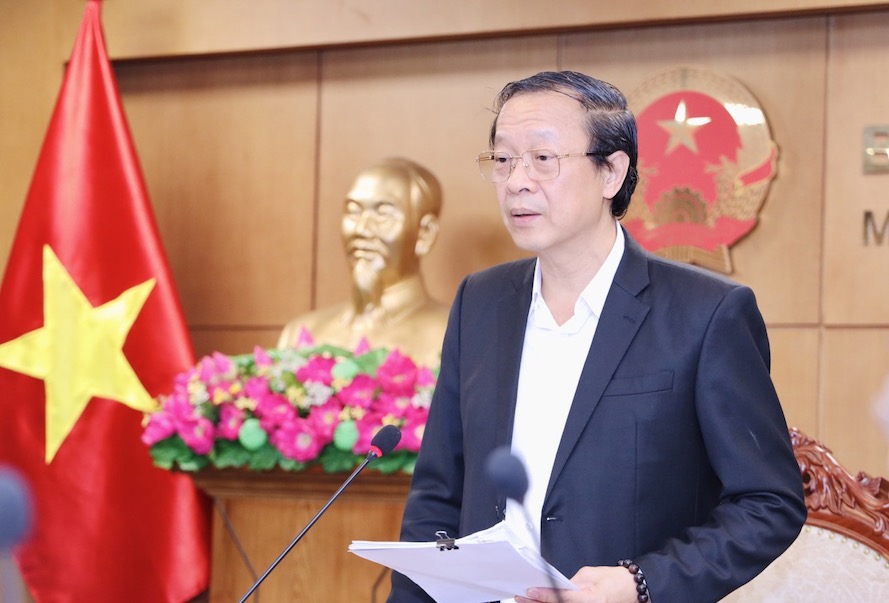
Reporting on the implementation of the arrangement and organization of preschool, primary and secondary education institutions according to the two-level local government model, Mr. Thai Van Tai - Director of the Department of Education and Training said that, synthesizing reports from 23/34 provinces and cities sent to the Ministry of Education and Training as of 12:00 on December 18, 2025, most localities will keep preschools, primary and secondary schools, high schools in 2025 and develop a roadmap for arrangement after the end of the 2025-2026 school year.
For preschool education, 6/23 provinces will maintain the status quo, 15/23 provinces will gradually decrease from 1.76% to less than 10%, 1 province has completed the merger, reducing 45.83% of educational institutions. In general education, 7/23 provinces remained unchanged, 15/23 provinces decreased from 0.2% to less than 10%, 1 province decreased 42.57%. Continuing education has a strong merger rate, many localities have reduced it by over 30%.
The initial arrangement has contributed to streamlining focal points, reducing management staff, rearranging the team of teachers and staff, and overcoming local shortages and excesses. However, some localities are still merging in a mechanical direction, on a large scale in a short time, posing a potential risk of overloading facilities, affecting the model of ethnic boarding and semi-boarding schools and the right to access education for students in disadvantaged areas.
Arrange schools cautiously, with a roadmap, without disrupting teaching activities
At the online conference, Mr. Nguyen Vinh Hung, Deputy Director of the Department of Education and Training of Hue City, said: The city determined the policy of keeping educational institutions under the Department stable, only considering arrangement at the commune and ward levels when truly necessary and ensuring safe travel conditions for students, especially in disadvantaged areas and border areas. According to Mr. Hung, the arrangement of the school network must be associated with investment in boarding and boarding schools to create stable and long-term learning conditions for students in specific areas.
Sharing the same view, Mr. Phung Quoc Lap, Deputy Director of the Department of Education and Training of Phu Tho, said that the merger of educational institutions should focus on small-scale schools and schools that are no longer suitable, and at the same time, do not seriously consider the requirement of completion in a short time. According to Mr. Lap, arranging the school network is a sensitive issue, requiring a suitable roadmap, associated with propaganda work, creating consensus among people and teachers.
From practical implementation, Deputy Director of the Department of Education and Training of Tuyen Quang Bui Quang Tri proposed that the Ministry of Education and Training soon have specific instructions on the organization, enrollment and operation of boarding schools and boarding schools in border areas, as a basis for localities to implement uniformly.
No mechanical cuts, taking education quality as the highest goal
Concluding the conference, Mr. Pham Ngoc Thuong - Permanent Deputy Minister of Education and Training - emphasized that reviewing and arranging the network of educational institutions is a regular task, which has been implemented since the implementation of Resolution No. 18 of the Central Committee, and has become even more urgent in the context of implementing the two-level local government model, arranging administrative boundaries according to the resolutions and conclusions of the Central Committee.
Mr. Thuong noted that the arrangement of the school network is not a mechanical cut, not following the number of schools reduced, schools reduced. The highest goal is to improve the quality of education, ensure the learning rights of students and teaching conditions for teachers. Places with small, unsuitable schools need to be reorganized and merged; on the contrary, places with large numbers of students and over-schools must consider the plan to separate and build new schools, ensuring regulations on class numbers, school safety and educational principles.
The Deputy Minister emphasized three consistent requirements in reviewing and arranging the network of educational institutions: enough schools, enough classes, enough teachers, but must be reasonable enough, suitable to the practical conditions of each locality. The arrangement must meet the goals of universal education, especially universal preschool education for children aged 3 to 5, compulsory education in primary and secondary schools. Along with that, the organization of schools must comply with the principles of education, contributing to improving the quality of teaching.
In addition, Permanent Deputy Minister Pham Ngoc Thuong requested localities to strictly implement current regulations on school standards, facilities, teaching staff, etc.


