
Boarding meals gradually stabilize
Rice is as delicious as at home" - Ly Nam Trung, a 6A3 student at Ly Thuong Kiet Primary and Secondary School (Cua Nam ward, Hanoi City) commented after a week of eating semi-boarding at school.
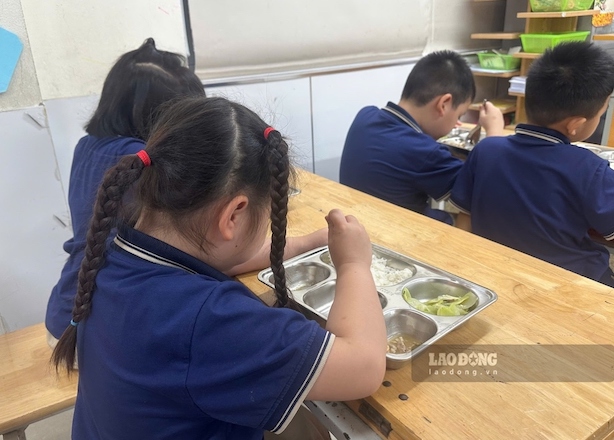
Students' lunch usually includes 5 dishes. Like this noon (September 14), the children's meal includes shrimp with braised meat, pork braised with radishes, sour soup cooked with bean sprouts, gourd stir-fried with beef and sticky rice.
Ms. Le Thi Thu Chung - Vice Principal of Ly Thuong Kiet Primary & Secondary School (Van Mieu ward, Hanoi City) - said that according to school regulations, food must be completed and checked by 6:30 am at the latest. However, on the first day of organizing the semi-boarding meal, some kitchen staff arrived late because their houses were far away, the road was congested, and the company's vehicles were congested.
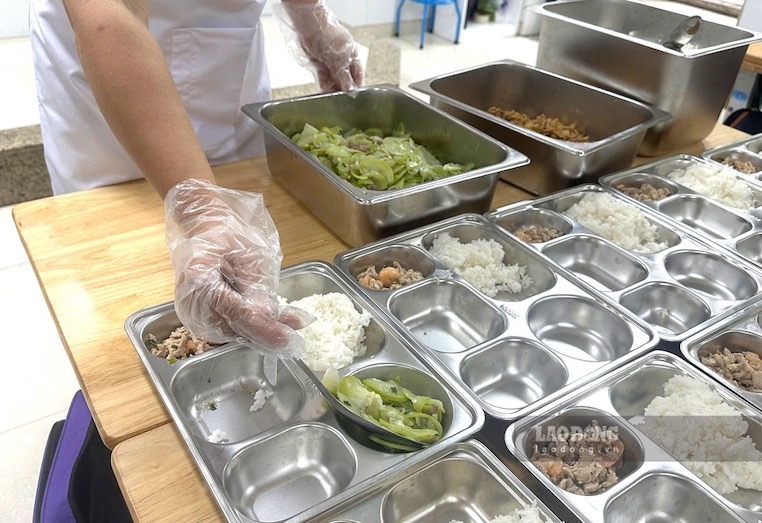
They are new, not familiar with the school, so they are a bit late on the first day" - Ms. Chung said.
Immediately after detecting the delay in food and personnel imports, the school inspected and closely monitored. Van Mieu - Quoc Tu Giam Ward also sent officials directly to the school to supervise and update the situation. The school continuously took photos and reported to promptly have handling plans.
By the end of the week, the organization of semi-boarding meals has stabilized and become regular" - Ms. Chung informed.
According to Lao Dong's records, in the first days of the 2026 - 2027 school year, in some schools in Hanoi, there was a situation of delays in the process of organizing semi-boarding meals. Faced with this situation, functional agencies and local authorities have requested schools to review, rectify, and put semi-boarding work into order.
Strengthening supervision and tracing of food origin
From the 2026 - 2027 school year in Hanoi, the People's Committees of communes and wards are the units in charge of establishing councils to select, sign contracts and assign suppliers of semi-boarding meals for schools in the area.
According to Ms. Chung, the selected meal providers have all been evaluated for their capacity. However, the school still has to directly supervise the implementation process to ensure food safety for students.
The control is carried out from the stage of food import to processing and when the meal reaches students. Food must be safe, of clear origin, still within its expiration date and in the correct quantity; the processing process must ensure food safety according to regulations.
This is a very clear closed process for the school to be responsible and supervised" - Ms. Chung said.
For elementary school students, meals are divided in the classroom to ensure warmth. After dividing all meals, teachers take pictures and send them to the group of classes for the school to control quantity and monitor by sensory perception. If abnormalities are detected, teachers must immediately report for handling.
The school also publicly discloses information about semi-boarding meals on the link so that parents can follow the menu, quantity of imported food, origin and portion size.
Ms. Chung said that the participation of parents in supervision is necessary. For many years, the school has invited parents to trace the origin of food and plans to build a schedule for parents to directly check at the place of food supply and production.
At Dong La Primary School (An Khanh commune, Hanoi), Ms. Pham Thi Huong - Vice Principal of the school - said that food safety assurance is emphasized right from the input stage, with the participation of the Board of Directors, representatives of parents and homeroom teachers.
The school coordinates with the supplier to build a diverse, constantly changing diet, ensuring sufficient nutrients and suitable for students.
Besides, the dish is also focused on its appearance so that the children feel delicious" - Ms. Huong shared.
Since last year, Dong La Elementary School has piloted the use of Hanoi Check software, helping teachers and school administrators trace the origin and track daily meals. Parents can also access it to track information about students' meals.
Compared to the previous pilot software, HanoiCheck has the advantage of deeper origin traceability. Previously, the system mainly monitored from the stage of food import to the completion of meals, while Hanoi Check could trace the origin of food to the end" - Ms. Huong said.


