
Attending the ceremony were Senior Lieutenant General, Dr. Le Quoc Hung - Member of the Party Central Committee, Deputy Minister of Public Security; Mr. Trinh Xuan Truong - Member of the Party Central Committee, Secretary of Thai Nguyen Provincial Party Committee.
At the ceremony, the Ministry of Public Security announced the decision to transfer the original state of the Culture School under the Department of Training to be directly under the Thai Nguyen Provincial Police, reorganized into the People's Police Culture School I. At the same time, it issued a decision stipulating the functions, tasks, powers and organizational structure of the school.
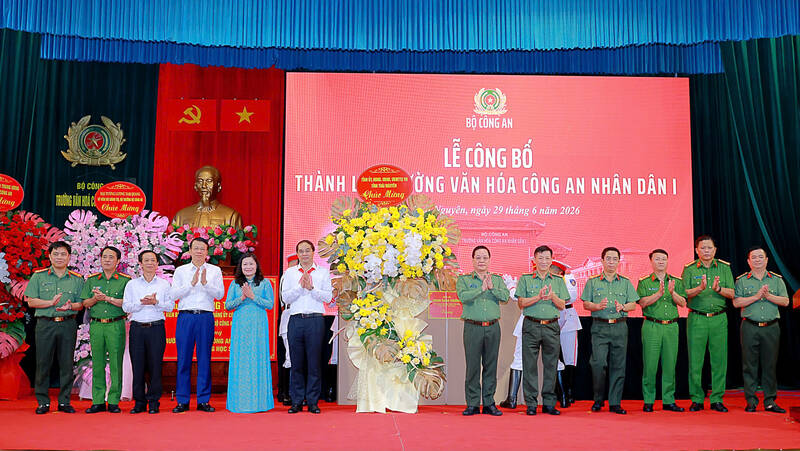
Thai Nguyen Provincial People's Committee also announced the decision to establish the People's Police Culture Boarding Primary, Secondary and High School I based on reorganizing the Cultural School.
Accordingly, the People's Police Culture School I is a department-level unit under the Thai Nguyen Provincial Police.
This is an educational institution in the national education system, implementing general education from elementary to high school according to the boarding model.
The school has the task of managing, nurturing, and educating students who are children of wounded soldiers, martyrs of the People's Police, students from policy families, students in ethnic minority areas, students in difficult circumstances and subjects according to regulations.
On this occasion, the Minister of Public Security presented the People's Police Culture School I with a STEM classroom. Presented many gifts to collectives and individuals in the education sector and Thai Nguyen province.
The People's Police Culture School I was formerly the Police Corporal School III, established in 1976.
Over nearly 50 years of construction and development, the school has trained many generations of police officers and soldiers and international students.
With the new organizational model, the People's Police Culture School I will implement general education at all three levels of education according to the boarding model. From there, it will contribute to the effective implementation of social security policies and human resource training for the midland and mountainous areas of the North.


