
If approved, the new Circular will replace Circular No. 01/2024/TT-BGDĐT in 2024 of the Minister of Education and Training regulating national standards for higher education institutions.
According to the Ministry of Education and Training, the development of the Circular aims to implement the provisions of the 2025 Law on Higher Education, and at the same time continue to innovate the state management method for higher education in the direction of strengthening autonomy, transparency and accountability.
The Ministry believes that the core point is to shift from a management approach based heavily on controlling input conditions and implementation procedures to supervising the quality, operational efficiency and output results of higher education institutions. Through this, schools proactively improve quality, self-improve and fully promote autonomy associated with accountability to learners and society.
The draft includes 19 criteria in 6 standards on: Organization and management; lecturers; Facilities; Finance; Enrollment and training; Science, technology and innovation.
Compared to Circular 01 in 2024, most criteria are kept unchanged. For example, regarding the teaching staff, the ratio of students to full-time lecturers needs to be 40 or less; the proportion of full-time lecturers accounts for at least 70% of the total. The group of lecturers with doctoral degrees must reach 20-40% or more, and from 2030 is 50%.
In enrollment and training, the Ministry of Education and Training requires the enrollment rate per target to be no less than 50%; the training scale not to decrease by more than 30% in the last three years.
The annual dropout rate is not higher than 10%, especially for the first year not exceeding 15%. Students graduating on time from 40% or more, the rate of having jobs suitable for their profession in the 12 months after graduation is not lower than 70%. Lecturers must receive satisfaction from at least 70% of students.
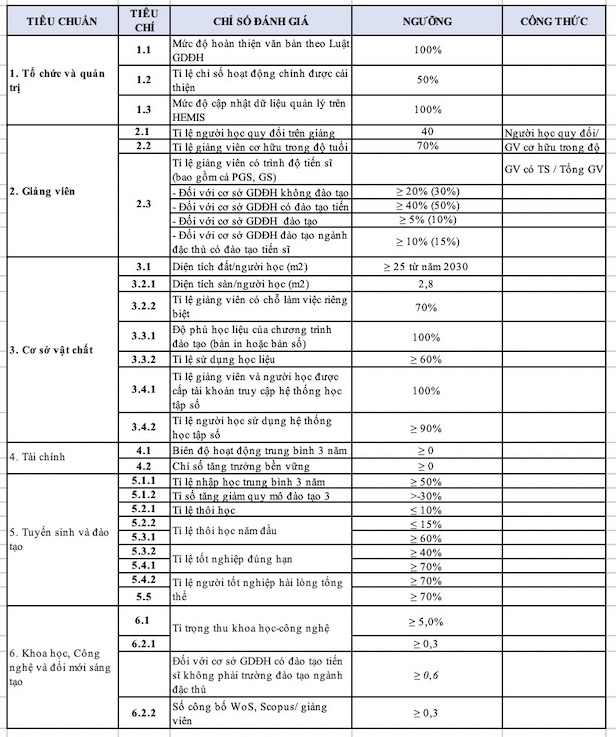
The difference is the criteria related to digital transformation. In addition to the requirements for traditional facilities, the draft supplements and clarifies indicators on digital learning systems, digital learning materials, open access resources and the level of exploitation and use by learners and lecturers.
For example, the ratio of lecturers and learners granted valid access accounts is 100% and at least 90% of learners have arising learning activities on the digital learning system during the school year.
The Ministry recognizes that the inclusion of criteria related to digital learning systems, digital learning materials and data infrastructure in the minimum set of standards will create motivation for higher education institutions to promote technology investment, develop a flexible learning environment, expand lifelong learning opportunities and improve learners' learning experiences in the context of digital transformation.
In addition, the drafting agency proposed some specific indicators for schools training in the fields of Law and Health, mainly related to students' practice.


