
For many years, in the low-lying area of My Tu commune, Nga Nam ward (Can Tho city), water levels have risen, making many areas unable to cultivate rice. Instead of abandoning fields or accepting losses, many farmers have flexibly switched to the model of raising fish on rice fields and brought clear economic efficiency.
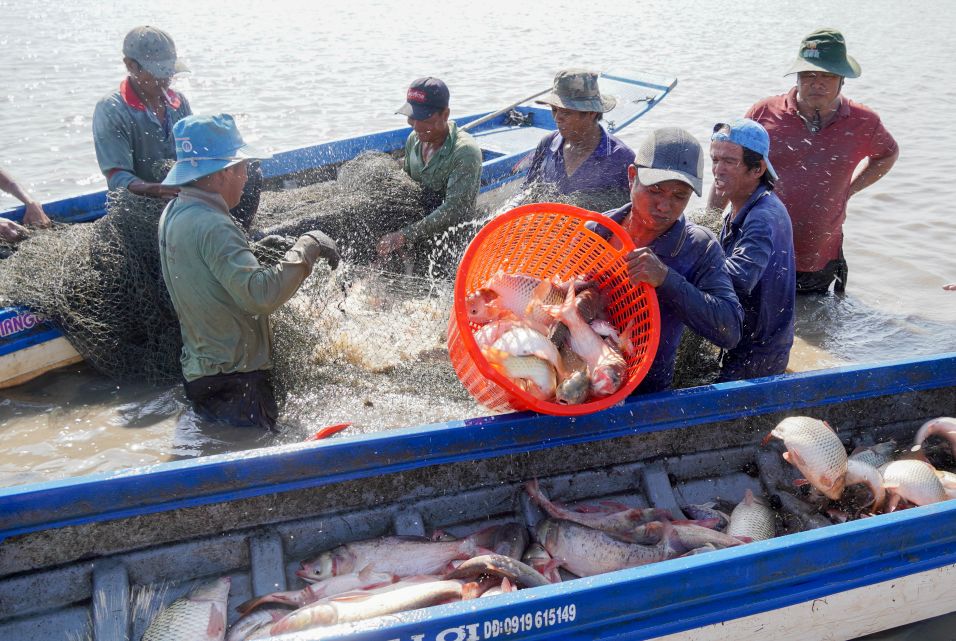
Mr. Dang Van Doi, a farmer in My Tu commune (Can Tho City), said that he has been attached to this model for more than 3 years. "Rice farming this crop is considered to have no food, the water is too high. But releasing fish is more successful, even better than rice farming," Mr. Doi shared.
Mr. Doi said that after harvesting Summer-Autumn rice, people take advantage of low-lying fields to retain water and raise natural fish fry throughout the flood season. Fish mainly eat plankton, algae and natural organisms in the fields, so they hardly spend on feed. The farming time is about 3-4 months before harvesting. With this model, each hectare of field (1,000 m2) if farmed properly can bring a profit of about 1 million VND. Meanwhile, at the same time, rice cultivation is almost unprofitable due to low rice prices, increased costs of fertilizers and pesticides.
This year, the fish grew quickly, some reaching 1 kg. On average, 1 kg of seed fish, about 80 - 100 fish, if raised properly, after deducting losses, about 50 - 60 kg of commercial fish will still be harvested," Mr. Doi added.
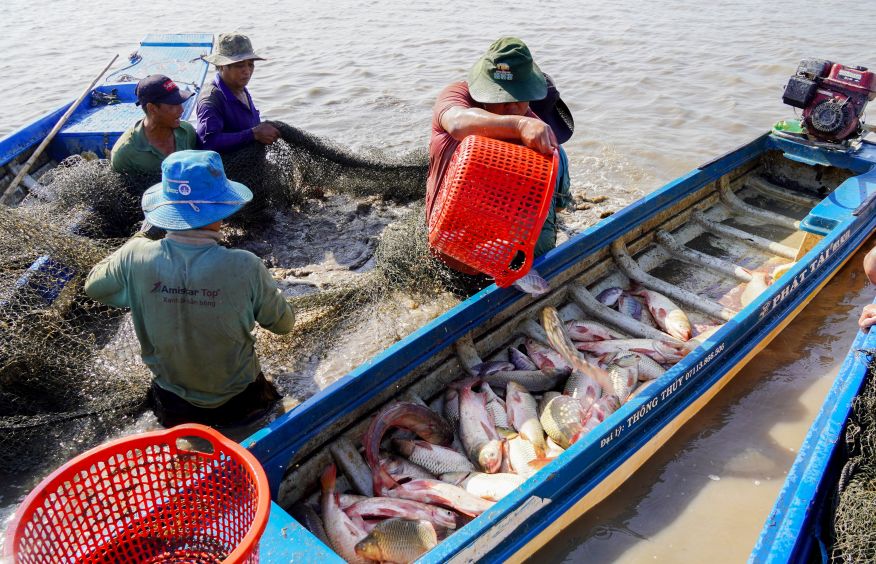
Also in My Tu commune, Mr. Nguyen Van Doi said that this year's fish crop his family raises on an area of more than 14 hectares, with about 86 kg of seed fish, mainly catfish and carp. The total cost of land lease and buying seed fish is about 60 million VND. Harvested output is about 15 tons of fish of all kinds, with catfish prices of about 11,000 VND/kg, carp 15,000 VND/kg, total income of nearly 200 million VND. According to Mr. Doi, fish after harvesting are all purchased by traders on the spot, so the output is quite stable.
According to people's assessment, the rice field fish farming model not only helps adapt to the increasing flooding situation but also effectively utilizes natural resources, reduces production costs and increases income.
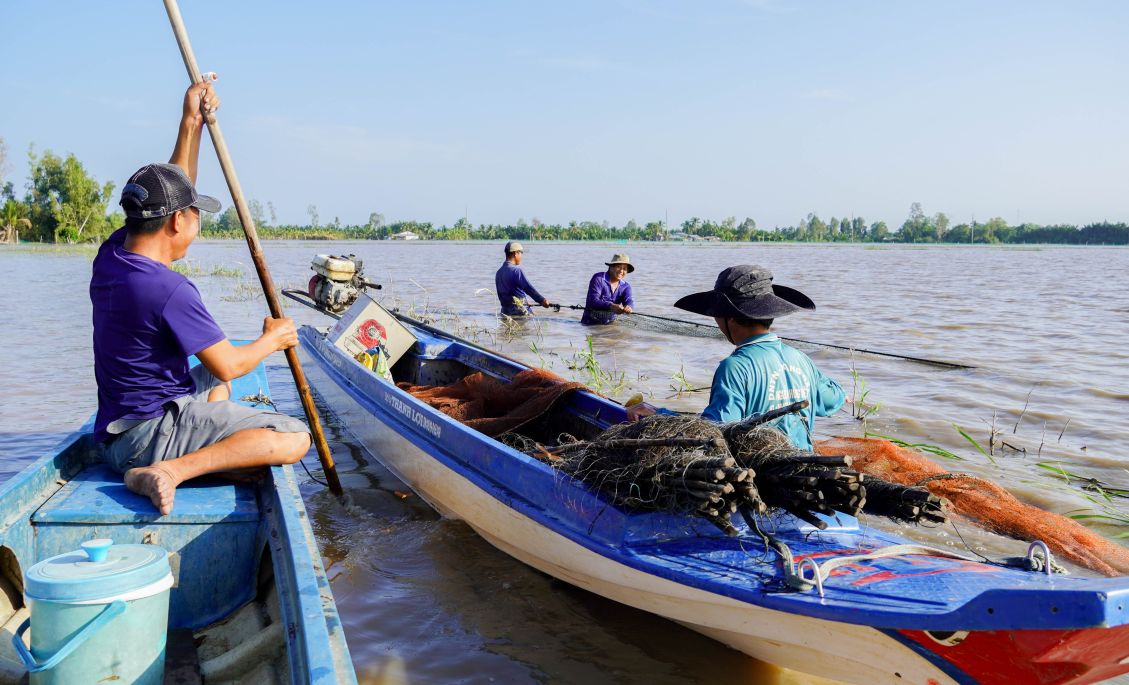
Mr. Vo Minh Luan, Chairman of My Tu Commune People's Committee (Can Tho City), said that My Tu is a low-lying area, of which about 2/3 of the area is deep-lying. Every year, floods and inundations occur. To adapt to this condition, the locality has oriented people to adjust production methods.
Accordingly, the commune focuses on producing 2 main rice crops, Summer-Autumn and Winter-Spring. From about June to December, when the fields are empty and flooded, people are encouraged to switch to aquaculture in rice fields, growing lotus or raising field ducks. This method both helps improve livelihoods and effectively utilizes land after the Summer-Autumn crop, preparing for the next Winter-Spring crop.


