
Big opportunities, risks also increase
Trading of goods in the electronic environment is increasingly popular but entails many risks, businesses need to identify and control them early.
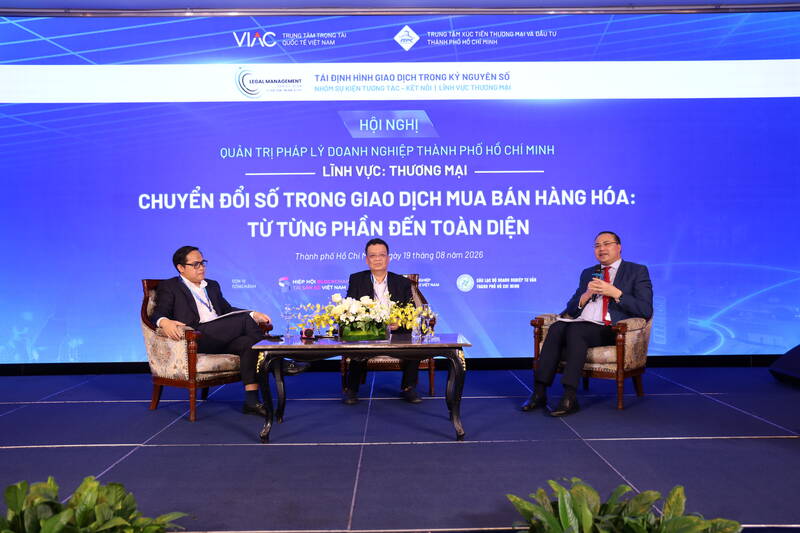
On August 19, at the conference "Digital transformation in goods trading transactions: from parts to comprehensive", Ms. Ho Thi Quyen - Deputy Director of the Ho Chi Minh City Trade and Investment Promotion Center (ITPC) - said that 2026 marks an important turning point for digital commerce when transitioning from "process digitization" to building a smart trade ecosystem.
According to Ms. Quyen, this trend helps businesses improve competitiveness, optimize costs and reach customers, especially small and medium-sized enterprises. However, for effective transactions, businesses must solve infrastructure, technology, human resources issues, while controlling the risk of fraud, protecting data and network security.
From the perspective of dispute resolution, Lawyer Chau Viet Bac - Deputy Director of Vietnam International Arbitration Center (VIAC) Ho Chi Minh City branch - said that the nature of electronic transactions is different from traditional transactions in the method of implementation, but basic legal risks still exist in the digital environment, even with more specific characteristics and complexity.
Therefore, businesses are recommended to increase the use of digital signatures and reliable services. These are considered tools that will develop strongly in the coming time, contributing to ensuring legal safety for electronic transactions, especially for the issue of identity verification and the authority of the signatory" - Mr. Bac said.
Not only digitizing, but also managing transactions
Assoc. Prof. Dr. Nguyen Xuan Minh - Standing Deputy Director of Foreign Trade University in Ho Chi Minh City, VIAC Arbitrator - said that in the past decade, digital transformation has changed the way businesses seek partners, negotiate, conclude, implement and resolve disputes over goods purchase and sale contracts.
Transactions gradually shift from paperwork to digital platforms and data. AI, Smart Contracts and Blockchain promote automation, improve contract management efficiency and transaction authentication. Electronic documents, interconnected digital ecosystems also help reduce manual processing, shorten time, increase transparency and connectivity.
In dispute resolution, email, system data and electronic documents are increasingly used to record and prove transaction developments. However, technology is developing rapidly while the legal framework and management capacity have not kept up.
According to Assoc. Prof. Dr. Nguyen Xuan Minh, many disputes do not originate from technology but from the fact that businesses do not have appropriate legal governance mechanisms, leading to difficulties in determining authority, ensuring data integrity and proving transactions. Therefore, businesses need to build a consistent governance process right from the time of establishing transactions, combining synchronously technology, governance and legality.
From practical business contacts, Mr. Vu Xuan Hung - Head of Legal Department of the Vietnam Chamber of Commerce and Industry - Ho Chi Minh City branch (VCCI-HCM) - pointed out risks such as disagreement on the time and place of conclusion; failure to recognize the authority of the signatory or data not compatible with the platform system.
Mr. Hung emphasized that electronic transactions are not simply about bringing traditional transactions to a digital environment, but also require process design and proactive dispute prevention. Businesses need to build 4 defense pillars including regulations, tools, storage and procedural solutions.
In the context of increasingly expanding digital commerce, businesses not only need technology for transactions but also must have management and legal capacity to control the entire process, thereby ensuring safe, transparent and effective transactions.


