On July 2nd, at the press conference announcing socio-economic statistics for the first 6 months of 2026, the Da Nang City Statistics Office said that the local economy maintained its growth momentum quarter by quarter, with the first quarter increasing by 9.28% and the second quarter increasing by 9.72%. The scale of the economy in the first 6 months is estimated at over 171,267 billion VND. The main driver of this growth comes from the industrial - construction sector (up 11.72%) and the service sector (up 9.31%).
In which, total realized social investment capital increased by 31.5% compared to the same period. In particular, newly registered FDI capital reached 283.5 million USD, an increase of 113.5%. Total state budget revenue reached 51,769 billion VND, an increase of 91.4%, mainly thanks to revenue from land and the recovery of the private economic sector.
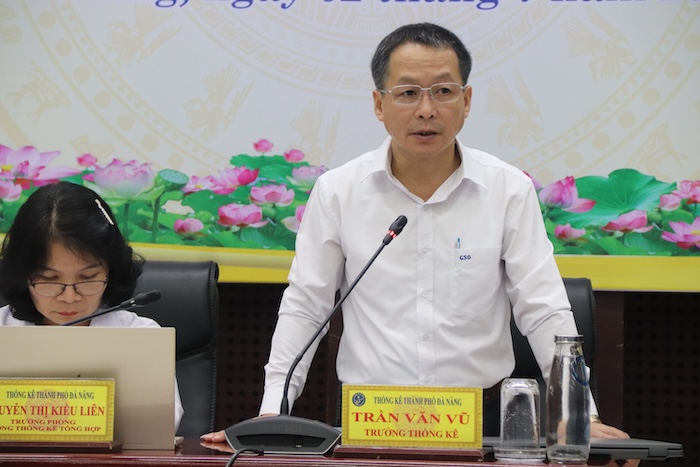
The results of the first 6 months of the year have not grown by 2 digits as required by the Central Government. The reason is that the first 6 months of the year focused on completing the organizational structure and many other reasons, but this is also a positive result. In the last 6 months of the year, there will be solutions to achieve double-digit growth. However, these results affirm Da Nang's position as one of the growth poles of the Central region, and at the same time consolidate its role as an economic, commercial and service center of the region," said Mr. Tran Van Vu, Director of Da Nang Statistics Department.
In 6 months, the city had 5,036 businesses temporarily suspending operations (up 6%) and 1,056 businesses dissolving (up 89.9%). At the same time, the slow disbursement of public investment capital also reduced the driving force of economic stimulus. The budget capital managed by the locality is estimated to be 6,471 billion VND, only up 0.3% compared to the same period. The main reason stems from prolonged obstacles in site clearance and investment procedures. The consumer price index (CPI) increased by 4.8%, also posing a difficult problem in controlling inflation and stabilizing the macroeconomy.
To close the growth gap in the second half of the year, Da Nang identifies the key task as removing procedural bottlenecks to accelerate the disbursement of public investment, especially key infrastructure projects with large spillover effects. Along with that, the city strengthens credit support policies, unlocks the market to limit the withdrawal of businesses, and at the same time implements price stabilization measures to ensure the set double-digit growth target.