
Lao Dong Newspaper had an exchange with Assoc. Prof. Dr. Ngo Tri Long - former Director of the Institute for Market and Price Research (Ministry of Finance) about the proposal of the Ministry of Industry and Trade.
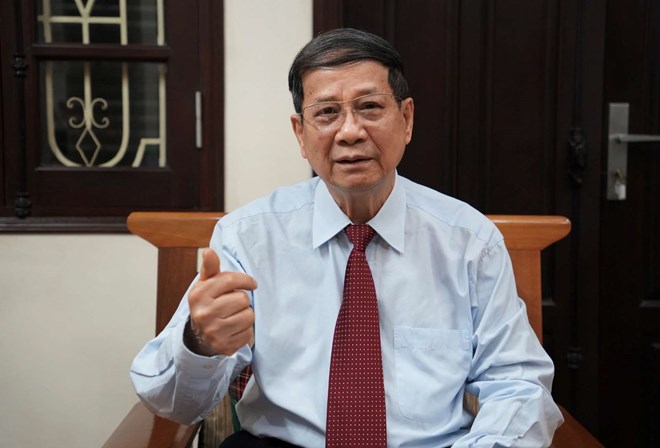
Sir, how do you assess the proposal to transfer EVN to the Ministry of Industry and Trade?
- Transferring EVN to the Ministry of Industry and Trade is changing the agency exercising the right to represent state ownership, not automatically changing the entire operating mechanism of the electricity industry.
If the Ministry of Industry and Trade simultaneously grasps EVN's planning, policies and ownership rights, an administrative coordination layer can be shortened. At that time, the "planning - assigning tasks - arranging resources - inspection" chain can operate faster, especially for urgent projects and tasks to ensure energy security.
But transferring EVN to the Ministry of Industry and Trade is only really meaningful if it achieves the three words: clear rights - clear tasks - clear responsibilities. If it is still necessary to ask for opinions through many levels for each investment, financial, and personnel decision, while the ultimate responsibility cannot be determined for whom, then changing the owner's representative agency will be difficult to create a fundamental difference.
This proposal may solve the coordination problem, but if the bottlenecks in investment procedure reform, land, site clearance, electricity prices and capital mobilization are not removed, the project may still be behind schedule.
If the Ministry of Industry and Trade both performs the state management function for the electricity industry and is the representative agency of EVN's ownership, how to clearly define these two roles, avoiding the risk of conflict of interest?
- This, in my opinion, is the most important legal issue of this model. The Ministry of Industry and Trade currently has very broad powers in the electricity industry: from planning, building electricity market mechanisms, supervising the market, electricity prices, transmission and distribution prices, licensing electricity operations to checking compliance with the law.
EVN is a very large entity in the electricity market, and at the same time the Ministry has become the owner's representative of EVN, so in principle, it is necessary to prevent the situation where the agency builds "rules of the game" and also pays attention to the capital interests of a very large "player" in that market.
I think it is necessary to establish at least four "firewalls".
First, separate the policy making and regulation department from the ownership enforcement department; dossiers, advisory staff and decision-making processes must be clearly defined.
Second, all decisions on price regulation, access to the power grid, electricity market, connection or electricity purchase and sale must be based on the same public criteria applied to EVN and other enterprises.
Third, it is necessary to continue to ensure the independence of the system operating unit and the electricity market.
Fourth, strengthen external supervision: The Ministry of Finance, the State Audit Office, competition agencies and competent authorities must be able to independently inspect capital, costs and decisions that may affect the market.
Regarding the proposal to transfer EVN to the Ministry, what mechanisms on corporate governance, investment, finance and supervision need to be changed in parallel, sir?
- If EVN is only transferred from the Ministry of Finance to the Ministry of Industry and Trade, but the investment decision process is still long, enterprise autonomy is still limited, the price mechanism does not reflect costs in time, capital mobilization capacity is not improved, and accountability is still unclear, then the actual effectiveness will not be much.
In my opinion, four reforms need to be implemented simultaneously.
First, corporate governance reform. Implementing the spirit of Law 68/2025/QH15: The owner's agency sets goals and supervises results, while the Members' Council and the Executive Board must have the right to proactively do business and invest within the scope of law and be personally responsible for their decisions. It is not advisable to return to the thinking of "the managing ministry" interfering in daily activities.
Second, investment reform. It is necessary to strongly decentralize EVN for projects in the planning that have clear capital sources, and at the same time apply an online progress monitoring mechanism, standardize procedures and handle urgent power grid projects separately.
Third, electricity prices need to reasonably reflect input costs, but all expenses must be audited, verified and disclosed. It is necessary to ensure that EVN has the ability to recover capital, but electricity price increases cannot be considered a solution to all financial problems.
Fourth, increase independent supervision and market discipline.
Thank you, sir!


