
According to the Ho Chi Minh City Trade and Investment Promotion Center, Vietnam has more than 34,000 logistics enterprises, contributing 4.5-5% of GDP, but logistics costs are still about 16% of GDP, higher than many developed countries. Therefore, the industry aims to promote digital transformation, reducing costs to 12-15% of GDP in the period 2025-2035. However, digitalization is not only about bringing processes and documents to the electronic environment but also sets requirements for legal value, authenticity and data management.
On August 26, at the Ho Chi Minh City Business Legal Administration Conference 2026 - Logistics field with the theme "Digital transformation in logistics transactions - Application of hybrid models in the transition period", Assoc. Prof. Dr. Pham Duy Nghia - Vice President of Vietnam International Arbitration Center (VIAC) - said that increasingly deep digitalization makes the dispute resolution process more complicated.
In logistics, businesses can simultaneously use paper contracts, email, electronic platforms, electronic transportation orders... At that time, disputes may arise regarding legal value, authenticity and priority order of documents. According to Assoc. Prof. Dr. Pham Duy Nghia, when disputes occur, it is not only necessary to prove the existence of data but also to determine the origin, integrity and formation process of data. Therefore, digital transformation needs to go hand in hand with data management, clearly stipulating the priority order of documents and how to establish, store, and use electronic evidence.
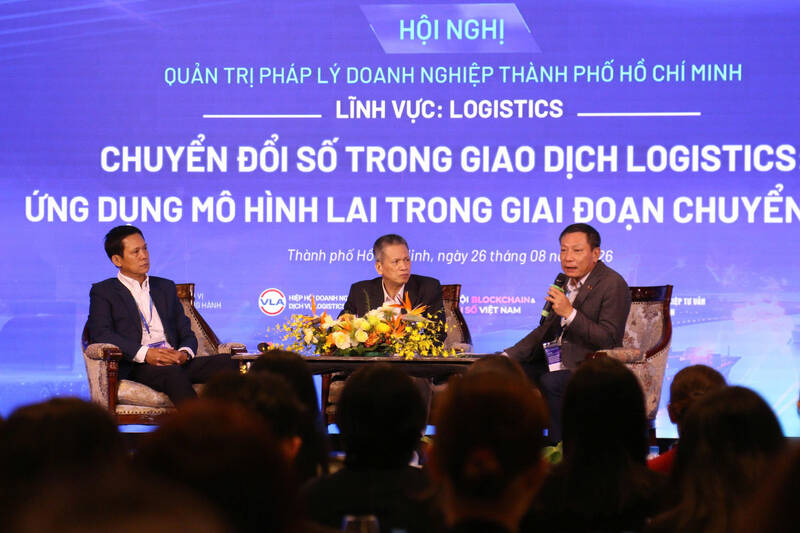
From industry practice, Mr. Ngo Khac Le - VIAC Arbitrator, VMC Mediator - said that digital transformation is taking place in many stages such as transportation, warehousing, delivery, seaports, customs and cross-border trade, but the speed is not uniform. Repetitive transactions are digitized quickly, while documents on ownership, payment and bank guarantees are still facing many challenges.
With the hybrid transaction model, Mr. Le believes that it is necessary to ensure that electronic documents have the same legal value and function as paper documents, especially transferable electronic bills of lading. The United Nations Convention on Secured Documents (NCD Convention) is considered an important step forward in creating a unified legal framework for paper and electronic documents, contributing to promoting the digitalization of cross-border logistics.
Meanwhile, Mr. Nguyen Duy Hung - Standing Vice Chairman of Dong Nai Logistics Association - said that in the current digital transformation period, logistics has a hybrid model, combining traditional operating methods and digital solutions. This is considered a transitional period suitable for many small and medium-sized enterprises.
In fact, most logistics enterprises are small and medium-sized, investment resources, human resources and technology infrastructure are still limited, and cannot comprehensively transform digitally like large enterprises or FDI enterprises. Therefore, enterprises both maintain some traditional operations and gradually digitize operations.
Shortening the transition period, standardizing data, and connecting systems will help logistics businesses improve operational efficiency, better exploit the value of data, and gradually improve competitiveness in the digital transformation process.


