
On the afternoon of December 29, 2025, the State Bank of Vietnam (SBV) held a Q4 press conference to inform about the results of monetary policy (MP) management and banking operations in 2025 and deploy tasks for 2026.
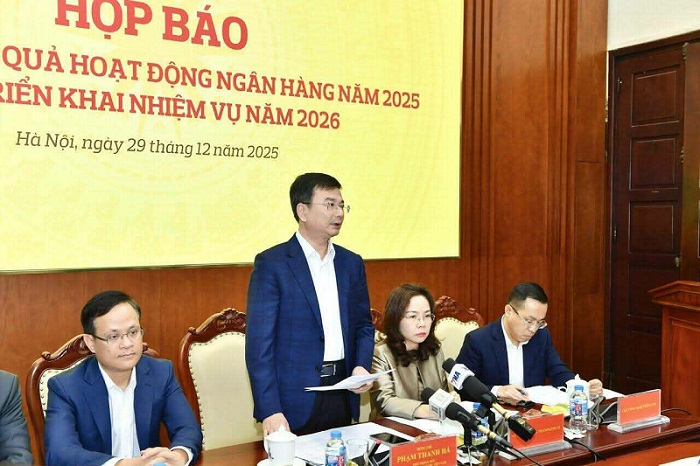
At the press conference, Deputy Governor of the State Bank of Vietnam Pham Thanh Ha said that as of December 24, 2024, outstanding credit balance of the economy reached over 18.40 million billion VND, an increase of 17.87% compared to the end of 2024.
The credit structure is suitable for the economy, meeting the credit needs of people and businesses, according to data by the end of October compared to 2024, the agricultural, forestry and fishery sector accounts for 6.15% of the total outstanding debt of the economy.
The processing and manufacturing industry accounts for 12.39%;
The construction industry accounts for 7.47% (including infrastructure investment projects, which is an industry being directed by the Government and the Prime Minister to promote investment);
The wholesale and retail sectors have the largest outstanding debt scale in the entire system, accounting for 22.24%.
Speaking about the difficulties in 2025, Deputy Governor Pham Thanh Ha said that the global economic context continues to face many risks and uncertainties.
The global economy is slowing down, affected by many factors: From rapidly changing tariff policies to increasing geopolitical tensions; the unpredictable monetary policy roadmap of major central banks. Inflation, although cooling down, still potentially increases again. Potential risks in the financial - monetary and global commodity markets are very large... These factors have a significant impact on an economy with great openness like Vietnam.
Domestically, 2025 is of particular importance, a year of acceleration, breakthrough, and reaching the finish line to achieve the highest results of the 13th Party Congress Resolution and the 5-year socio-economic development plan 2021-2025.
At the same time, it is also a year of actively preparing and consolidating the foundation for the period 2026-2030, creating a premise to bring the country into a new era.
2025 is also the year the Government chose the operating theme as: "Discipline, responsibility; proactive, timely; streamlined, effective; accelerated, breakthrough" with the goal of economic growth reaching 8% or more, creating a premise for double-digit growth in the coming years.
In monetary policy management, the SBV actively, flexibly, and synchronously operates monetary policy instruments, closely coordinates with fiscal policy and other macroeconomic policies to control inflation, stabilize the macroeconomy, support recovery, promote economic growth, and ensure the safety of the system of credit institutions (CIs).
Regarding interest rate management, the SBV continues to maintain the operating interest rates to create conditions for CIs to access capital from the SBV at low costs, thereby having conditions to support the economy.
At the same time, the SBV regularly directs credit institutions to continue to reduce operating costs, strengthen the application of information technology, digital transformation and other solutions to strive to reduce lending interest rates; be ready to share a portion of profits to support people and businesses to access bank credit capital to contribute to promoting economic development. As a result, the lending interest rate level continues to trend downwards, businesses and people are accessing loans at lower interest rates than before.
Regarding exchange rate management, since the beginning of 2025, the foreign exchange market and the VND exchange rate have mainly been affected by complex and unpredictable developments in the international market such as the unpredictable monetary policy (MP) roadmap of the US Federal Reserve (Fed), trade policy, tariffs of the US Administration and fluctuations of the international USD. In some periods, the domestic foreign currency supply and demand balance has been under temporary pressure from short-term factors.
In that context, the SBV manages exchange rates to fluctuate flexibly, in accordance with market conditions, contributing to absorbing external shocks; coordinating synchronously with monetary policy tools on interest rates, VND liquidity and foreign currency intervention sales; at the same time, to meet liquidity needs, especially at the end of the year, in addition to the money supply channel through open market nghiep vu channels, the SBV has deployed foreign currency swap transaction nghiep vu with credit institutions, thereby contributing to supporting exchange rate stability, macroeconomic stability and inflation control.


