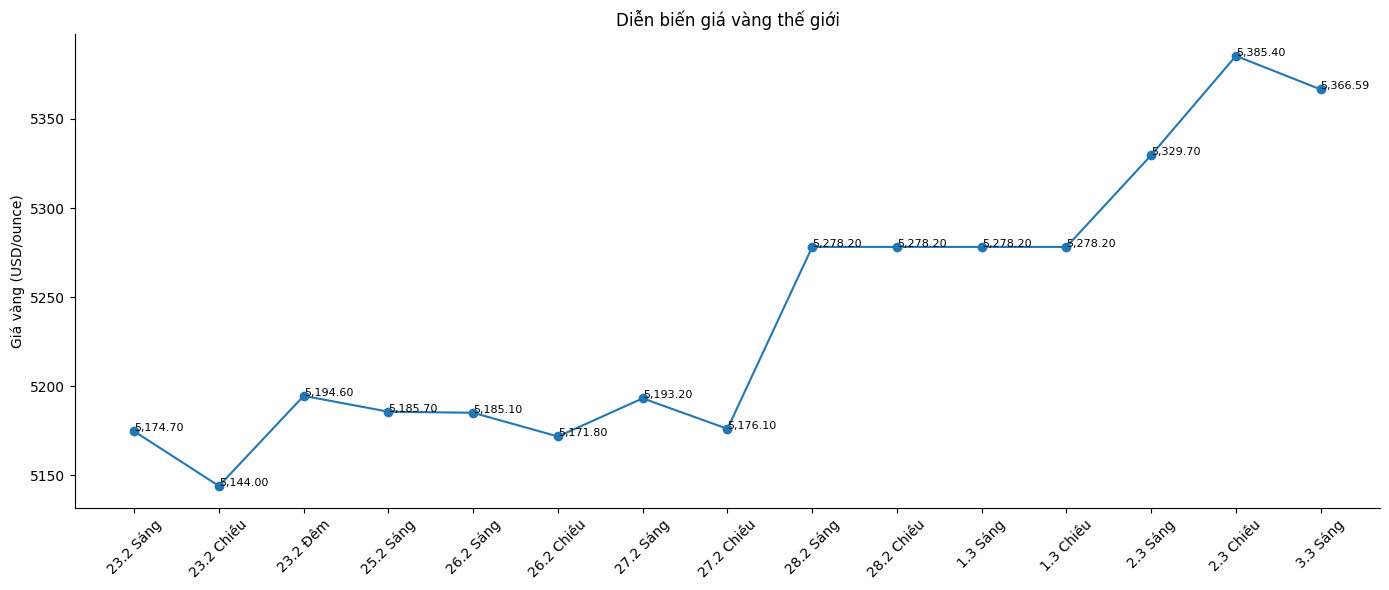
Gold prices rose for the fifth consecutive session as escalating conflict in the Middle East disrupted the global energy market and prompted investors to seek safe assets.
The precious metal at one point increased by 1.1%, surpassing the 5.380 USD/ounce mark, extending the increase of more than 3% in the previous four sessions as tensions spread throughout the region. US President Donald Trump declared Washington would continue the military campaign "as long as necessary", while Israel announced the launch of an "air wave" targeting Iranian command centers. Tehran has attacked oil and gas infrastructure and threatened transportation through the Strait of Hormuz, a strategic shipping route.
The surge in energy prices has raised concerns about inflation in the US, causing Treasury bond yields to fluctuate sharply and increasing the possibility that the US Federal Reserve (Fed) will maintain high interest rates for a longer time. Currently, traders are assessing the possibility that the Fed will cut interest rates in September, later than previously predicted. Although high interest rates are often detrimental to gold because this metal does not generate yields, that environment may also strengthen the role of gold as a channel to store value.
Even before the weekend attacks between the US and Israel on Iran, there were signs that inflation in the US could increase. Production input prices in February increased at the fastest rate since 2022, according to a survey by the US Institute for Supply Management. JPMorgan Chase & Co. CEO, Jamie Dimon, warned that inflation could become a "bad apple at the party" for the US economy.
Since the beginning of the year, gold prices have increased by nearly 25%, supported by prolonged geopolitical and trade tensions and concerns about the Fed's independence. The trend of withdrawing from bonds and currencies, also known as currency devaluation hedging, also added momentum to the multi-year upward momentum of the precious metal.
Swiss private bank Union Bancaire Privee believes that gold still has "significant room" to challenge the historic peak above 5,595 USD/ounce set at the end of January if the conflict in the Middle East lasts for many weeks. In the first session of the week, gold closed at its highest level in more than a month.
However, if the situation is controlled, gold may lose its upward momentum, according to Mr. Han Xiao, General Director of Zhishui Investment Management, a Chinese investment fund. He assessed that the impact of geopolitical events, especially wars, often appears strongly in the early stages and is quickly reflected in prices. If tensions do not escalate further, the impact on precious metals may gradually decline over time.
In the latest developments on Tuesday, the US Embassy in Riyadh was attacked by two drones as Iran increased airstrikes targeting Saudi Arabia in response to the US and Israel. President Trump said Washington would respond.
As of 11:51 am in Singapore, spot gold prices rose 0.8% to $5,366.59/ounce. Silver prices rose 0.8% to $90.11/ounce after falling 4.7% in the previous session. Platinum and palladium fluctuated slightly. The Bloomberg Dollar Spot Index almost went sideways after rising 0.7% in the previous session.