
In 2025, the digital economy continues to affirm its role as one of the important growth drivers of the Vietnamese economy, closely linked to the national digital transformation process.
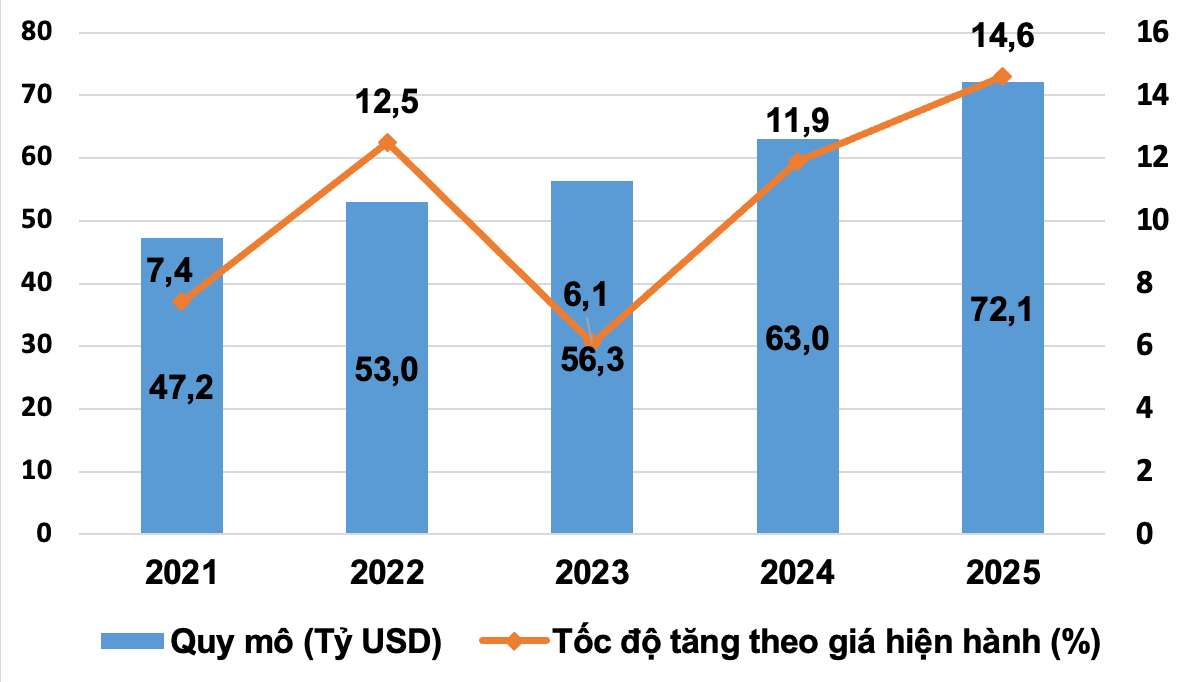
According to the Statistics Office, the proportion of added value of the digital economy in GDP is estimated at 14.02%, equivalent to about 72.1 billion USD, an increase of 1.64 times compared to 2020. The digital economy is developing in both breadth and depth, of which core digital economy sectors account for over 60%, and the level of digitalization in industries and fields is increasingly expanding, especially trade, finance, administrative services and energy infrastructure.
The average growth rate of added value scale of the digital economy at current prices in the period 2021-2025 reached 10.4%, of which the lowest level in 2023 was 6.1%; the highest in 2025 was 14.6%.
According to the comparative price, in 2025, the growth rate of the digital economy increased by about 11.8% compared to 2024; on average, in the period 2021-2025, the added value of the digital economy increased by 9.8%. According to the economic sector, the agricultural, forestry and fishery sector contributed 0.13%; the industrial and construction sector contributed 6.67%; the service sector contributed the most with 7.22%.
According to economic sectors, core digital economy sectors contribute 8.42%, (equivalent to 43.3 billion USD) accounting for more than 60% of the total digital economic value in 2025; digitization sectors account for 5.6% (equivalent to 28.8 billion USD).
In which, some digitized industries have high added value of the digital economy such as: Wholesale and retail trade applying digital technology (e-commerce) accounting for about 11.8% of the total added value of the digital economy; Production and distribution of electricity, gas, hot water, steam and air conditioning accounting for about 4%;
Notably, according to Deputy Director of the Statistics Office Le Trung Hieu, the service industries applying information technology in production and business and management and administration tend to increase rapidly, contributing to increasing the proportion of the digital economy of the service sector's contribution to GDP from 6.5% in 2020 to 7.2% in 2025. This shows the efforts of the Government, ministries, branches and localities in promoting the development of information and communication technology, and the digitization activities of economic sectors are increasingly strengthened.
According to the Deputy Director of the Statistics Office, in 2025, the digital economy has become an important factor, creating differentiation in the growth of the digital economy between localities.
Among the 34 provinces and cities directly under the central government, there are 4 provinces and cities with a proportion of added value of the digital economy in GRDP of over 20%, including: Bac Ninh (46.30%), Thai Nguyen (29.53%), Hai Phong (22.28%), Phu Tho (22.71%); 4 provinces and cities with a proportion of 10-20%; 26 provinces and cities with a proportion of 6-10%. Specifically, the two growth poles of the whole country are Hanoi reaching 17.34% and Ho Chi Minh City reaching 13.43%.
This differentiation reflects differences in the level of industrial development, digital infrastructure, investment attraction and the ability to apply digital technology to socio-economic activities in each locality" - Mr. Le Trung Hieu emphasized.


