
On January 12, the Academy of Finance in coordination with the Price Management Department (Ministry of Finance) organized the first annual Forum on market and price developments in Vietnam in 2026. The event gathered dozens of experts, researchers and representatives of ministries and sectors in the context of Vietnam entering a pivotal year with a GDP growth target of 10% - an unprecedented high, requiring great efforts in macroeconomic stability and price control.

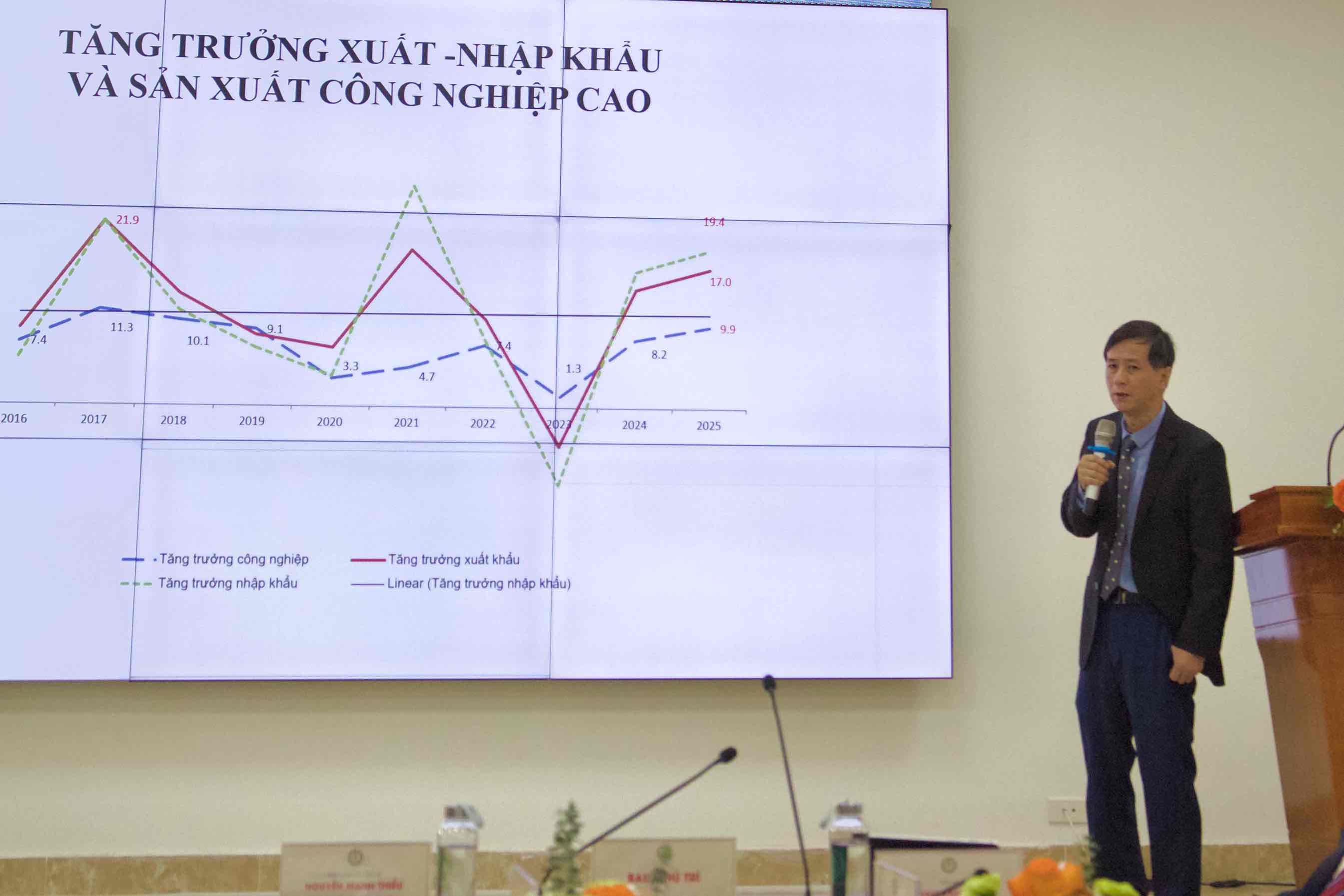
Speaking at the opening ceremony, Assoc. Prof. Dr. Nguyen Dao Tung - Director of the Academy of Finance emphasized that 2025 continues to be a year for Vietnam's economy to maintain stability. GDP increased by over 8%, average inflation was only 3.31%, exports increased by 16.27%, consumption increased by 7.95% and asset accumulation increased by 8.68%, showing that the economy is recovering sustainably and has room to enter 2026 with greater expectations.
According to the Price Management Department, the price level in 2025 is generally stable despite local impacts from weather, crops and supply. Food prices in the Central - Northern region increased following rain and floods; construction materials increased due to scarcity; electricity prices adjusted during peak hot weather. Conversely, the decrease in international gasoline prices and domestic pork prices has helped curb inflationary pressure, contributing to keeping CPI within the target range and creating a favorable foundation for 2026 management.
Inflation forecast for 2026 under control
Speaking at the forum, Dr. Nguyen Duc Do - Deputy Director in charge of the Institute of Economics and Finance predicted that inflation in 2026 is likely to remain around 3.5% ± 0.5%, continuing to be under the Government's control. According to him, the factors affecting inflation are all moderate: credit growth of 17.65% in 2025 may leave behind delays, but the impact is not large due to most capital flows into assets; the exchange rate increased by 3.92% in the past year but is still within the reasonable regulatory scope of the operating agency.
The international context also brings many positive signals. Crude oil, steel, food and basic commodity prices are forecast to stabilize or decrease slightly, helping to reduce input costs for businesses and limit the risk of "push costs". Adjusting electricity, health, and education prices, if implemented according to a clear roadmap, will not create major fluctuations in the price level.
The growth target of 10% in 2026 is challenging but feasible
At the forum, the research group of the Institute of Economics and Finance assessed that the GDP growth target of 10% in 2026 is "very challenging" but still feasible. The challenge comes from the requirement for strong aggregate demand, while pressure on exchange rates, credit and public investment is still present. However, Vietnam's macroeconomic foundation has been consolidated, along with the emergence of new drivers such as new generation FDI and large-scale public investment, helping the goal achieve high feasibility.
Assoc. Prof. Dr. Ngo Tri Long, former Director of the Institute for Price Market Research, said that 2026 is not the year of price shocks but a year that requires smooth coordination between currency, fiscal and price management. According to him, maintaining exchange rate stability, managing interest rates appropriately and ensuring smooth supply of goods will help control inflation effectively while still supporting growth.
Fiscal policy is expected to continue to play its role through disbursement of public investment and support for the production and export sector. In parallel, completing the price data system and strengthening forecasting will help management agencies be more proactive in the face of market fluctuations.
Overall, the economic - price picture in 2026 continues to be positively assessed, with the stable foundation of 2025, moderate price pressure and many international supporting factors. With proactive, flexible management and synchronous policy coordination, the goal of maintaining inflation in the controlled zone is assessed to be completely feasible, creating room for sustainable economic growth in 2026.


