
Prices of many agricultural products pouring into Ho Chi Minh City continue to plummet in recent days as abundant supply but purchasing power has not clearly recovered.
Recorded at traditional markets in Ho Chi Minh City, many types of vegetables and fruits are being sold at surprisingly low prices. Pumpkins and watermelons are only about 5,000-10,000 VND/kg. Other fruits such as king oranges, dragon fruit... also decreased sharply, commonly at 10,000-20,000 VND/kg (depending on type).
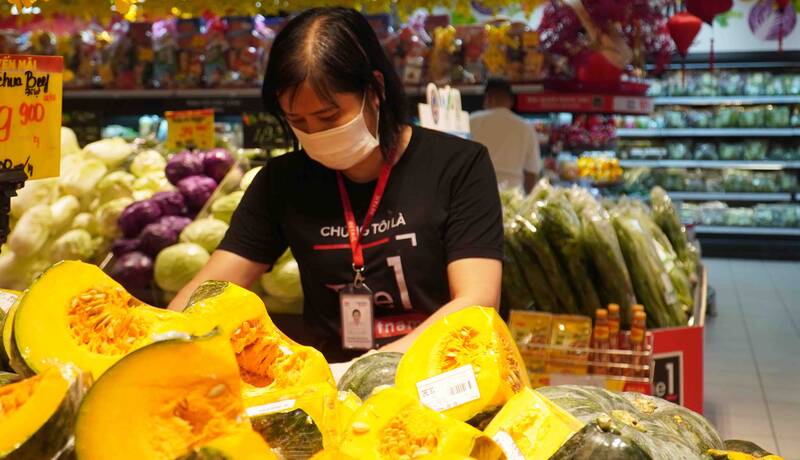
At Hoa Binh market, Ms. Hoang Loan - a small trader selling fruit - said that the amount of goods imported is much more abundant than before, but purchasing power is still slow. "Prices have dropped sharply but sales are not as good as expected. Many days of inventory have to lower prices further to attract customers to buy" - Ms. Loan said.
From a consumer perspective, Ms. Tran Minh Tam (Binh Tien ward) shared: "This time I see that fruits are quite cheap and many places sell them, so I buy more, especially watermelons and oranges. These are all fruits that last a long time and quench thirst, very suitable for the weather in Ho Chi Minh City.
According to small traders, the price decrease is not only happening in a few items but is spreading across many groups of agricultural products. The main reason is that supply from provinces to the city has increased sharply while the consumption channel has not expanded accordingly.
Mr. Dang Phuc Nguyen - General Secretary of the Vietnam Fruit and Vegetable Association - said that agricultural product prices have decreased sharply due to many factors at the same time. In which, the Chinese market - where most Vietnamese fruits are consumed - is tightening quarantine and improving quality standards. In addition, some domestic laboratories are overloaded or temporarily suspended, causing customs clearance progress to be affected.
Pressure also comes from increased logistics costs. Conflicts in the Middle East are affecting freight routes to this region and to Europe. Seagoing freight rates have recently increased to about 5,000-6,000 USD per container, compared to 3,000-4,000 USD previously, causing costs to increase significantly.
Costs increase but selling prices decrease, causing difficulties for both businesses and farmers. If this situation continues, many gardeners may reduce production or suffer losses," this person shared.
In that context, experts believe that it is necessary to soon diversify export markets, and at the same time improve product quality and standards to meet increasingly strict requirements. In the long term, the development of logistics systems and deep processing is also considered a solution to help reduce fresh consumption pressure and stabilize agricultural product prices.


