
100-year-old "old mangosteens
The Mekong Delta region was once known for its mangosteen gardens laden with fruit. To this day, many ancient mangosteen trees are still preserved by families, regularly bearing fruit every season, becoming witnesses of the gardening profession in the riverine region.
In Phong Nam islet (Can Tho City), Mr. Hua Van Len's family still preserves 4 mangosteen trees that are over 100 years old. These are trees planted by his grandmother around five years ago.
1923 - 1924, when the family came to this land to reclaim land and start a business.
According to Mr. Len, more than a century has passed, the "old mangosteen" are still green and regularly bear fruit every season. The tree still has few pests and diseases, and almost no need to use fertilizers or pesticides. The fruit has a thin skin, thick segments, and a characteristic sweet taste, favored by many traders and consumers.
In favorable weather years, each tree can yield from 300 - 500kg of fruit, even higher yields than many young mangosteen trees," Mr. Len said.
To preserve these precious ancient trees, his family has invested in a system of concrete pillars to support large branches after being damaged by storms many times.
Similarly, in Xeo Cao hamlet, Thanh Xuan commune (Can Tho City), Mr. Nguyen Van Tan's family's mangosteen garden of more than 2.3ha currently still preserves 2 mangosteen trees over 100 years old.
According to Mr. Tan, these trees were planted by his grandfather from around 1920, after buying seedlings from boats selling trees in Tien Giang (old). After more than a century, the 2 trees still grow well, have overcome the years of war and regularly bear fruit every season.
He said that currently the garden has more than 500 mangosteen trees of many ages, harvesting about 15 tons of fruit each year. The 2 ancient trees alone still yield over 300kg of fruit/tree/year. In addition to selling fruit, the family also combines ecotourism, attracting many tourists to visit and experience the 100-year-old mangosteen garden.
The quality of Mekong Delta mangosteen has also been affirmed at many prestigious playgrounds. In 2023, gardener Pham Van Thuyen in Dai Hai commune (Can Tho City) won the first prize in the "Delicious Fruit - Safe Southern Region" contest, surpassing hundreds of fruit samples from 21 southern provinces and cities.
Difficult to please" tree but bears clean fruit
According to Mr. Lam Ly Dien, a mangosteen grower in Dai Hai commune (Can Tho City), this year 20 mangosteen trees over 20 years old of his family achieved a yield of about 50kg/tree, double that of last year. However, the joy of a bumper crop does not mean that growers can proactively produce.
According to Mr. Dien, from the time of flowering to harvesting, mangosteen develops completely according to natural laws. Gardeners cannot intervene to adjust the time of fruit setting or harvesting according to demand. When picking, they must also choose each ripe fruit on the tree, because if harvested too early, the fruit will become "chai" and cannot continue to ripen.
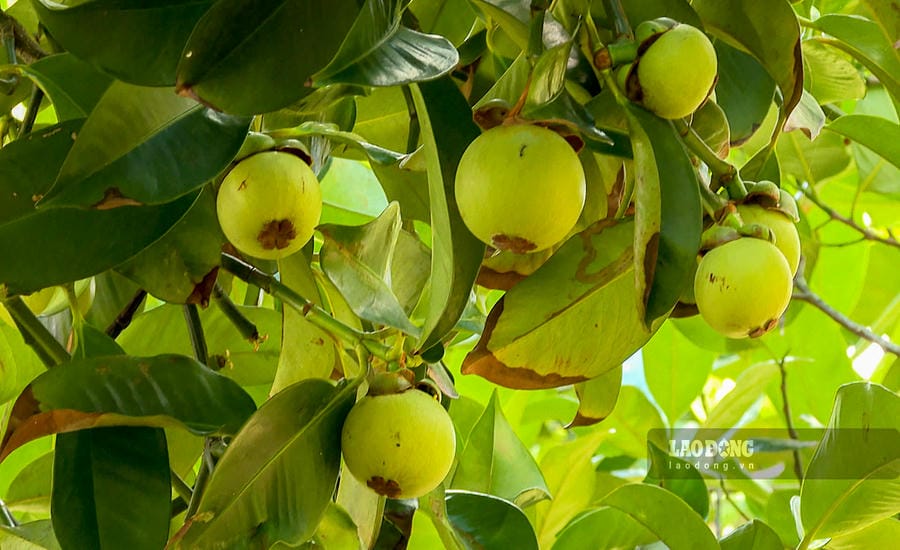
Mr. Dien added that mangosteen has very few pests and diseases. In the process of care, gardeners only fertilize in moderate amounts, and almost do not use pesticides.
Cases of fruit being rough or oozing pus are mainly due to the growth characteristics of the tree, not caused by pests and diseases," he said.
Not only Mr. Dien, many mangosteen gardeners also said that this is a rather "difficult" type of tree. Unlike many fruit trees that can apply technical measures to proactively handle flowering according to market demand, mangosteen only blooms when weather conditions, rainfall and temperature are favorable. In particular, many gardens also bear fruit every year, some years fruit is abundant, some years almost no fruit, causing uncertain output.
In return, this is considered one of the quite "clean" fruits. Throughout its growth process, the tree almost does not need to use pesticides. Thanks to that, the fruit retains its natural flavor, while being rich in vitamins and many nutrients.
Keeping precious trees but "difficult to keep" growers
Although highly appreciated by the market for its quality, mangosteen is still not a crop that brings outstanding economic efficiency.
Mr. Dien said that at the beginning of this year's crop, traders purchased at the garden for about 70,000 VND/kg, at times up to 80,000 VND/kg. However, when entering the main crop, the supply increased sharply, causing the price to decrease to 20,000 - 30,000 VND/kg. Meanwhile, harvesting must choose each ripe fruit, causing labor costs to be quite high.
Mr. Dien further shared that mangosteen has a very long construction time. If planted in low-lying areas, it takes about 6 years to start bearing fruit, while many places have to wait from 7 - 8 years. That is also the reason why currently very few farmers boldly invest in new planting.
Unstable economic efficiency has caused many gardeners to switch to other fruit trees that are capable of processing and flowering, bringing higher and faster incomes. Most of the mangosteen area today is mainly long-term gardens, intercropped or preserved by families through many generations.
In recent years, green mangosteen chicken salad has created a "fever", helping this fruit become more known. However, for those who have been attached to mangosteen for many years, the greatest value is still the naturally ripe fruit with dark purple peel, thick white segments, light sweetness mixed with a slight sourness and characteristic aroma.


