
According to a report by the Statistics Department (Ministry of Finance), import and export activities in the first 5 months of 2026 continued to maintain positive growth momentum. Total import and export turnover reached 445.12 billion USD, an increase of 25% compared to the same period last year.
The United States continues to be Vietnam's largest export market with a turnover of 69.6 billion USD, while China is the largest import market with a turnover of 92.6 billion USD.
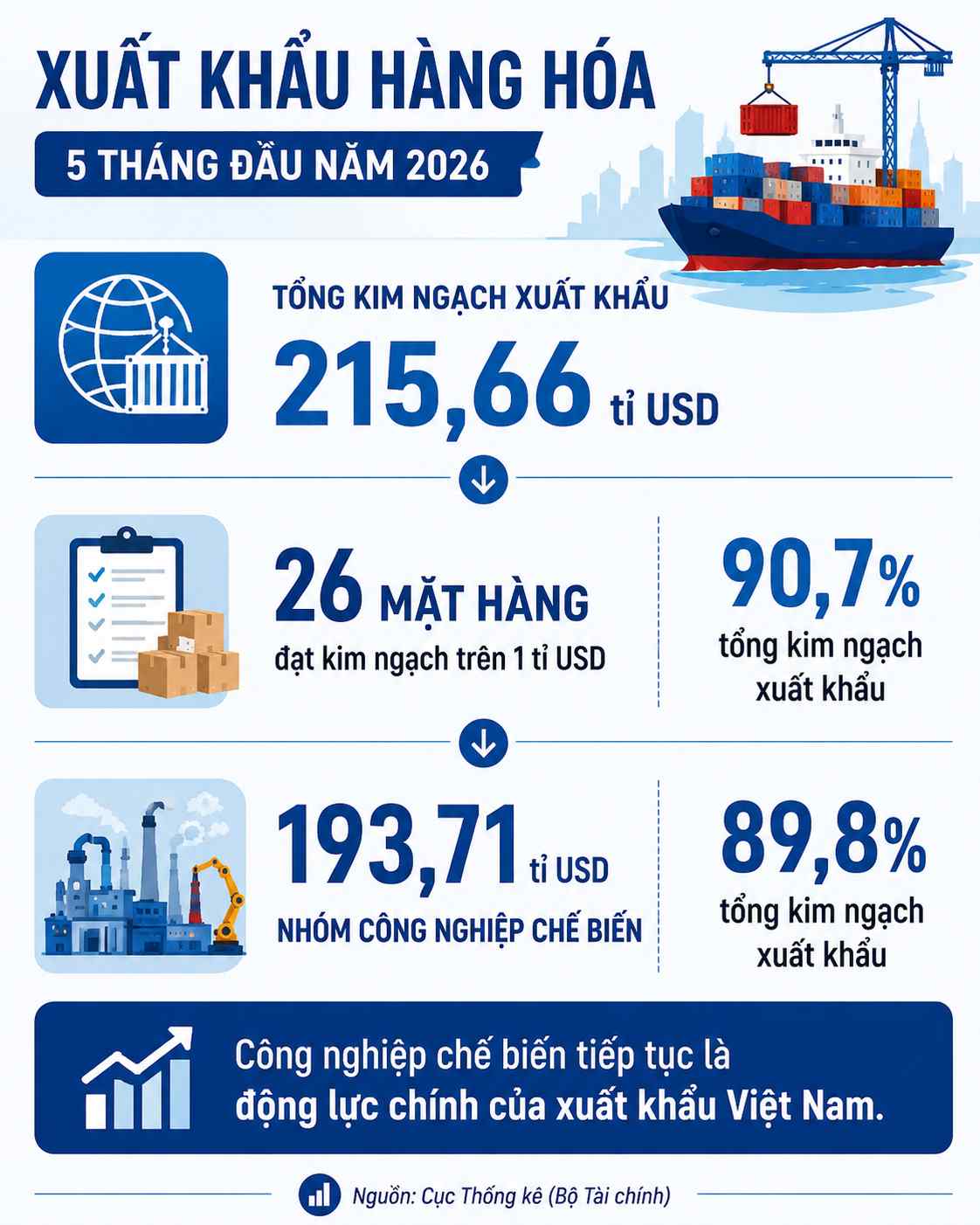
Regarding exports, export turnover in the first 5 months of 2026 reached 215.66 billion USD, an increase of 19.5%. In the first 5 months of the year, there were 26 items with turnover over 1 billion USD, accounting for 90.7% of total export turnover. Among them, 7 items reached turnover over 10 billion USD, accounting for 69.3%.
In terms of commodity structure, the group of processed industrial goods continued to play a key role with a turnover of 193.71 billion USD, accounting for 89.8% of total export turnover. The group of agricultural and forestry products reached 15.79 billion USD, accounting for 7.3%; seafood reached 4.67 billion USD, accounting for 2.2%; fuel and minerals reached 1.49 billion USD, accounting for 0.7%.
In the opposite direction, the import turnover of goods in the first 5 months of 2026 reached 229.46 billion USD, an increase of 30.8%. In May alone, it is estimated to reach 52.14 billion USD, an increase of 4.3% compared to the previous month and an increase of 33.8% compared to the same period last year. In which, the domestic economic sector reached 13.17 billion USD, down 10.8% compared to the previous month but up 22.2% compared to the same period last year; the foreign-invested sector reached 38.97 billion USD, an increase of 10.7% and 38.2% respectively.
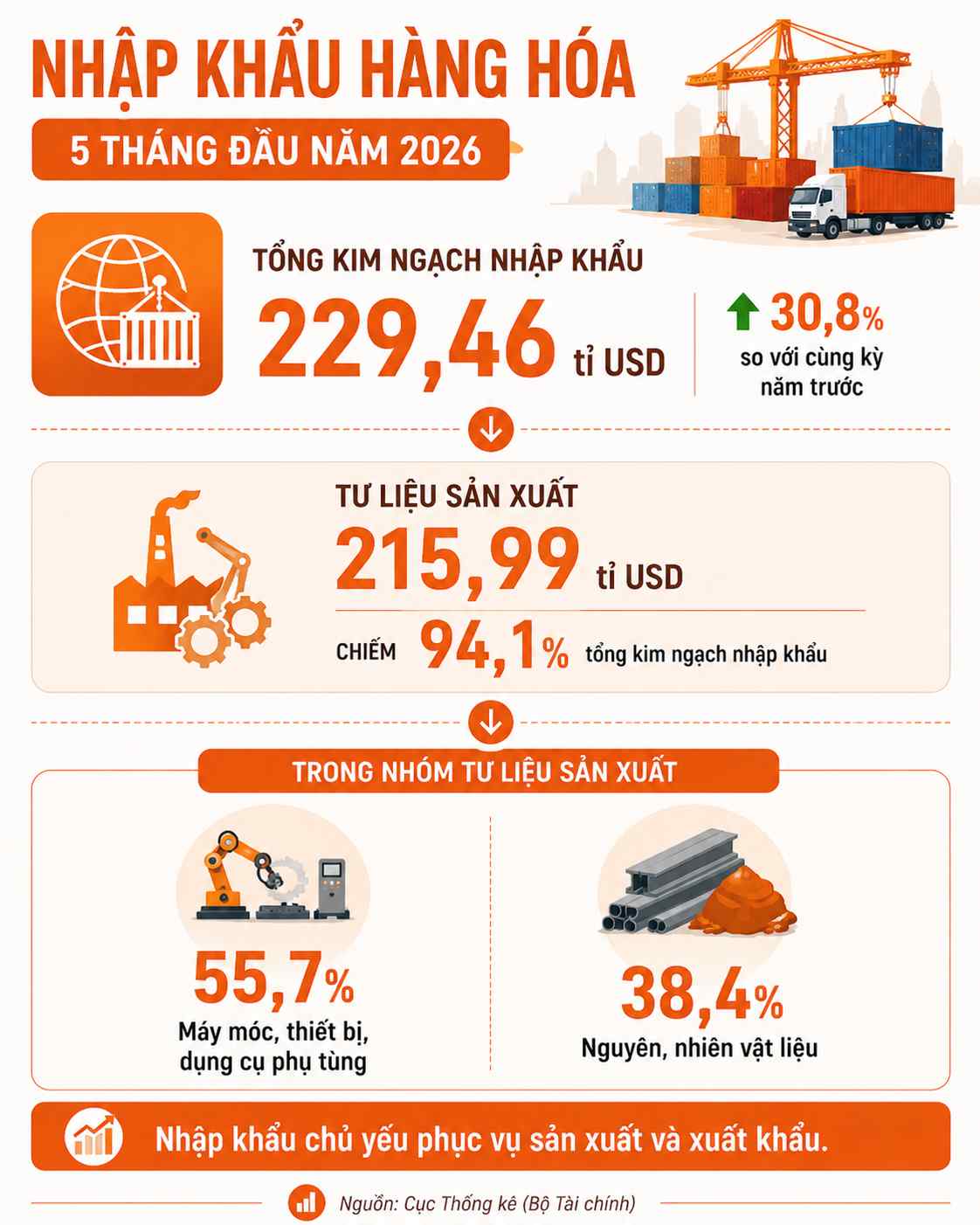
In general, in the first 5 months of 2026, import turnover reached 229.46 billion USD, an increase of 30.8% compared to the same period last year. The domestic economic sector imported 64.26 billion USD, an increase of 22.7%; the foreign-invested sector reached 165.2 billion USD, an increase of 34.3%.
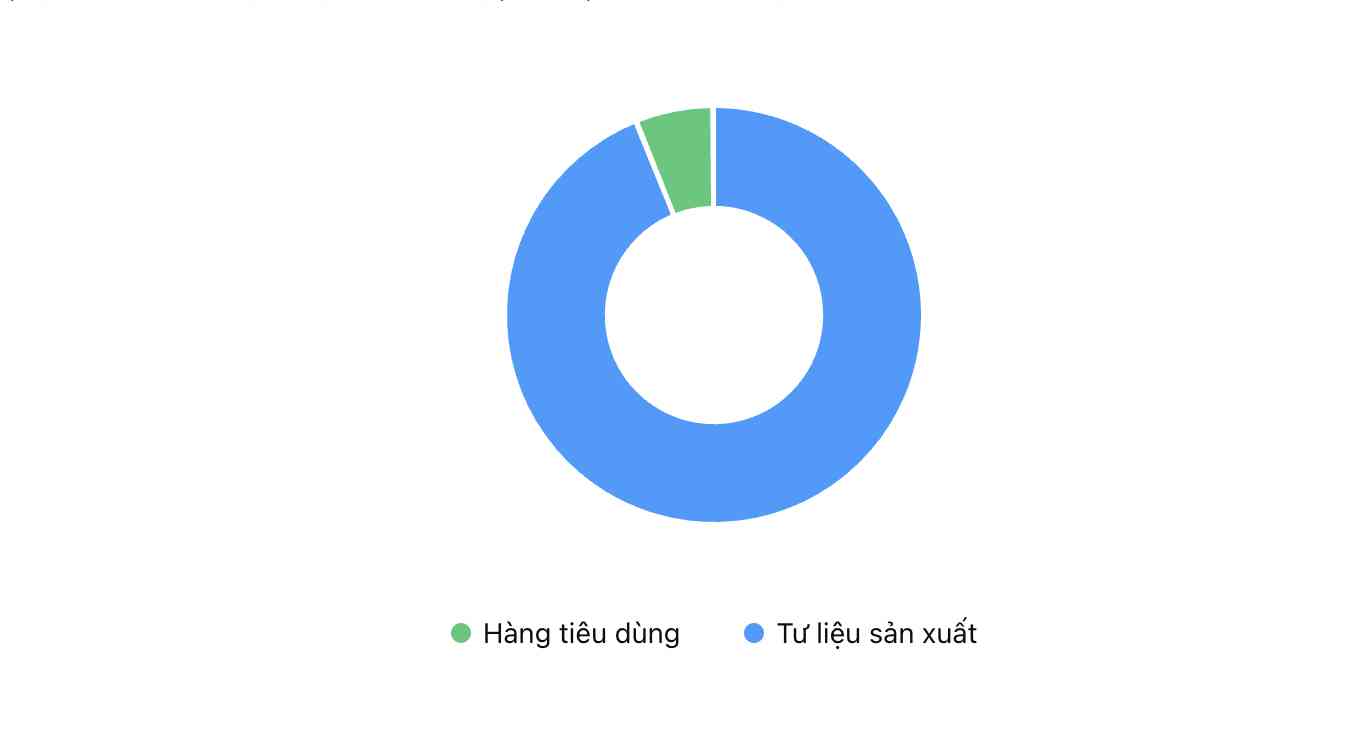
Regarding the import structure, the group of production materials accounted for a dominant proportion with a turnover of 215.99 billion USD, equivalent to 94.1% of total import turnover. In which, the group of machinery, equipment, tools and spare parts accounted for 55.7%; the group of raw materials and fuels accounted for 38.4%. The group of consumer goods reached 13.47 billion USD, accounting for 5.9%.
In the first 5 months of the year, Vietnam had a trade surplus with the United States of 60.4 billion USD, up 21.1% compared to the same period last year; trade surplus with the EU reached 18.1 billion USD, up 11.3%; trade surplus with Japan reached 0.8 billion USD, down 13.2%. In the opposite direction, trade deficit from China reached 62.5 billion USD, up 36.4%; trade deficit from Korea reached 21.1 billion USD, up 72.5%; trade deficit from ASEAN reached 8.6 billion USD, up 33.1%.
Although trade activities maintained high growth, the trade balance of goods in May 2026 recorded a trade deficit of 5.21 billion USD. In general, in the first 5 months of the year, the trade balance of goods had a trade deficit of 13.8 billion USD, while in the same period last year it had a trade surplus of 5.1 billion USD. In which, the domestic economic sector had a trade deficit of 20.76 billion USD, and the foreign-invested sector (including crude oil) had a trade surplus of 6.96 billion USD.
According to analysis by economic experts, most of the increased import turnover belongs to the group of production materials, which are inputs for production and export, so it is not too worrying.
Dr. Vu Thi Kim Oanh - senior lecturer in international business (RMIT University Vietnam) - said that if the trade deficit continues to be prolonged, as well as there is a change in the import structure (Vietnam's imports increase to non-essential consumption groups, due to logistics costs or increased fuel prices...) then it is necessary to pay attention.
In 2026, Vietnam's total import and export turnover is likely to still increase, but the trade surplus will be more modest than in 2025," Ms. Oanh predicted.


