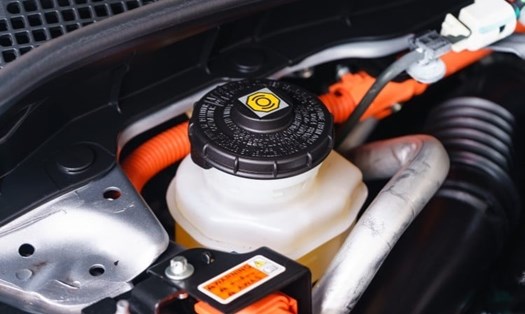
Brake oil is a hydraulic liquid that performs the task of transmitting pressure from the brake pedal to the brake mechanism at the wheels, helping the vehicle decelerate or stop safely.
According to Mr. Tran Minh Tien - lecturer of Automotive Technology, Dung Quat College of Technology (Quang Ngai), the quality of brake oil is not only assessed by color or transparency but also depends on heat resistance, shown through the boiling point index.
This is an important parameter announced by the manufacturer on the packaging, in addition to indicators such as viscosity and solidification temperature.
During operation, especially when the car has to brake continuously such as going downhill, carrying heavy loads or moving in crowded traffic conditions, the braking system will generate a very large amount of heat.
If the brake oil temperature exceeds the boiling point, oil may form air bubbles inside the hydraulic pipe.
Unlike liquids that are almost impossible to compress, air bubbles can be compressed, making the brake pedal softer, the braking journey longer, and reducing braking efficiency. In severe cases, the car may experience temporary brake failure.
This risk increases when brake oil has been used for a long time. Most of the brake oils used on cars today have the characteristic of absorbing moisture from the air.
Over time, the amount of water absorbed will reduce the heat tolerance of the oil, making the oil more prone to boiling when the braking system works at high temperatures. This is also the reason why many manufacturers recommend periodic brake oil changes, even when the car has not traveled much.
According to Mr. Tien, to accurately assess the condition of brake oil, it is necessary to use a specialized measuring device to check the heat tolerance (boiling point) of the oil.
The results will be compared with the standards of each type of brake oil prescribed by the manufacturer. For example, new DOT 3 brake oil usually has a boiling point of about 205°C or higher, while after use, if the heat resistance drops below the safe threshold according to standards, the oil should be replaced.
If the boiling point is below this level, then this is a sign that the oil has absorbed a lot of moisture, reducing its heat resistance and no longer suitable for continued use.
In addition to checking with specialized equipment, vehicle owners also need to comply with the manufacturer's maintenance schedule.
Most car manufacturers recommend changing the brake oil after about 2 years or 40,000 km. For cars that regularly operate in hilly areas, high humidity environments, or have to go through flooded areas, brake oil checks should be done earlier.
Car owners should not just rely on the color of the oil to decide whether to replace it or not. In fact, brake oil may still be quite clear, but its heat resistance has decreased significantly due to absorbing moisture during use.
In addition, car owners need to use the correct type of brake oil as recommended by the manufacturer and do not arbitrarily mix other standard oils. This is an important solution to help the braking system always operate stably, maintain braking efficiency and ensure safety in all operating conditions.