
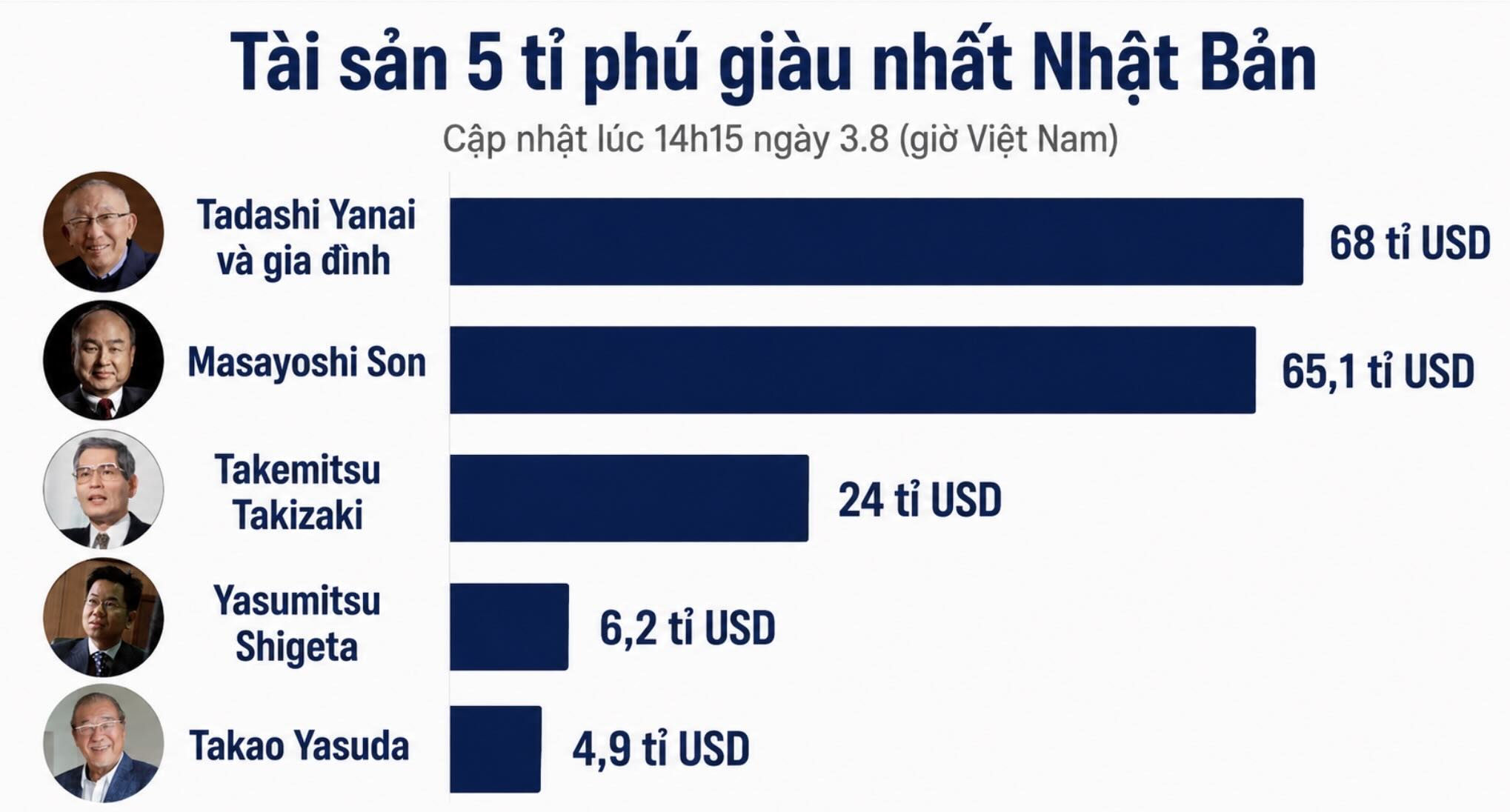
Forbes' real-time asset data recorded at 2:15 PM on August 3rd (Vietnam time) shows that the 5 richest billionaires in Japan own assets ranging from 4.9 to 68 billion USD.
The total assets of this group reached approximately 168.2 billion USD. Compared to the 156.5 billion USD recorded at 0:00 on July 30, the assets of the 5 people increased by 11.7 billion USD, equivalent to nearly 7.5%.
Meanwhile, the increases or decreases displayed on Forbes records reflect asset fluctuations compared to the closing time of the previous trading session. According to Forbes' method, data on asset increases and decreases is compared with the closing price of the previous trading day.
According to this calculation, Tadashi Yanai and Masayoshi Son increased their assets, while Takemitsu Takizaki, Yasumitsu Shigeta and Takao Yasuda all recorded decreases. The group's total assets increased by about 2.5 billion USD compared to the previous trading session.
Assets of Uniqlo owner reach 68 billion USD
Topping the ranking in Japan is billionaire Tadashi Yanai and his family with assets of 68 billion USD.
Compared to the closing time of the previous trading session, Yanai's assets increased by 1 billion USD, equivalent to 1.57%. He is currently ranked 28th in the list of the richest people in the world.
Compared to the 66.6 billion USD recorded at 0:00 on July 30, the assets of the Fast Retailing founder have increased by about 1.4 billion USD. His world ranking has also increased by one place, from 29th to 28th.
Tadashi Yanai is the founder and head of Fast Retailing, a fashion retail group that owns the Uniqlo brand.
Masayoshi Son increases by 9 billion USD compared to July 30
Ranked second is billionaire Masayoshi Son with assets of 65.1 billion USD, ranked 30th in the world.
Compared to the closing time of the previous trading session, the assets of the founder of SoftBank increased by 1.7 billion USD, equivalent to 2.66%. This is the largest absolute value increase in the group of 5 billionaires in this update.
Compared to the 56.1 billion USD recorded at 0:00 on July 30, Mr. Son's assets increased by 9 billion USD. His world ranking also increased from 34th to 30th.
The strong increase helps the gap between Masayoshi Son and Tadashi Yanai narrow to 2.9 billion USD. As of 0:00 on July 30, the asset gap between the two is 10.5 billion USD.
Keyence founder owns $24 billion
Third place belongs to billionaire Takemitsu Takizaki, founder of Keyence, a company that provides sensors and equipment to serve factory automation operations.
Mr. Takizaki's assets currently reach 24 billion USD, down 150 million USD, equivalent to 0.62%, compared to the closing time of the previous trading session. He is currently ranked 106th in the list of the richest people in the world.
However, compared to 22.5 billion USD at 0:00 on July 30, his assets still increased by about 1.5 billion USD. The world ranking also improved 11 places, from 117th to 106th.
Two bottom billionaires simultaneously reduce assets
Ranked fourth is Yasumitsu Shigeta, Chairman of Hikari Tsushin, with a fortune of 6.2 billion USD.
Compared to the closing time of the previous trading session, Mr. Shigeta's assets decreased by 17 million USD, equivalent to 0.27%. He currently ranks 664th in the world.
Compared to the data at 0:00 on July 30, his assets remain unchanged if calculated according to Forbes rounded figures at 6.2 billion USD. However, the world ranking dropped from 658th to 664th.
Closing the top 5 is billionaire Takao Yasuda with assets of 4.9 billion USD, ranked 859th in the world.
Compared to the closing time of the previous trading session, the assets of the founder of the Don Quijote retail chain decreased by 29 million USD, equivalent to 0.6%.
Compared to the 5.1 billion USD recorded at 0:00 on July 30, Mr. Yasuda's assets decreased by about 200 million USD. The world ranking also decreased from 818th to 859th.
The asset value of billionaires is estimated by Forbes in real time, mainly based on stock price fluctuations, exchange rates and investment value. Therefore, the data may change significantly in a short time and does not accurately reflect the entire actual assets of each individual.


