
AI can write, but cannot take responsibility
The emergence of artificial intelligence (AI) is changing almost the entire journalistic production process. From suggesting topics, searching for materials, removing tapes, translating to editing content, AI is increasingly present in the newsrooms. A news bulletin that once took tens of minutes to complete can now be created after just a few commands.
That unprecedented speed also leads to a big question: “When AI can create content that is increasingly human-like, what will keep the journalism profession from being replaced?”.
Talking to a reporter from Lao Dong Newspaper, Dr. Tran Van Le - Head of the Faculty of Communications, FPT University said that this is not the first time technology has impacted journalism. Printers, radio, television, the Internet or social networks have all created revolutions in information production. However, AI is different in that it not only supports means of production but also directly participates in the process of thinking, processing and creating content.

However, Dr. Tran Van Le believes that AI will change many job positions but cannot replace the core professional values of journalists.
AI can write faster than humans, but cannot take responsibility for humans. What makes a journalist's bravery is first of all professional integrity. It is not only honesty in each piece of information, but also social responsibility, independence when evaluating information sources and commitment to pursue the truth to the end.
AI can create thousands of news bulletins in a few minutes, but will not be the responsible party when misinformation causes consequences for the community. That responsibility still belongs to humans" - Dr. Tran Van Le assessed.
In the AI era, the advantage of journalists is no longer in who reports first. According to Dr. Tran Van Le, professional journalism is shifting from the race of "reporting first" to "reporting the most reliable". When information is created at an almost instant rate, what the public seeks is verified content, with depth of analysis and reflecting the true nature of the problem.
To do that, journalists not only need to be proficient in technology but also must retain irreplaceable AI capabilities, from critical thinking, questioning ability to understanding the social and cultural context of each event.
From a training perspective, Dr. Tran Van Le also expressed concern that many young people consider AI as "a substitute", instead of a support tool. According to him, the most frightening thing is not that students use AI, but that they no longer want to think for themselves before asking AI.
Currently, we are strengthening forms of evaluation such as direct defense before the council; group criticism; project implementation diary; asking students to explain why they chose communication solutions instead of other solutions. At that time, AI can support, but cannot replace students in answering questions that require personal thinking and experience" - Dr. Tran Van Le shared.
When Deepfake becomes a new "scene
If Dr. Tran Van Le looks at AI from a professional value perspective, according to Mr. Pham Tan Anh Vu - Head Representative of the Southern region, Vietnam Artificial Intelligence Solutions Joint Stock Company (VAIS), AI is also creating unprecedented challenges for operational activities.
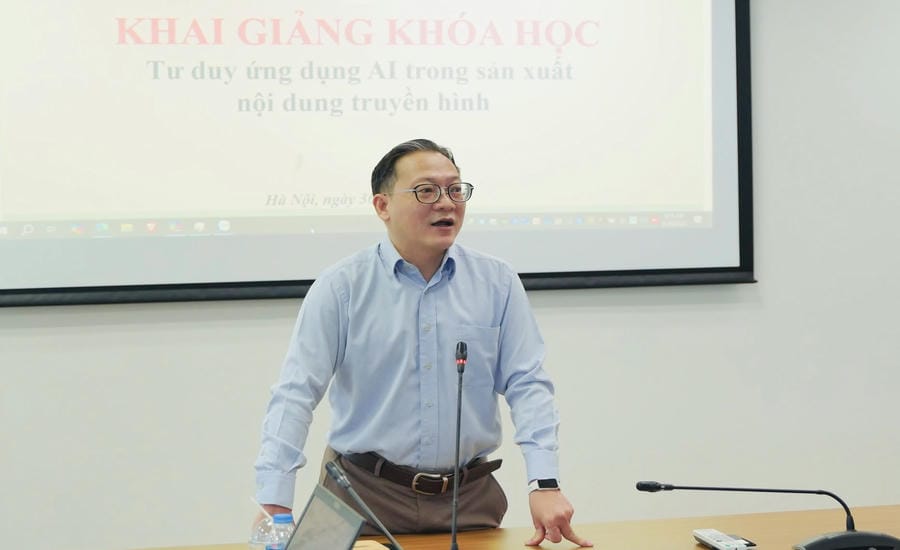
According to him, the dangers of journalists today no longer only come from the scene or the pressure in the investigation process, but also appear right in cyberspace.
The digital environment today is putting journalists in a state of comprehensive "AI exposure"" - Mr. Vu assessed.
Mr. Pham Tan Anh Vu cited that AI can now completely analyze the history of conversations to learn how to use words and writing style of a journalist, and then combine voice copying technology to impersonate to approach colleagues or sources of information.
Not only that, the development of Deepfake also makes information verification more difficult than ever. An image, video clip or call that seems completely authentic can be created by AI with very high authenticity. According to Mr. Vu, in that context, technology is only the initial support layer. The deciding factor is still the professional bravery of the writer.
Facing the matrix of Deepfake tools and sophisticated scams, technology is just a secondary filter, the ultimate weapon of journalists is experience, intuition and judgment" - Mr. Pham Tan Anh Vu assessed.
Therefore, according to him, reporters cannot only rely on verification tools but must practice the ability to suspect, compare and verify from many independent sources. Because in the journalism profession, a wrong decision not only affects an article but also directly affects the reputation of individual journalists and press agencies.
However, Mr. Vu also said that AI not only brings risks. When properly deployed with a secure internal data source, AI can completely become a "shield" for the editorial office, helping to detect abnormalities, compare data, warn of signs of dirty communication campaigns or support reporters to exploit valuable topics from huge data warehouses.
Amidst the AI wave that is changing the media industry globally, experts believe that the most sustainable value of journalism is still not in technology, but in the bravery of those who use technology.


