
The current painful situation of scams targeting the elderly makes me very scared and worried when I have to work far from home and cannot be by my parents and grandparents' side to take care of and protect them regularly," Mr. Dinh Son, a business household owner in Hanoi, expressed his concern about the information about scams that has attracted attention in recent times.
As the average life expectancy increases, the problem of caring for the elderly is becoming a major challenge for the working class of many countries, including Vietnam.
In the US, about 11,000 people turn 65 every day. Most of them do not want to move to nursing homes but want to continue living in their familiar homes. According to a survey by AARP in 2024, up to 75% of people over 50 years old want to spend their remaining life at home. In that context, in this country, the field of technology support for the elderly, also known as "Age Tech", is emerging as a promising solution.
The friend of old age
The development of Age Tech is creating a diverse product and service ecosystem specifically for the elderly. According to experts, homes are now not just a place to live but are gradually becoming a real healthcare space.
Many products are being put into use to support long-term independent life. These are smart travel devices, glasses capable of displaying subtitles in real time for people with hearing difficulties, or services connecting the elderly with drivers and delivery services even when they do not use smartphones.
The trend of remote care is also developing strongly. According to AARP, about 25% of caregivers currently monitor their loved ones through applications, videos or wearable devices, nearly double compared to 5 years ago. Many localities in the US have implemented free support programs for the elderly such as fall detection radar systems or video calling platforms through television screens.
One of the products that attracted attention was the robot pet. In New York, Ms. Carol DeMaio, 80 years old, suffering from amnesia, was given a robot dog named Sabrina. This dog reacts when its owner wakes up, accompanies them in bed and brings a feeling of closeness like a real pet. For Ms. DeMaio's family, Sabrina not only helps reduce feelings of loneliness but also brings peace of mind to caregivers who have to work full-time.
However, experts also noted that Age Tech still faces some barriers such as costs, access to high-speed Internet in rural areas and uneven level of technology penetration.
The participation of AI and robots
Artificial intelligence is opening a new era for the field of elderly care. Many technologies that were not designed specifically for Age Tech such as remote medical examination and treatment platforms, smart speakers, smart watches or remote lighting and temperature control systems can be adjusted to serve the needs of the elderly.
One of the most important roles of AI is early detection of abnormal signs. The AI system can analyze changes in voice, frequency of leaving home or changes in daily behavior to warn of the risk of cognitive decline or mental health.
AI-integrated companion robots are also becoming a new trend. ElliQ, a desk robot shaped like a lamp with an integrated screen, is being used by many families. This robot can guide exercise, remind you to take medicine, remind you to supplement water, and ask about sleep and mood through automated conversations.
However, the increasingly deep involvement of technology also raises many questions about ethics and privacy. Experts warn that excessive supervision can make the elderly feel their personal lives are being violated. Therefore, the deployment of technology needs to be accompanied by transparent exchanges between caregivers and caregivers, ensuring that technology truly serves people instead of creating new barriers in old age life.
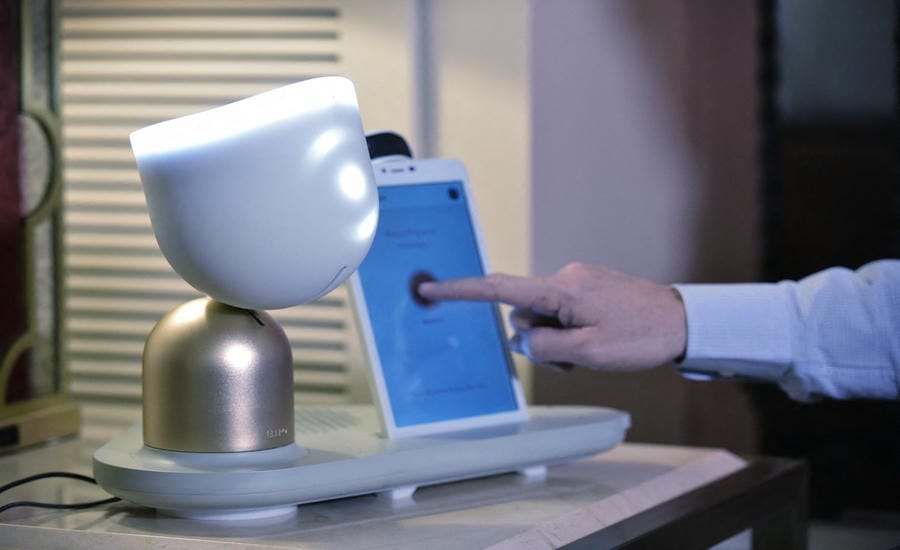
For many elderly people in the US, robots like ElliQ are not only a support tool but also a companion. Robots can chat, tell jokes, remember hobbies and create daily interactions, contributing to reducing loneliness in lonely elderly people.
Currently, more than 700 companies have joined AARP's AgeTech Collaborative alliance to develop new solutions for the elderly. Startups in this network have raised nearly 1 billion USD in the past 4 years.


