Not just a drone
Images of farmers using drones in agriculture to quickly rescue 2 young children from the fast-flowing water in Ia Tul commune, Gia Lai province in the flood season of 2025, make many people admire.
Mr. Tran Van Nghia (resident of Chu Se commune), the drone operator, said that when he could not rescue the two children due to the fast-flowing water, he came up with the idea of using the DJI T50 agricultural aircraft he brought with him for rescue.
This story raises a big issue: A country that is heavily affected by natural disasters every year, especially the increasingly complicated situation of rain, floods, and inundation like Vietnam, the application of unmanned aerial vehicles in search, rescue, and relief becomes urgent.
In normal situations, surveying an area with unmanned aerial vehicles can help collect data faster. But in natural disasters, the value of UAVs is even greater because it can replace humans to perform part of the work in dangerous places.
When roads are flooded, bridges are swept away, landslides block roads, or a residential area is isolated, bringing people and vehicles to the scene always poses risks. A UAV can fly in advance to determine the situation, helping rescue forces know where to prioritize and choose a suitable approach plan.
In Da Nang, UAVs are being considered as a component in disaster response plans. Recently, on September 13, the Military Command of Da Nang City inspected civil defense, disaster prevention and search and rescue work in areas that are frequently heavily affected by rain and floods, with the risk of deep flooding, division and prolonged isolation.
The spirit is set out not to wait for natural disasters to occur before responding, but to prepare early and remotely, according to the "4 on-the-spot" motto. In particular, the forces also proactively develop plans to apply unmanned aerial vehicles. The flight path of this vehicle is pre-programmed to serve reconnaissance, search and rescue work as well as transporting necessities in a timely manner to isolated areas that cannot be accessed by road.
A residential area can be surrounded by water in just a few hours. People need drinking water, medicine, food; rescue forces need to know where people are trapped; medical facilities need to be maintained while traffic is cut off.
In those conditions, a vehicle capable of flying through flooded areas, quickly accessing and transmitting information to the operating center can significantly shorten response time. UAVs can therefore become a link in the emergency logistics chain, alongside canoes, specialized vehicles and on-site forces.
Next, suitable UAVs can participate in search and rescue. In the civil defense exercise, response to flash floods, landslides and landslides in Lao Cai in May 2026, UAVs were used to serve search and rescue, contributing to improving the ability to handle situations quickly and effectively.
This is no longer the story on the design. Bringing UAVs into the exercise shows that technology is gradually being put into situations close to reality, in which rescue forces must evacuate people, establish a field command post, deploy field hospitals and rescue people and property swept away by floods.
In Dien Bien, before the complicated natural disaster situation, the locality is also studying the application of UAVs to serve rescue and relief. In just the first days of July 2026, the post-storm circulation caused heavy rain, causing many houses to be affected, dozens of roads to be cut off and causing estimated damage of more than 13.5 billion VND. Therefore, Dien Bien is also ready to study and apply UAVs to limit damage to people and property in this year's rainy and flood season.
Right at the beginning of September 2026, Thai Nguyen Provincial Police coordinated with a charity group to use drones to deliver supplies to people in flooded areas in some areas of Quang Vinh, Dong Bam, Hoang Van Thu wards... Large drones, tying relief goods (life jackets, food, batteries... ) into remote hooks and transferring them to flooded, difficult-to-reach areas. Images of unmanned aerial vehicles carrying life jackets and food sent to people show the effectiveness of technology in flood relief.
Bringing UAVs into key industries
The greatest value of UAVs in rescue is not in replacing humans but in the ability to deliver "eyes" and part of the transportation capacity to places where humans are difficult to reach.
In the early stages of a natural disaster, UAVs can undertake observation tasks: Identifying flooded areas, divided roads, landslide points, isolated residential areas or locations in need of relief. The collected data helps functional forces have more basis to classify the level of danger and prioritize resources.
To make UAVs truly become a rescue tool, localities need to develop operating scenarios in advance: Which areas need to be monitored, which flight paths are allowed to be used, where data is transmitted, who is the operator, how ground forces receive information and in which cases UAVs switch from reconnaissance to transportation.
It is worth mentioning that Decision No. 21/2026/QD-TTg of the Prime Minister on the List of strategic technology, strategic technology products, including the field of unmanned aerial vehicles, is an important basis to promote research, development, mastery of technology, form supply chains and expand UAV applications in many socio-economic fields, including rescue and relief.
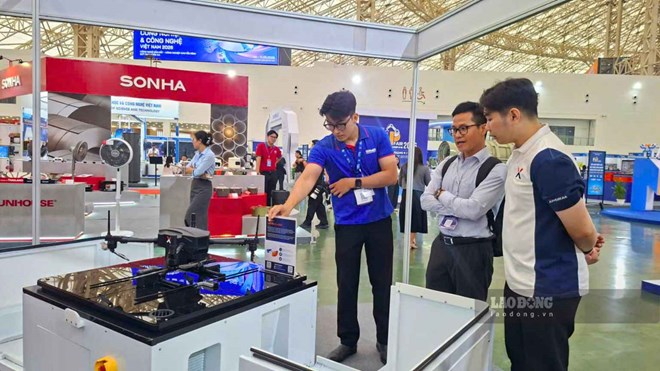
At the UAV Vietnam 2026 exhibition held in Hanoi in mid-September 2026, some Vietnamese businesses introduced products developed in the direction of "Make in Vietnam". In which, HTI UAS introduced an ecosystem with the Horus P02, Horus QS24 and
Horus HW-100, aimed at many missions from reconnaissance, surveillance, patrol to search and rescue and transportation. Meanwhile, Horus HW-100 is a heavy transport UAV, aimed at transportation, emergency supply and rescue missions.
From logistics, precision agriculture, surveying - mapping, infrastructure inspection, environmental monitoring to smart cities and rescue, UAVs can participate in more and more socio-economic activities.
The involvement of functional agencies and localities in applying UAVs in this year's rainy and flood season is expected to minimize the damage caused by natural disasters to people.