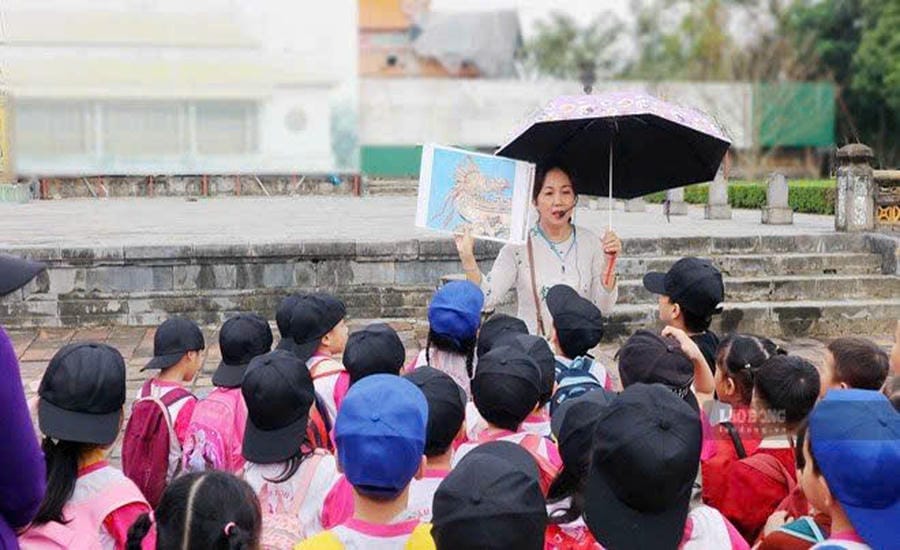
Heritage opens doors, classrooms open their hearts
One weekend morning at Hue Imperial Citadel, instead of the familiar sightseeing footsteps of domestic and foreign tourists, we can encounter groups of students engrossed in listening to tour guides tell stories, take notes, and even role-play to recreate an ancient ritual. The relic space, at that moment, has become a special class. There, lessons do not start from books, but from the vivid experiences of students themselves.
This shift is not accidental. Mr. Hoang Viet Trung - Director of the Hue Ancient Citadel Relic Preservation Center recalled: "In 2018, when heritage education content was institutionalized in the general education program, especially the integration into history and local education, we see this as a great opportunity to bring heritage closer to students.
And at the end of 2019, the opportunity became a reality when the Department of Education and Training of Thua Thien Hue province at that time (now Hue City) and the Hue Ancient Citadel Relic Preservation Center signed a cooperation program "Hue Cultural Heritage Education" in schools. "From the beginning, we determined that the most important thing was how to make students "touch" the heritage. Hue has a great advantage when it owns a rich relic system, and has a policy of exemption and reduction of entrance fees. Thanks to that, students have the opportunity to access it directly" - Mr. Hoang Viet Trung said.
According to statistics from the Hue Ancient Citadel Relic Preservation Center, in the past 5 years, nearly 190,000 students and teachers of general schools in Hue city participated in the "Hue Cultural Heritage Education" program. That is an impressive number. However, for Mr. Hoang Viet Trung, the most impressive thing is not the number.
Mr. Trung said that the number reflects the scale and level of spread, but is not the most important measure. The core thing lies in the change in students' awareness. That is how to make them feel the value of heritage, thereby forming pride, love and responsibility. When a student starts to pay attention to local history, proactively learns, participates in activities related to heritage or shares with friends and family, then that is real success.
If previously, relics were mainly seen as sightseeing spots or lessons to remember, now children come to heritage with proactiveness, curiosity and emotion. Students ask questions, learn, interact, and even re-create what they receive. "To do that, we not only rely on the heritage space but also mobilize a team of guides, interpreters, artists, researchers... to participate. The Center also initially built an intuitive curriculum, a question bank, concise content according to each topic, suitable for the age group. This is the initial foundation for heritage education to go deeper and more sustainable in the coming time" - Mr. Trung said.
A generation of students who love heritage
In a class at the relic, Nguyen Thao My, an 8th grade student at an secondary school in Hue City, shared: "Before, I thought history was just numbers and events that were hard to remember. But when I went to the place, listened to stories and participated in activities, I felt history was closer. I remember it longer and also feel proud of my homeland.
Emotions like Nguyen Thao My's are not easy to measure, but they are the most sustainable value of heritage education. Because from initial excitement, children gradually form love, from love leading to the awareness of preserving and spreading. A student sharing a story about the relic with his family, a group of friends making a video introducing the heritage, or simply a change in the way of looking at history... all are important "seeds" for education. And that is also how Hue is preparing for the future of its own heritage, not only preserving it with works, but with people who understand, love and continue that value.
Another noteworthy point of the "Hue Cultural Heritage Education" cooperation program in schools is that besides direct experience, technology is becoming a powerful support tool. Virtual sightseeing models, 3D data, QR codes or digital versions of artifacts deployed synchronously by the Hue Ancient Capital Relic Preservation Center in the past time have helped students access heritage more flexibly and visually. Especially, for students far away, technology opens a "second door" to come to heritage. Without having to be present in Hue, they can still explore space, learn information, and even interact with digitized content.
The biggest expectation of the organizers of the "Hue Cultural Heritage Education" cooperation program in schools is not only limited to what students receive today, but also to what they can do with heritage in the future. Today's young generation has advantages in technology, creative thinking and connectivity. Hopefully, they can retell heritage stories in new forms such as videos, digital products, community projects... When heritage is "told" in a way close to modern life, it will continue to spread more strongly.
In the orientation for the period 2026 - 2030, the heritage education program in Hue will continue to expand and improve the learning system and strengthen the application of technology. Further, Hue aims to become a center of heritage education and cultural creation, not only domestically but also internationally" - Mr. Hoang Viet Trung emphasized.