
Not only is it a costume, the Pieu scarf also sends the soul, memories and pride of the Thai community, woven from the silent needles and threads of the skillful hands of women.
Cultural symbol associated with the life of Thai people in Son La
In Thai villages in Son La, from Yen Chau, Mai Son to Muong Bu, Thuan Chau, Song Ma, Sop Cop communes, the image of women in traditional dresses, wearing Piêu scarves has become a familiar feature in daily life as well as festivals. For the Thai people, Piêu scarves are not only for beauty but also carry memories, roots and family traditions of each family.
Traditional Pieu scarves are usually woven from cotton yarn, dyed black indigo, with a length of about 140 - 150cm. The patterns are concentrated at both ends of the scarf, highlighted by the "Cut Pieu" part - small coils of fabric in the shape of snail shells, attached with odd numbers such as 1, 3, 5... According to Thai beliefs, odd numbers are "number of birth", symbolizing birth, development and luck. Pieu ba cut is usually for young women, while Pieu scarves with more coils are used in formal occasions or to give to elders, respected people.
The patterns on the Pieu scarf are considered the unique "language" of the Thai people, reflecting the worldview and spiritual life closely associated with mountains, forests, and villages. These are images of water waves, sawtooths, fish bones, ban flowers, olives... each motif carries the meaning of praying for peace, happiness, loyalty and community cohesion.
According to Ms. Hoang Thi Thoat - Head of the Thai Culture Preservation Club of Yen Chau commune, the Pieu scarf is not simply an item in traditional costumes but also carries profound spiritual values.
“For the Thai people, the Pieu scarf is associated with women from childhood until they return to their ancestors. Each needle and thread sends a life concept, a desire for happiness, loyalty and peace. Looking at the Pieu scarf, one can partly understand the family tradition, family customs and dexterity of women,” Ms. Thoat shared.
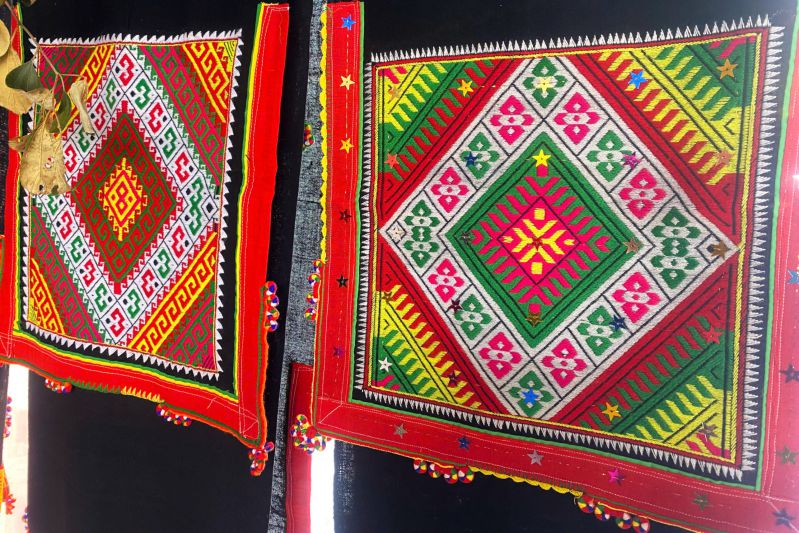
The hands of women and the traditional Piêu embroidery craft
A special feature in the Piêu scarf making technique is the reverse embroidery method. The embroiderer works on the back side of the fabric, but the pattern appears complete and balanced on the right side. No drawings or measurements are needed, everything is based on memory, experience and aesthetic feelings taught through many generations.
To complete a traditional standard Piêu scarf, Thai women can take from a few weeks to a month. The job requires patience, meticulousness and sophisticated aesthetics. Therefore, for a long time, embroidery of Piêu scarves has been considered a "measure" of the resourcefulness and dexterity of Thai girls.
From a young age, girls have been taught every needle and thread by their grandmothers and mothers. Piêu embroidery sessions by the fire are not only a time to learn a trade but also a space to teach lifestyle, behavior, gentleness and patience - the core values in Thai women's lives.
Keeping the profession in the modern rhythm of life
However, along with the changes in social life, the traditional Piêu scarf embroidery profession in Son La is facing the risk of fading away. Many young people no longer know how to embroider Piêu, instead using ready-made, convenient products.
Faced with that situation, in Yen Chau commune, the "Piêu Scarf Beauty Model" Club, the "Yen Chau Thai Culture Preservation" Club have been established, becoming a bright spot in the work of preserving Thai ethnic culture.
Ms. Hoang Thi Truong - Head of the club, said: "Piêu scarves are an indispensable item for Thai Yen Chau women. From childhood to adulthood, Thai girls have been taught by their mothers to embroider, sew, and weave fabric to make scarves. However, nowadays many young people no longer know how to embroider Piêu in the traditional way. Therefore, the club was established with the goal of teaching those beautiful features.
Currently, the club is directly teaching traditional Piêu scarf embroidery techniques to nearly 20 girls in the area. In addition to teaching embroidery, club members also guide traditional dances associated with Piêu scarves, helping them understand more deeply about the cultural values of their nation. This is also a model of the Yen Chau Commune Women's Union, expected to be replicated in the near future.
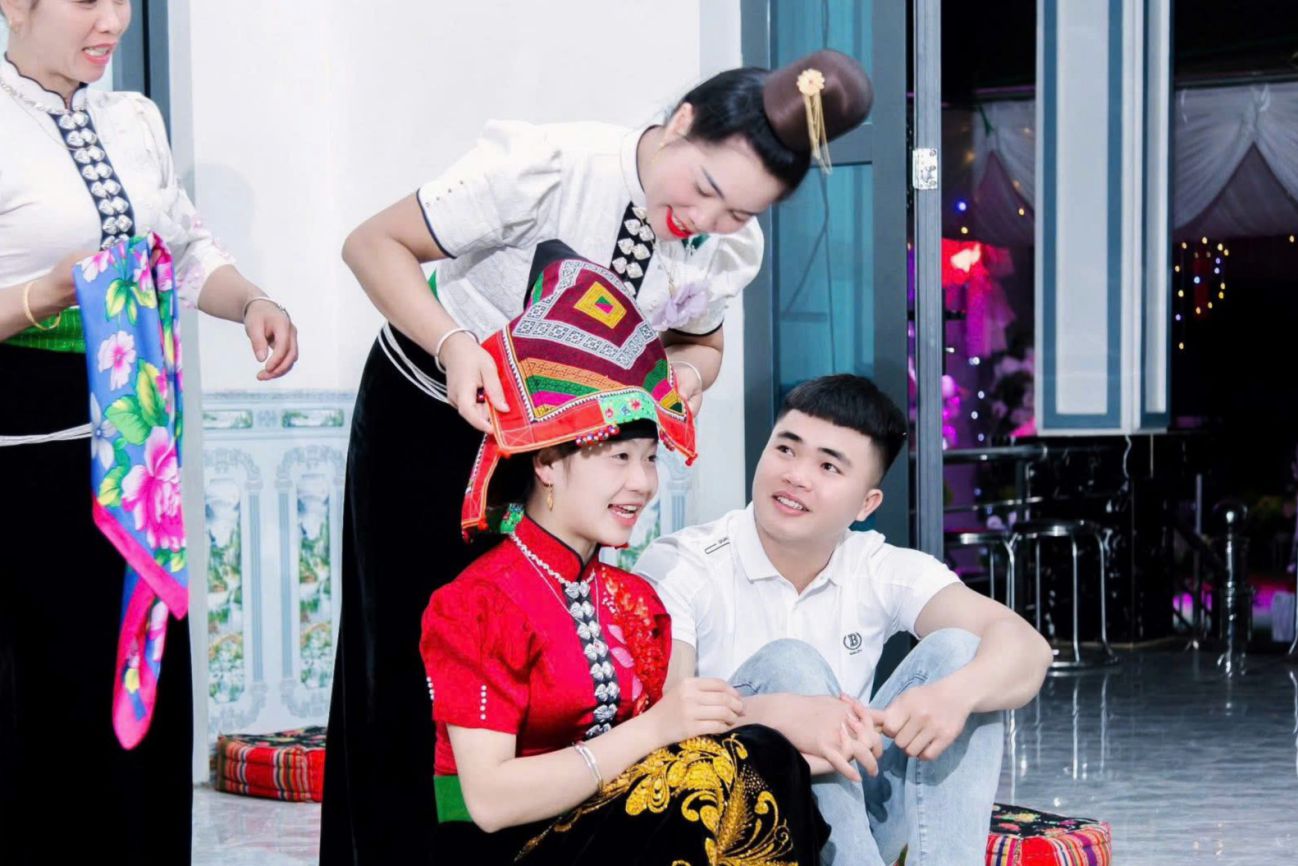
Young generations continue, keeping Pieu's soul for the future
Not only in Yen Chau, in Chieng An ward, the Piêu scarf embroidery craft is still maintained by many women. Embroidery clubs not only create traditional handicrafts but also contribute to helping women have more income, while preserving and promoting national cultural identity.
In club activities, not only grandmothers and mothers but also the enthusiastic participation of many young children. In the cozy stilt house space, needles silently follow each other, creating a natural connection between generations.
Ms. Tong Anh Tuyet, Trung Tam village, shared: "My mother is a member of the Piêu scarf embroidery club of the village. Outside of school hours, when I have free time, I learn embroidery with my mother and aunts and uncles in the club. Now I can embroider a Piêu scarf for myself to use on festivals and holidays. I love my national identity very much and want to learn more".
And Ms. Ca Thi Thuong, a member of the Piêu scarf embroidery club in Tam Quynh village, Chieng An ward, said that participating in the club, she was instructed on each embroidery point and pattern on the Piêu scarf.
Learning embroidery is not difficult, but to become a skill takes a lot of time. I studied for about two weeks to embroider basic patterns. Up to now, I have embroidered proficiently and taught it to my children," Ms. Thuong said.
The stories of Anh Tuyet or Ms. Thuong show that when culture is taught with love and perseverance, the younger generation can completely accept and proudly preserve the identity of their nation.
In the midst of the cycle of modern life, the Pieu scarf is still quietly but persistently present in the life of Thai people in Son La. It is not only a strip of fabric embroidered with patterns, but also the soul of the village, a thread connecting the past with the present and the future. Preserving the Pieu scarf is also preserving the Thai cultural soul in the Northwest mountains.


