
When the legacy is told in a new language
Dong Ho folk paintings are one of the typical symbols of Vietnamese folk art. Created from paper, natural colors and sophisticated handcrafted wood carving techniques, Dong Ho paintings reflect everyday life, folk beliefs, and at the same time convey the philosophies of life, moral beliefs and worldviews of ancient Vietnamese people.
However, in the context of the increasingly bustling modern pace of life, the public's approach to art is also gradually changing. Dong Ho paintings are therefore somewhat subsided in contemporary life - not because of fading values, but because traditional introduction and dissemination methods have not fully kept up with the rhythm of perception of today's generation.
In December 2025, Dong Ho folk painting profession was recognized by UNESCO as an intangible cultural heritage to be urgently protected. This event is not only a source of pride, but also raises a big question: How can the heritage not only be preserved in museums, but continue to "live" with the community?
In that context, "Dong Ho Painting Circus" - the opening stage of the "Remembering the Heritage" project initiated by a group of students from the Faculty of Communication and Foreign Culture (Diplomatic Academy) - was born from that same concern. Instead of approaching the heritage through explanation or display, the project chose circus art - a type rich in physical, visual and less language barriers - to tell the stories hidden in folk paintings.
The central play named "Memories of Ho Village" lasts 90 minutes, structured into 3 parts, leading the audience through a seamless emotional journey. The opening is the lyrical "Du Quan Ho" space, recreating the peaceful rhythm of life in the Northern countryside. Next, the exchange with Meritorious Artist Nguyen Huu Qua becomes an important focus, where the history, technique and spirit of Dong Ho paintings are told with real-life stories, rustic but full of weight.
The climax of the program is the staged play "Ti's Story", where familiar paintings such as "Rain Wedding", "Coconut Grasping", "Honored Return to Homeland" are adapted in circus language. The acrobatics, balances, and juggling movements not only show off techniques, but become the lines, rhythms, and colors of paintings, helping audiences feel the heritage with intuition and emotions, instead of accepting it theoretically.
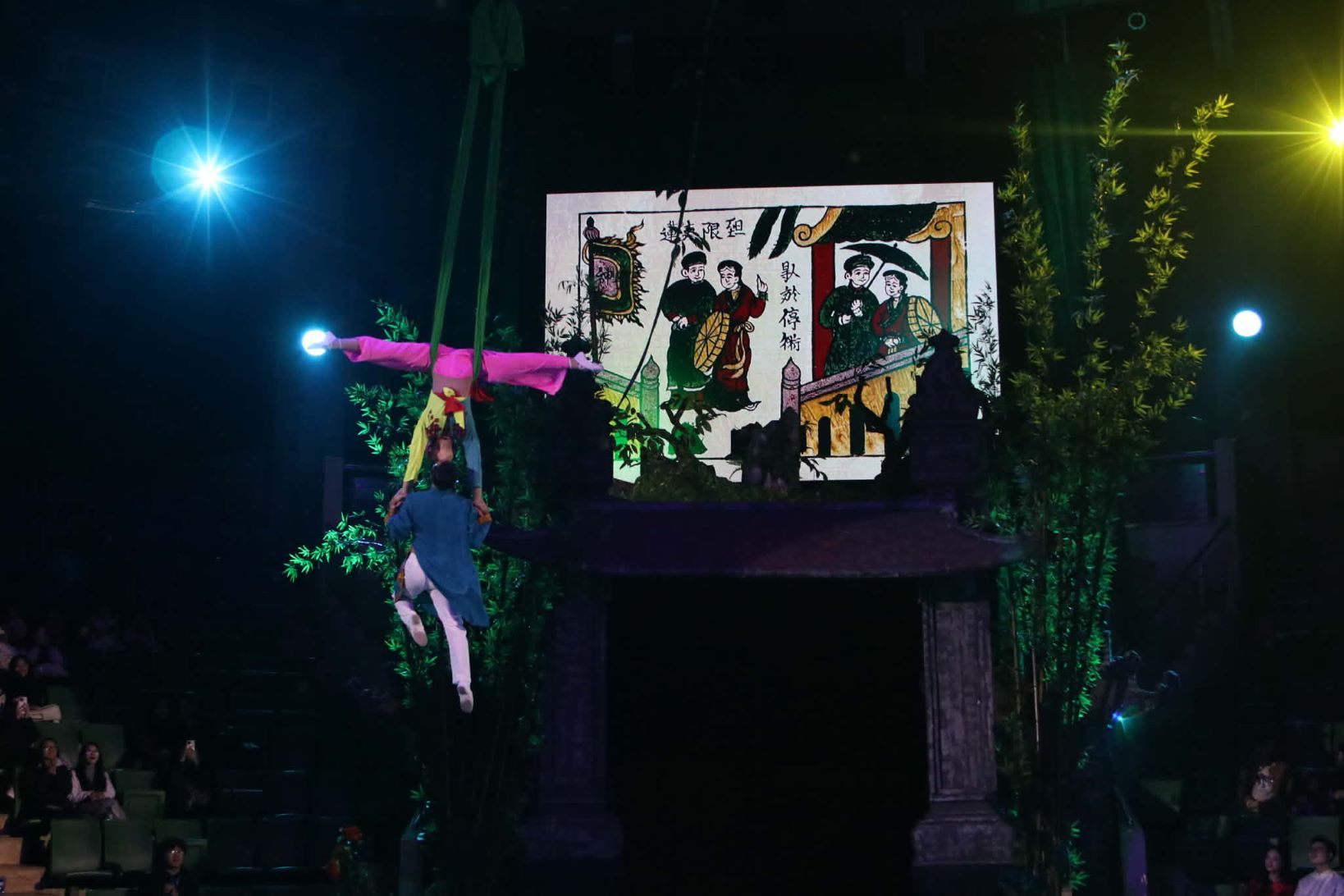
Young people and multi-industry connectivity
The noteworthy point of "Dong Ho Painting Circus" is not only the idea of combining 2 seemingly distant art forms, but also the organizational, research and coordination capacity of young people. The project is seriously built, with a process of understanding heritage content, consulting artisans, and working closely with the team of professional circus artists of the Vietnam Circus Federation.
Sharing after the play, artist Bui Hai Quan - actor of the Vietnam Circus Federation said that the process of working with students brought him many new experiences. “Working with young people helps me learn more approaches, thinking and new creative energy. This is also an opportunity for myself to innovate in artistic labor. Everyone has worked together and brought the audience positive spiritual values,” Mr. Quan shared.
Witnessing traditional works being "live" on stage, Meritorious Artist Nguyen Huu Qua expressed his emotion: "For the first time, the cultural value of Dong Ho paintings has been brought into circus art. I am surprised by the way artists and students lead the audience from one surprise to another".
Not stopping at the performance space, "Dong Ho Painting Circus" also expands the heritage experience with a series of pre-event activities. Previously, the project, in collaboration with the Foto Flicker brand, launched the photo frame "Dong Ho Painting Circus" inspired by typical paintings such as "Ruoc rong", "Bit mat bat de", "Hoi du"... This activity is estimated to reach about 6 million young people aged 18-25, with more than 7,000 direct experiences and bringing the photo frame home, contributing to helping the traditional heritage enter everyday life naturally.
In parallel, the project also deploys a series of content on social networks, providing information about the history of the painting village, deciphering the meaning of paintings in creative forms, close and intuitive language, helping heritage reach young people without dogmatism.
New direction for heritage conservation
From the perspective of promoting cultural values, "Dong Ho Fine Arts Circus" shows a suitable approach to the contemporary context: Instead of placing heritage in a static space, the project proactively brings heritage into the flow of life through performance, experience and digital communication. This approach not only helps heritage get closer to the young public, but also contributes to expanding the existence space of heritage in modern society.
Agreeing with this approach, Mr. Pham Thanh Tung - Member of the Executive Committee of the Ho Chi Minh Communist Youth Union of the Ministry of Foreign Affairs - commented: "In the context that young people are heavily influenced by modern cultural flows, alienating traditional values is a gap that needs to be filled. Dong Ho circus shows an effective direction when bringing heritage closer to the young public in new, emotional and modern ways.
Sharing about the orientation in the coming time, Head of the Project Organizing Committee Nguyen Tat Dat said: "Thuc cung di san is identified as a long-term, annual project, aimed at innovating traditional cultural materials through the connection between performing arts, direct experience and digital communication. From the initial results, the project will continue to expand the journey of innovating other cultural materials, in the spirit of respecting the original values and boldly testing the expressive languages of the times.
According to Dat, young people are fully capable of participating deeply in the journey of preserving heritage if they are equipped with knowledge, have a spirit of learning and know how to dialogue with tradition. "Returning to heritage" does not set the ambition to replace or fully recreate heritage, but chooses the role of paving the way - arousing curiosity, so that the public can continue to learn and connect more deeply.
From the reality of the project, it can be seen that heritage preservation does not necessarily have to be opposed to creativity, if the creative process is based on understanding and dialogue with tradition. When young people are given opportunities, connected with artisans and professional artists, they can become an effective bridge between heritage and the public, contributing to creating new vitality for long-standing cultural values.
It's a bit of a bit of a bit of a bit of a bit of a bit.
It's a bit of a bit of a bit of a bit of a bit of a bit.


