Green lungs" of the West Hau River region
After traveling by passenger car from Can Tho City to visit Ba Chua Xu Temple in Chau Doc, I rented a motorbike and drove smoothly to Tinh Bien, amidst coconut trees and vast fields.
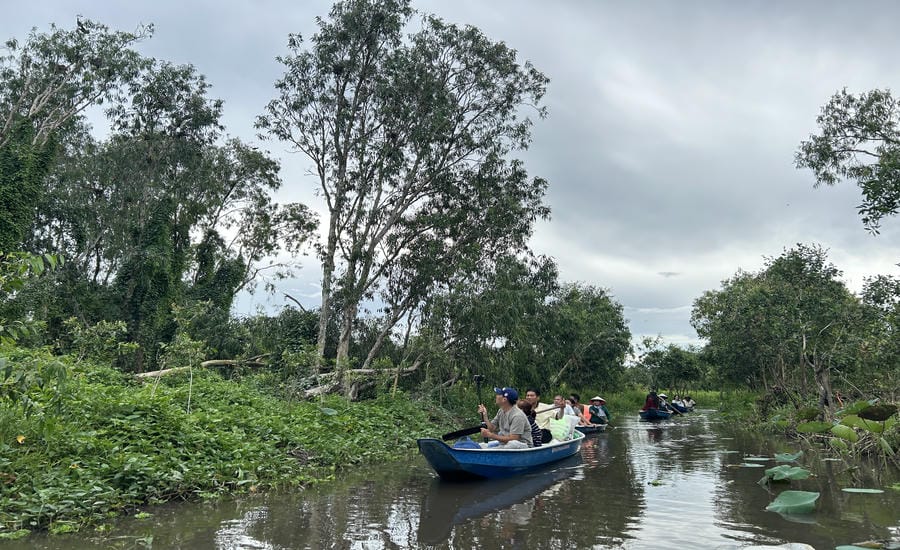
Right from the gate of the tourist area, groups of tourists take turns buying tickets, excitedly preparing for a trip to explore the most famous forest in the Mekong Delta. The small boat slowly splits the water, taking tourists deep into the canals covered in the green of duckweed. On both sides are straight melaleuca trees reflecting on the calm water surface. Occasionally, flocks of birds suddenly spread their wings and fly across.
The deeper I go, all the sounds of the city seem to disappear. Only the gentle rowing sound, the sound of the wind blowing through the foliage and the chirping of birds echoing in the vast forest. That moment made me forget all the hustle and bustle of everyday life, just silent in front of the rare peace that nature bestows.
Pristine nature keeps tourists near and far
Covering about 845ha, Tra Su Melaleuca Forest is considered one of the typical wetland ecosystems of the Mekong Delta region. This is home to dozens of species of waterfowl and many rare animal and plant species, creating a unique natural picture that is rarely found anywhere else.
The first time coming to An Giang, Mr. Bui Anh Tung (from Phu Tho province) almost never took his camera off his hand. "I used to think that the Mekong Delta only has orchards or floating markets. Coming here, I see so beautiful nature. Sitting on a boat in the middle of a melaleuca forest, listening to birds singing, looking at the green stretching before my eyes, I feel very peaceful. All the pressure of work seems to be left behind," he shared.
According to Mr. Tung, what impressed him was not only the scenery but also the way people here preserve nature. He said: "Every activity takes place very gently. The boatmen are not in a hurry, and the guests are not noisy. Everyone tries to keep quiet so as not to affect birds and the landscape. I think that is what is precious.
Besides its natural beauty, Tra Su cajeput forest also preserves many cultural imprints. Some scenes of the movie "Southern Forest Land" are still preserved after the film crew completed filming, becoming a stop loved by many tourists.
Simple leaf houses, stalls in the old Southern style or wooden bridges across canals make many people feel like they are stepping into the space of the Mekong Delta many years ago. Some people come to take photos, some people simply want to sit for a long time by the water's edge, take a deep breath of the fragrance of cajeput and enjoy a rare peaceful feeling.
The forest nurtures many fates
Leaving the small boat to continue taking visitors through the lush green canals, I encountered images of workers silently attached to Tra Su melaleuca forest day by day.
In a place where many people come to admire the beauty of nature, there are people who see this forest as a second home, a place that brings work, income and supports their whole family. Mr. Nguyen Van Binh is one of them. This skinny man with tanned skin is familiar with every stream of water, every path in the forest. His daily job is to row a boat to take tourists to visit, introducing the characteristics of Tra Su Melaleuca Forest with simple but emotional stories.
Having lived here for a long time, I remember every canal, every forest section. Each flood season, each bird season has its own beauty," Mr. Binh shared.
For more than two decades of rowing, he has met countless groups of tourists from all over. The rowing profession also depends a lot on the number of visitors. Each tourist boarding the boat, he receives about 12,000 VND. On weekends, holidays, and Tet when there are many visitors, his income is somewhat better. Conversely, on days when there are few visitors, the money earned is only enough to cover daily living expenses.
His wife also makes a living right in the tourist area with a small water stall. Every day, she sells familiar drinks from the Mekong Delta such as ginseng water, coconut water, palmyra palm water... to serve tourists after a journey to explore the forest. "Thanks to this forest, my family has a job. I row a boat, my wife sells water. For many years, the lives of the whole family have been associated with this place," Mr. Binh confided.
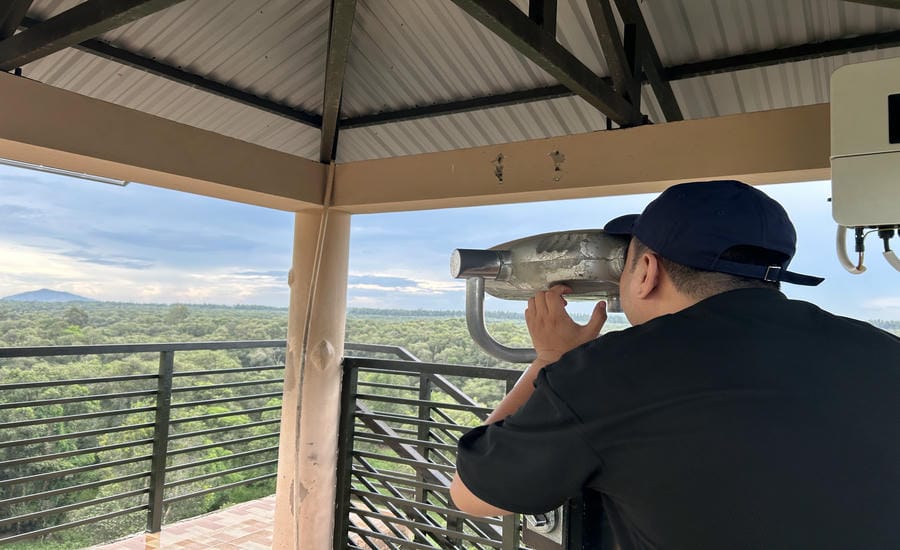
Not only Mr. Binh's family, Tra Su Melaleuca Forest also creates livelihoods for many other local workers. From boat rowers, service staff, souvenir sellers to regional specialty business households, all are contributing to creating a tourism ecosystem associated with the community.
In the late afternoon, when the sunlight gradually softens, the last boats take visitors back to the wharf. On the water surface, small waves spread out and quickly disappear under the green of duckweed cover. Birds also begin to return to their nests after a day of hunting. The space of Tra Su cajeput forest returns to its inherent peacefulness.
Looking at Mr. Binh diligently taking guests ashore, I realized that the beauty of Tra Su cajeput forest is not only in the endless green cajeput trees, flocks of precious birds or rare natural scenes. Behind that picture is also the story of ordinary people who are attached to the forest every day.
They not only do the job of serving tourism, but are also people who directly contribute to preserving the vitality of this land. Each rowing boat taking visitors through the forest, each glass of palm water given to tourists or each friendly smile contributes to creating a more intimate and warmer Tra Su cajeput forest.
Tra Su cajeput forest eco-tourism area is located in An Cu commune, An Giang province. The forest was forested in 1983, the soil here is heavily alum-contaminated and cannot be cultivated. Therefore, cajeput - a plant with alum resistance is chosen to green vacant land and prevent upstream floods. On May 27, 2003, the cajeput forest was recognized as "Special-use forest - landscape protection located in the Vietnamese special-use forest system and typical year-round flooded forest area of the West Hau River".