
The race to regain "memories" of glaciers
Hidden near the Concordia research station, a French-Italian scientific outpost in Antarctica, "Ice Memory" is a project that may only appear in the era of climate change.
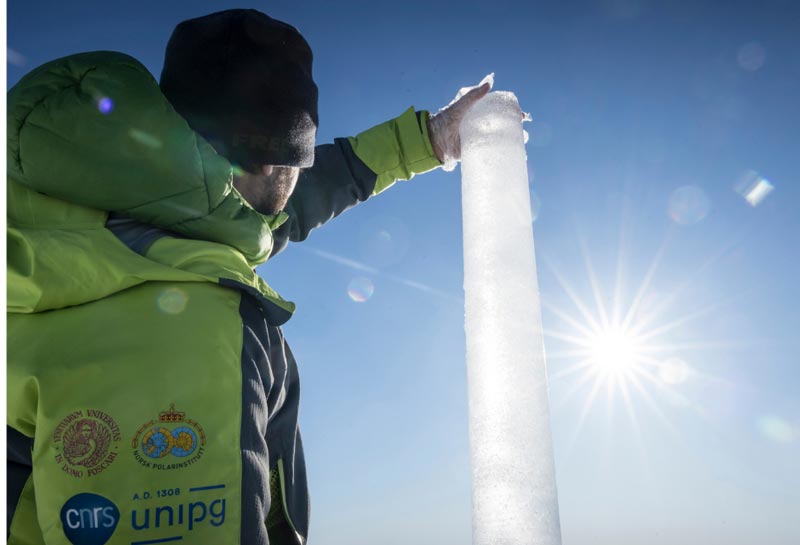
Inside the cave are stored cylindrical ice cores drilled from glaciers in the Alps, Andes or Pamir Mountains of Tajikistan. They are not just ice water bubbles. Tiny gas bubbles trapped inside the ice core are traces of the atmosphere from hundreds, even thousands of years ago: from atmospheric dust, volcanic eruptions, forest fire smoke or pollutants.
This is a unique location, a unique idea. From many perspectives, this is truly a pioneering project," said Thomas Stocker - Chairman of the Ice Memory Foundation, professor of climate and environmental physics at the University of Bern (Switzerland).
He explained: "We cannot save the entire glacier, but we can save the environmental and climate information stored in it.
Small gas bubbles in the ice cores are the key. "They contain air at the time the bubbles were formed, possibly from 100 years, 1,000 years or further in the past," Stocker said.
By analyzing these ancient air samples, scientists can recreate the history of carbon dioxide, methane and many other greenhouse gases. According to Professor Stocker, ice cores show that current carbon dioxide concentrations are about 30-35% higher than at any time in the past 800,000 years.
But while global climate data is still kept in Antarctica or Greenland, many "local climate records" are rapidly disappearing.
I live in Switzerland, we have observed for decades and found that glaciers are decreasing at an increasingly rapid rate. Local climate reserves such as in the Alps, Himalayas or Andes are disappearing at an alarming rate," he said.
That is the reason the Ice Memory project was born: Racing against time to preserve climate memories before they disappear.
Archive for the future
To obtain an ice core, researchers must carry nearly 500kg of equipment to harsh high mountains. Most recently, in Tajikistan, a drilling operation took place at an altitude of 5,820 meters above sea level. Before drilling, they also had to survey the structure inside the glacier with radar to find the most stable location.
There are places on the planet where valuable climate records are being lost day by day. Every day ice melts adds another piece of climate history lost from the record," said Alison Criscitiello - Director of the Canadian Ice Core Laboratory at the University of Alberta.
After a long journey, the ice cores were brought to Concordia. This is one of the coldest places on Earth, where winter temperatures can drop below minus 80 degrees Celsius.
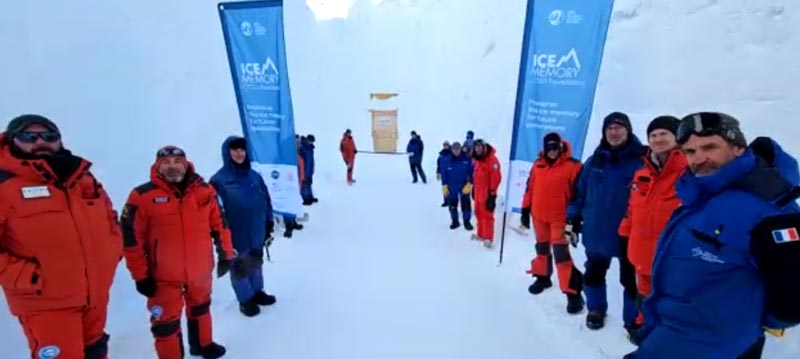
This is really a safe place," Professor Stocker said, adding: "We also make it safer by building an ice cave at a depth of 10m below the surface. There, the temperature is always maintained at minus 52 degrees Celsius.
The ice cave is about 60m long, 5m wide, completely covered by compressed snow. Without a complex cooling system, nature itself becomes a giant safe to preserve artifacts.
What is special is that in the future the value of these ice cores may be even greater as technology develops more modernly.
According to Professor Stocker: "Today we can measure things that no one imagined 50 years ago. So we believe that in 50 or 100 years, the next generations of scientists will exploit completely new information from the ice cores we store today.
In other words, "Ice Memory" is not just a science project of the present. It is a message to the future: When it is impossible to keep the disappearing glaciers, humans can still preserve their memories for future generations.
THE GLACIERS ARE GRADUALLY DISAPPEARING
In recent decades, thousands of glaciers around the world have disappeared. A 2025 study warns that if climate change continues in the current trend, by the middle of the 21st century, there could be up to 4,000 glaciers disappearing each year.
In Switzerland, glaciers have lost about 35% of their volume. According to Thomas Stocker, in a scenario of high greenhouse gas emissions, up to 90% of low-lying glaciers could disappear by the end of the century. Along with ice and snow, many valuable natural climate records are also gradually being erased.
ARCHIVE IN THE COLDEST PLACE IN THE WORLD
Located on the Antarctic Plateau at an altitude of over 3,000m above sea level, Concordia is one of the most isolated and coldest research stations on the planet. In winter, the temperature here can drop below minus 80 degrees Celsius.
Inside the storage tunnel dug deep under the snow, cylindrical ice cores are preserved in white insulated barrels, arranged in long rows and carefully labeled. The Ice Memory project aims to store ice cores from 20 glaciers around the world. To date, 10 glaciers have been sampled, which are glaciers belonging to the Alps, Andes and Pamir (Tajikistan).


