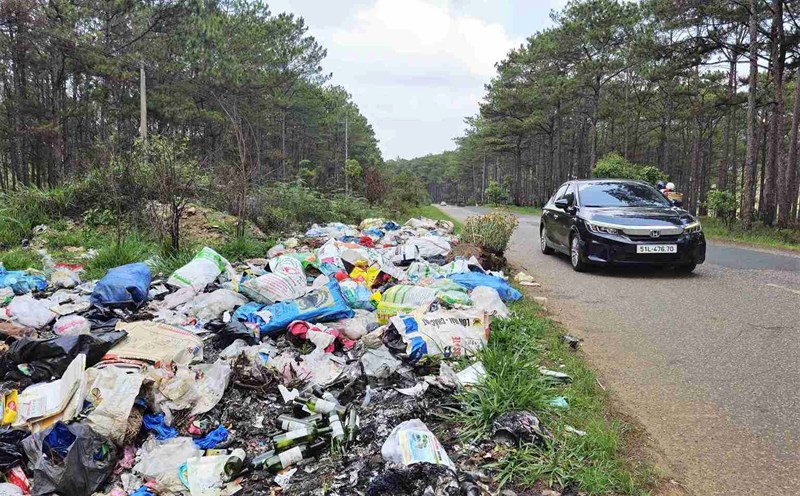
There, discarded items are not just garbage, but also a story about lifestyle, convenience and even private needs of wealthy people.
When garbage also needs "high-end services
A light rainy morning in London, England, a neon yellow truck weaves through the crowded traffic on the Battersea Bridge. The driver is Will Ferguson, 45 years old, owner of a private garbage collection company. He laughed and said that the biggest difficulty in the job is not the smell of garbage or the volume of furniture, but the parking fee. On average, he receives a fine ticket worth 80 pounds (equivalent to 2.8 million VND) per day.
The first destination of the day was a two-front house under repair on a quiet, luxurious street in the southwest of the city. In less than 20 minutes, Ferguson and his associates gathered a series of items discarded by the homeowner: a few bags of clothes, a children's bicycle worth about 500 pounds, a large mirror, electric car chargers and even exercise equipment. The homeowner - a young woman who was busy with construction workers - almost did not care where those items would go, as long as they were taken as quickly as possible.
This service is not cheap: 125 British pounds (equivalent to 4.4 million VND) excluding VAT for the amount of furniture occupying about one-third of the truck bed area. But in return is convenience. Clothes and mirrors can be taken to charity shops, waste is taken to the treatment site, and valuable things will be resold. "A rainy day like this, such a start is okay" - Ferguson happily said, before turning the car around to continue.
Ferguson's story is a typical cross-section of a silently booming industry. In London, more than half of local government agencies outsource garbage collection services. In parallel, many private companies have been established to serve the needs of personalization - from busy households to the super-rich. According to data from the UK Environment Agency, there are currently more than 2,000 garbage treatment contractors operating in the London area. Clearabee, the UK's largest on-demand garbage collection company, has seen its revenue grow to £23 million (approximately 807 billion VND) per year since launching its on-demand service in 2012.
Returning to Ferguson, his background is not related to "junk". He studied at a prestigious university, has a degree in art history and started his career in the shipping industry. But in 2006, he decided to switch directions, establishing his own company called Junk Monkey. After initial difficulties, he now has a fleet of 5 vehicles and a team of 6 official employees and seasonal labor force.
On his daily journey, he witnesses a familiar reality: "This person's trash can be another person's treasure." Some days, he only collects worthless trash bags. But there are also days when discarded items bring in significant profits.
London discharges the equivalent of 3 Wembley stadiums of garbage every day. The official figure is about 7 million tons per year. In that context, services like Ferguson help people save time, avoid having to go to the garbage dump, and handle difficult-to-discard items such as refrigerators or mattresses.
But for many of his customers, the reason is not just convenience.
The story behind the discarded items
Ferguson's clients are not ordinary families. His list includes famous actors, financial investors, and even princes. Many people hire regular services, wanting to ensure privacy and confidentiality. He rarely refuses any job, whether big or small.
One of the stops during the day was a house in Belgravia - the most expensive area in London - owned by a Swiss billionaire. Ferguson's company comes here 3 times a week, costing more than £100 (equivalent to 3.5 million VND) each time, just to collect a few bags of garbage.
Although the homeowner is not present, only the staff lives here, but they still have a lot of garbage to throw away," he said while taking a bag full of withered flowers onto the car. The work took place quickly, discreetly, without leaving a trace.
Among the jobs he has ever received, there are special stories. Once, he was called to clean up a warehouse full of party accessories after an event organizing company dissolved. Post-divorce house cleaning campaigns are also not uncommon. Even more memorable is the time he had to handle a chair where an old man had passed away and was not detected for 10 days.
Sometimes you have to overcome the initial feeling," he said briefly.
A good working day can bring in revenue of about 7,000 pounds (245 million VND). There are also revenues from reselling used goods. However, the cost is also not small. Each ton of garbage brought to the transfer station costs more than 275 pounds (9.6 million VND), a sharp increase compared to 43 pounds (1.5 million VND) when Ferguson first started his business. On average, the company collects about 6 tons of garbage per day. To make a profit, he must achieve a minimum revenue of 1,200 pounds (42 million VND) per day.
In the afternoon, when the lights began to fade, Ferguson drove to a large garbage transfer station in Battersea. Here, the car was weighed before and after dumping garbage to calculate fees. The work ended not with a clean scene, but with cost and volume figures.
Sitting in a bar after a long day, he shared: "Some days it's very easy to make money, some days it's extremely hard. But after all, everyone has something to give up.
From another perspective, the development of this industry also reflects a thought-provoking reality: Increasing consumption leads to huge amounts of waste. A recent survey shows that hundreds of illegal landfills exist throughout the UK, including "super landfills" containing tens of thousands to hundreds of thousands of tons of waste.
In that picture, people like Ferguson play an intermediary role - both solving personal needs and contributing to reducing pressure on the public system. However, the bigger question remains: When disposal becomes too easy, are people consuming more than necessary?