Few people know that behind the majesty and prosperity of this ancestral land in the 18th century is the nurtured hand of a special woman from the "golden branch and jade leaf" lineage. That is Nghiem Quan Chua - Dang's daughter, adopted daughter of Lord Trinh - the benefactor who wholeheartedly donated land and restored the three treasures, leaving gratitude for posterity.
The ancient temple is famous throughout the region
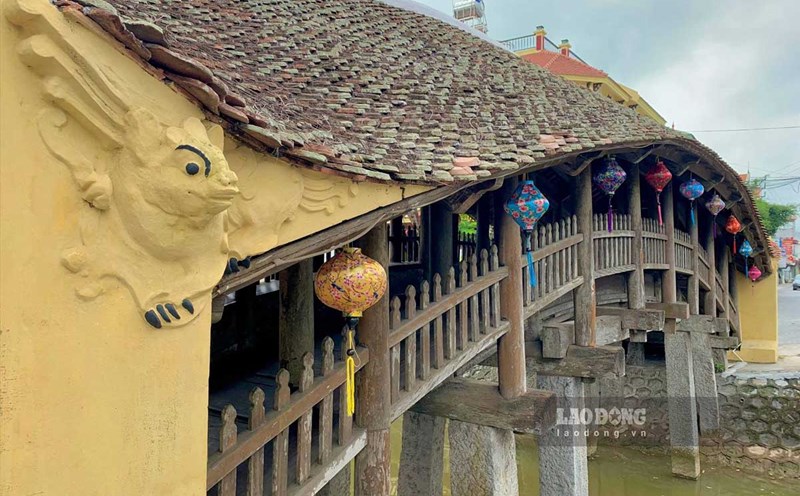
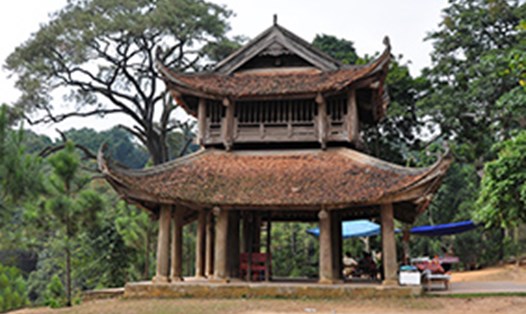
Quang Nghiem Pagoda is often called Tram Gian Pagoda by the people, one of the famous ancient pagodas of Hanoi. The pagoda was built under the Tran Dynasty and is located in Tien Lu village, Chuong My ward, Hanoi city, although it has gone through many historical changes, the pagoda still stands majestically located on the top of Tien Lu mountain, the pagoda is associated with Saint Boi (Nguyen Binh An) who cultivated and became enlightened here.
The book "Dai Nam nhat thong chi" states: "On the mountainous territory of Tien Lu commune, An Son district in ancient times, there was a person in Boi Khe - Thanh Oai named Nguyen named Binh An who was the abbot there, with very wise Dharma, when eating and drinking with everyone, he transformed little into a lot, and was good at crossing roofs and walking on them, people praised him for being devoted to true people. And when he died, the fragrance was fragrant, people in this land put his body in the infirmary to worship. By the time of Emperor Tran Hau, he came to pray for his son to carry on the lineage and the spirit appeared, so he was ordained as Dai Tu Bi Bo Tat. When the Minh invaded, he burned the infirmary, then it rained blood for 3 days, the number of Minh deaths could not be counted, so he led troops to withdraw. People in this land just renovated the infirmary, to worship. From the 4th to the 6th day of the first lunar month
After the Le dynasty restored the country, people rebuilt the new pagoda in its old shape. Throughout the time until the beginning of the Le Trung Hung period, in the stele of Quang Nghiem Tu Bi, author Do Tap Nghia wrote: "I have visited pagodas in Quoc Oai district, Son Tay religion, but no pagoda has been as brilliant as the pagoda on the high mountains of Yen Son district [... ]. However, because it has been a long time, the works have been damaged, but the shadow of the foundation can still be seen. In the year of Dinh Suu, Hoang Dinh era (1601), the pagoda repaired some works such as: Thuong Dien, Tien Duong, left-right corridor of the pagoda. In the year of Ky Hoi (1603), Da Son Palace and Buddha statues were repaired". In the year of Chinh Hoa, the reign of King Le Hy Tong, a bell tower was built, and in the 10th year of Canh Hung (1749), a bronze canteen was cast with a length of 1.20m and a height of 0.60m.
In the Tay Son period, the pagoda continued to be restored and embellished, and new works were built, the most typical of which was casting the ancient Quang Nghiem bell in the second year of Canh Thinh (1794) and building the Ngu Dien in November of Giap Thin (1784) as a place to place the throne of Saint Boi to watch puppetry.
Great predestined relationship between the Dang family and Tram Gian Pagoda
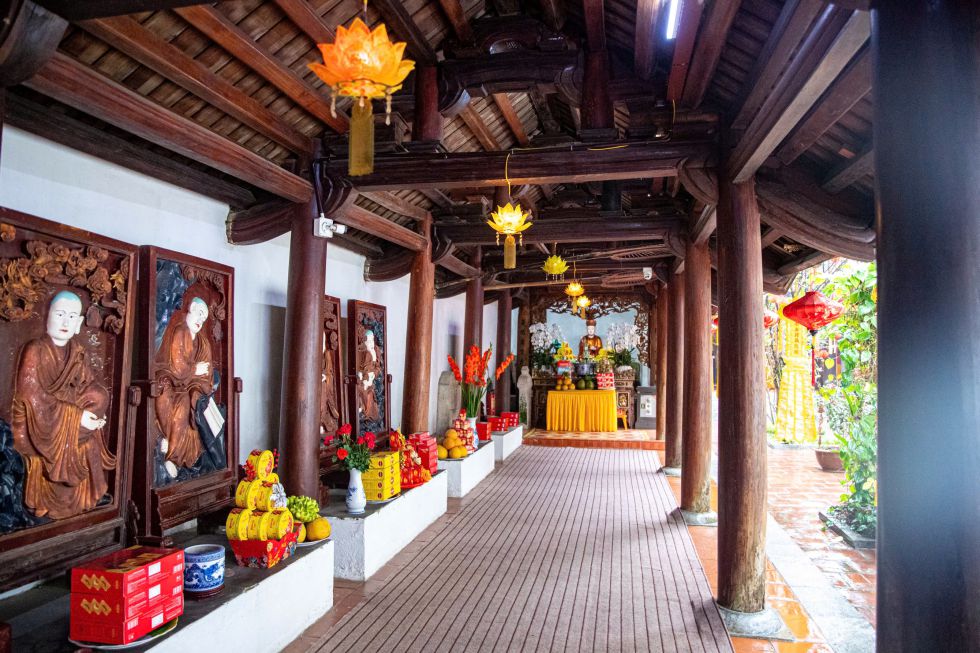
The pagoda is also associated with the Dang family in the restoration and construction of the pagoda. Inside the pagoda, a 4-sided stele is also erected to record the merits of Dang Tien Gian (Dang Tien Dong), who has made many contributions to the restoration and construction of the pagoda. Among them is Mrs. Nghiem Quan Chua, whom Dang Tien Dong calls To Co.
Her real name is Dang Thi Ngoc Phuc or Trinh Thi Ngoc Ky, she was adopted by Lord Trinh Trang and conferred the title of District Lord, given the Trinh surname, later married to Ta Trung Quan Doanh Pho do tuong Thieu uy, Tu khong Nghiem Quan cong. According to the Dang family genealogy, Lord Trinh Trang raised her as a child, conferred the surname Trinh Thi Ngoc Ky, conferred the title of District Lord, married Nghiem Quan cong, she raised Dang The Lang, with many rice fields, and the statue is in Quang Nghiem Pagoda (Tram Gian).
The stele "Quang Nghiem Tu Bi Ky" (around the reign of Canh Thinh 1797) written by Ngo Thi Nham has a passage stating: "... immediately gave birth to the second ancestor, Nghiem Quan Chua, connecting light in the cinnamon palace, spreading a generous heart, with kindness towards the Dharma of Tam Thua, posthumously honoring the Buddha, opening three large palaces, offering hundreds of mau of incense fields, old and young around the village, all thanks to gratitude...".
The background and merits of Nghiêm Quận Chúa
Regarding the background of Nghiem Quan Chua, the stele of Dang Tuong Cong bi dated Bao Dai 2nd year (1927) records: "Quang Nghiem Pagoda in Ban Tong is a beautiful mountain and river place, truly a land of victory. There are also sacred relics and famous pagodas. The Le Dynasty had Mr. Ta Tu without Ha Quan Cong Dang Tuong Cong, whose name was Thuy Nhan, whose name was Thuy The Vinh, whose name was Thuy Trong Uyen, who was a famous mandarin of the Trung Hung period. In his old age, he often enjoyed the scenery, admired the scenery of this mountain pagoda, and often came to stroll without getting bored. His eldest daughter was the wife of the Deputy General Lieutenant, who was conferred the title of Nghiem Quan Chua, whose name was Thuy Ngoc Phuc, whose name was Thuyen Minh, whose religious name was Tu Thien, who bought 100 mau of rice fields and handed them over to the people in the commune to preserve as fields for worship and worship on the day of Soc V
The stele of Dang Tuong Cong Bi records: "To co Pho tuong Thieu uy Nghiem Quan chua, with a portrait statue, born on August 12, death anniversary on September 17". See the information in the stele, it is said that Dang Tien Dong addressed Nghiem Quan chua as To co. Currently, her statue is still in Tram Gian Pagoda.
Thus, information about Nghiem Quan Chua can be summarized as follows: Her real name is Dang Thi Ngoc Phuc or Trinh Thi Ngoc Ky, self-named Huyen Minh, code name Tu Thien, is the second daughter of Ha Quan Cong Dang Nhan. Abdopted by Lord Trinh Trang and conferred the title of Quan Chua, giving her the surname Trinh. Later, she was married to Ta trung quan doanh Pho do tuong Thieu uy, Tu khong Nghiem Quan cong. It should be renamed Nghiem Quan Chua.
Nghiem Quan Chua bought 100 mau of rice fields and handed them over to the pagoda to make post-harvest fields for worship and worshiping in the pagoda, besides that, 3 large halls were built, from which old and young people from all directions were blessed.