
Story about a multi-generational family guarding the border
The road to Ban Chu has a very private, melancholic look of the remote border region. Amidst that simple rural space, traces of the Vi family mansion appear quietly, like a witness who has gone through many layers of ups and downs.
No longer the complete appearance of a once famous establishment in the region, today the relic site only has old brick gates, mossy walls and some architectural traces left. The vast desolation makes visitors feel regretful. But even in that fading appearance, this place still evokes a lineage that once held a special position in the history of Lang Son border region.
The Vi lineage is a large lineage of Tay people, who used to be land ty in Lang Son for many generations. This lineage moved to Ban Chu, Khuat Xa commune, former Loc Binh district, established Thai hamlets and has been attached to the land located next to the Ky Cung river branch for a long time.
Since then, Ban Chu has not only been the residence of a highland community, but also a space that preserves many traces of the role of indigenous clans in guarding the northern border.
In the history of the Vi family, Mr. Vi Van Dinh is a prominent figure. He was born in 1878, died in 1975, alias Ngoc Khue, belonging to the 13th generation of the Vi family. Born into a family with many generations assigned important responsibilities by the court in the border region, Mr. Vi Van Dinh held many important positions such as Tri Chau Loc Binh, assistant to Lang Son provincial affairs, Governor of Phuc Yen province, Governor of Hung Yen province, Governor-General of Thai Binh province, Governor-General of Ha Dong province.
He was promoted to Lieutenant Colonel of the University, title Crown Prince of Thieu Bao, and retired in 1942. In his local memory, Mr. Vi Van Dinh is mentioned as a strict and upright Governor-General. Later, when the country entered the resistance war against the French colonialists, he followed the revolution, joined the Lien Viet Association and became a member of the Central Committee of the Lien Viet Association.
After the successful resistance war, he returned to live in Hanoi and continued to participate in the Vietnam Fatherland Front. He was also the father-in-law of 2 famous intellectuals at that time, Professor Ho Dac Di - Rector of Hanoi Medical University and Dr. Nguyen Van Huyen - Minister of National Education (now the Ministry of Education and Training).
The remaining traces of the Vi family's "mansion
Because of those layers of history, the Vi family mansion in Ban Chu is not only the vestige of an ancient mansion. This place is also a memory of a Tay family that once played a role in managing the border region, a story about the transformation of a historical figure from a court official to a participant in the great national unity bloc in the revolution.
Mr. Hoang Van Bao, who has volunteered to look after the relic site for many years, said that the old building was built in 2 phases. Initially, Mr. Vi Van Ly, Mr. Vi Van Dinh's biological father, built the first floor. After his father passed away, Mr. Vi Van Dinh continued to build more and expand the scale to create a majestic mansion.
According to Mr. Bao, previously the mansion had a 2-story main house, a horizontal house, a cement tennis court, 3 large ponds in the campus and 5 entrances. These details show the scale of a once very large estate in the border area, and at the same time reflect the life, position and cultural intersection in the architecture of a powerful family.
Talking about this relic, Mr. Vi Van Phong, former Chairman of Khuat Xa commune (now holding the position of Secretary of the Party Committee of Xuan Duong commune), said that after Governor Vi Van Dinh left Lang Son, the mansion no longer had regular caregivers. At one point, this place once became a base for soldiers. In 1979, during the border war, the mansion was almost completely filled by artillery shells.
What remains today is very precious, because it is a rare trace of a work once associated with the history of the Vi family and the land of Ban Chu," Mr. Phong shared.
According to Mr. Phong, the main gate of the mansion is built of fired bricks, lime and sand. Some old walls also show the special construction technique of the ancients, when the walls are made from a mixture of ash, paving sugar and pink silk resin. This adhesion method creates durability, helping some parts of the walls still exist over time despite having gone through war, rain, sun and many years of not being fully preserved.
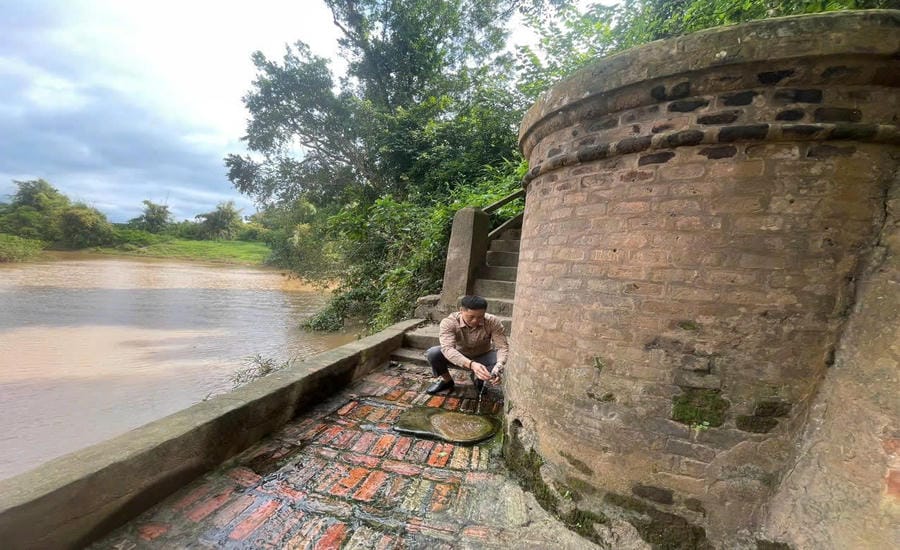
Not only are there remnants of the mansion, Ban Chu also preserves the ancient Bo Lai well located next to the Ky Cung river branch. The well was built by Governor Vi Van Dinh in 1910, and it has been more than a century now.
Leaders of this commune also said that Bo Lai well water has been almost never dry for more than a hundred years. Up to now, Ban Chu people still use well water for drinking and living. Many people from other places also come, bringing cans and drums to ask for well water to bring back.
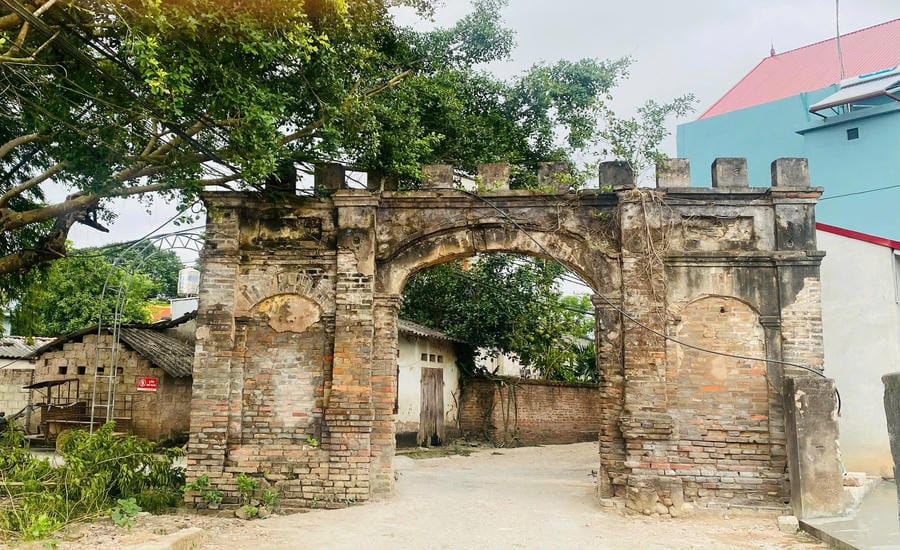
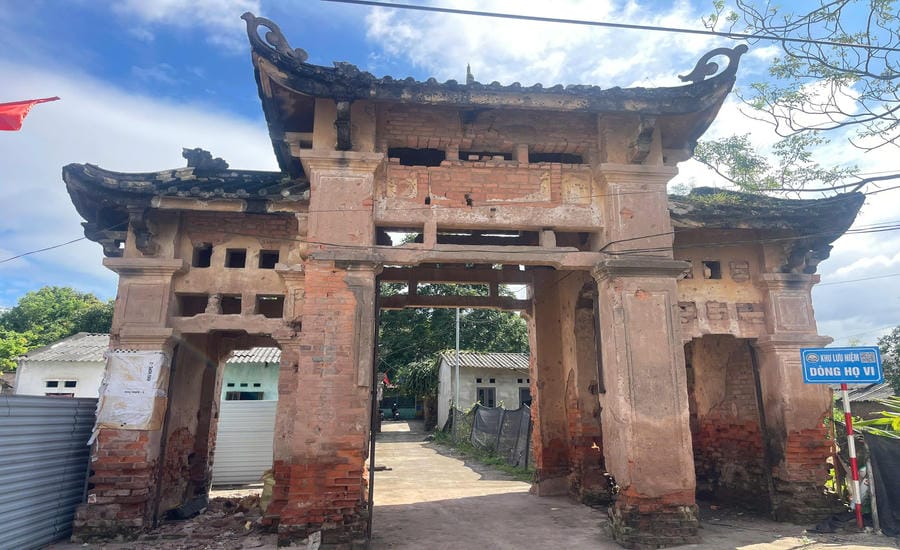
In 2019, the Vi family relic site in Ban Chu was ranked as a provincial-level relic by Lang Son Provincial People's Committee according to Decision No. 2337/QD-UBND dated November 29, 2019. This is a recognition of the historical and cultural value of the relic. However, the current reality shows that many items are still suffering from the erosion of time and have not been restored to their inherent value.


