The love for folk songs came to her very early, in a natural and persistent way. Phuong's childhood was associated with listening to the program "Folk songs and traditional music" on Voice of Vietnam Radio. Sometimes because she was absorbed in listening, she went to school late, cooked late, and was scolded by her parents, but it was these melodies that silently nurtured the spiritual life of little Phuong in those years.
Phuong's ability to absorb and learn folk music is very quick. When she grew up a little, following friends to Bac Ninh to attend Lim Festival, Phuong was attracted to the singing voice of "lien anh lien chi", to the gentle, discreet and humane way of giao duyen of Kinh Bac people. That is a feeling that is not ostentatious but deep, very close to her personality.
At that time, Phuong was still vague about love, but songs like: "Sadness returns in April/ Eyes are lush with rice, no need to eat" (in the song "Buon bac buon dau" (Quan Ho folk song of Bac Ninh) moved her with the beauty of words and melodies. Folk music, in the most natural way, enriched Phuong's spiritual life, to the point that she no longer paid much attention to beautiful clothes or shoes like her peers.
2008 was an important milestone when Phuong, through the introduction of an aunt, participated in the Xam vocal selection contest of the Vietnam Center for the Development of Music Arts (under the Vietnam Musicians Association) at Hao Nam communal house (Hanoi). Among about 200 candidates, she was 1 of 5 people retained for training.
After only a short time, Phuong was officially performed in the space of Dong Xuan market on weekends. Then she passed the entrance exam to Hanoi University of Theater and Cinema, Faculty of Ethnic Theater, but after studying for about a year and a half, she stopped studying to participate in a performance in France. At the end of 2010, she again took the entrance exam to Hue Academy of Music and studied for 5 years at the Faculty of Cultural Heritage Music, majoring in Xam singing.
Phuong said that luck is also a predestined relationship when she learned and watched the book "Hat Xam" by researcher Tran Viet Ngu - the author who was awarded the State Prize for Literature and Arts. The book has become Phuong's handbook, helping her systematize knowledge about the history of Xam singing, from legends to folk studies, as well as the characteristics of Xam singing art, becoming an important foundation in her career journey.
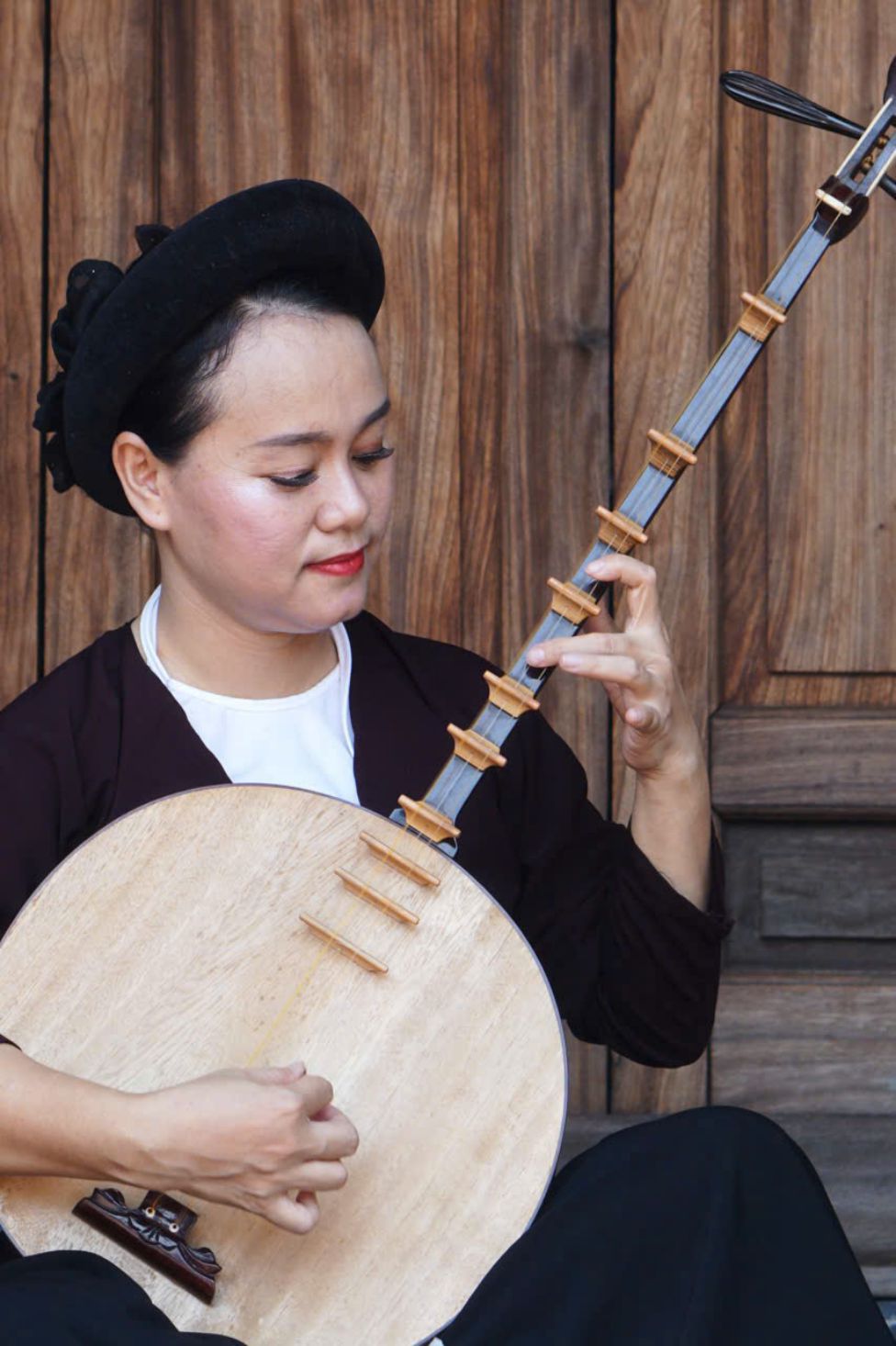
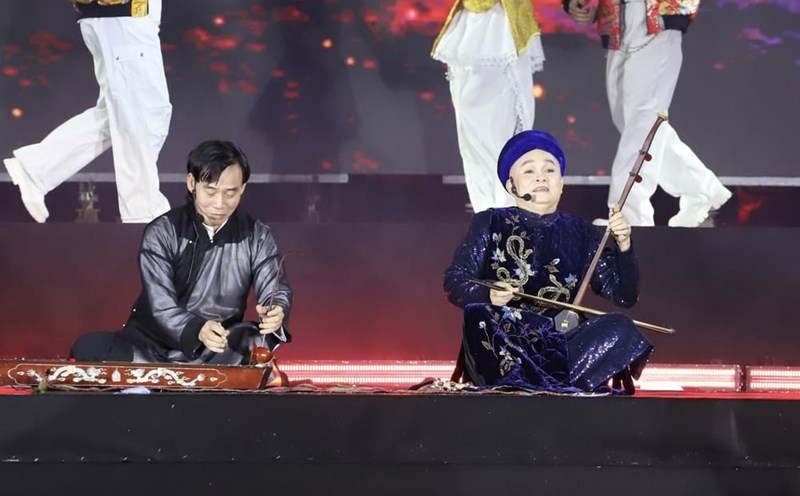
Xam singing originates from visually impaired people in the Northern Delta and is composed of 4 core elements: Performance environment; literary lyrics used for Xam singing; musical instruments (dan bau, dan nhi, tambourine, couplet); and melodies are often named after the environment or form of performance such as Xam cho, Xam ho khoan, Xam sai, Xam tram, Xam thap an...
The most difficult thing in Xam singing, according to her, is to express the diverse nuances of emotions through singing. Xam is not just about complaining about oneself or talking about suffering, but sometimes a proud voice before life, like in the song "Determined to cultivate oneself". Each melody requires different expressions: Xam thap is caring for grief, telling about the merits and virtues of parents who worked hard to raise their children to adulthood; Xam tram carries the urgency of love; while the rauc melody requires emotional restraint to reach deep sadness.
Initially, Xam lyrics were mainly based on folk songs, proverbs, praising the homeland, country and love. When artisans followed traders from the countryside to Hanoi, they realized that the taste of Trang An people tended to be cheerful and optimistic. Therefore, many poems by contemporary authors such as Tu Mo, Tu Xuong, Nguyen Binh... were incorporated into Xam singing to easily reach the public. Some artisans such as Trum Nguyen, Than Duc Chinh once had a well-off life, and were invited by wealthy families in Hanoi to perform at their homes.
Today, artisans like Phuong continue to expand the creative space by incorporating Xam melodies into modern poems, familiar to Vietnamese programs, such as "Bam oi" by To Huu, "Tre Viet Nam" by Nguyen Duy, "Me" by Tran Quoc Minh... Regarding the role of Xam singing in contemporary life, Phuong believes that this art form used to have a fading period, but now it has gradually gained a clear position, a firmer position in the awareness of professionals and audiences. The fact that many singers and artists use Xam material in new remixes such as "Muc ha vo nhan", "Ha Thanh 36 pho phuong", "Vui nhat co cho Dong Xuan" are positive signs showing the vitality of Xam in today's music life.
Currently, Thu Phuong is the leader of a group of Xam singers and Cheo singers serving the Hanoi 5-Cua O tourist train. Every week for 4-5 days, she and the artists not only perform but also introduce and tell stories about the profession to tourists. In addition, Phuong also participates in teaching and training young people and children at Hao Nam communal house, Cu Dong communal house (Long Bien) and many other facilities. Her daughter, Nguyen Phuc Phuong Uyen (13 years old), who followed her mother to perform from a young age, has early revealed her singing talent through songs such as "Ha Thanh 36 streets".
Looking back at the journey of her career, Phuong recounted one of the most memorable memories is her trip to France in 2010, when she was only 20 years old, in a troupe of artists from the Ministry of Culture, Sports and Tourism, including about 20 artists of many different types. As a representative of Xam singing, Phuong performed in the capital of light with the mindset of a young person carrying traditional music. After the performance of singing about Hanoi, she gave a quai thao hat to a Paris dignitary, a simple but unforgettable moment. In particular, after the performance, many audiences expressed their desire to buy Vietnamese ao canh, yem, and dup dresses, as a way to preserve memories of the culture they had just touched.