When audiences pay to experience Vietnamese culture
For many years, traditional materials in entertainment products have often been seen as accents. A few folk instruments, ancient motifs or rural settings are brought into the stage and cinema to create color. However, the development of the market in the past 2 years shows a clear change: Vietnamese identity is no longer a "backdrop", but has become a central factor creating attraction.
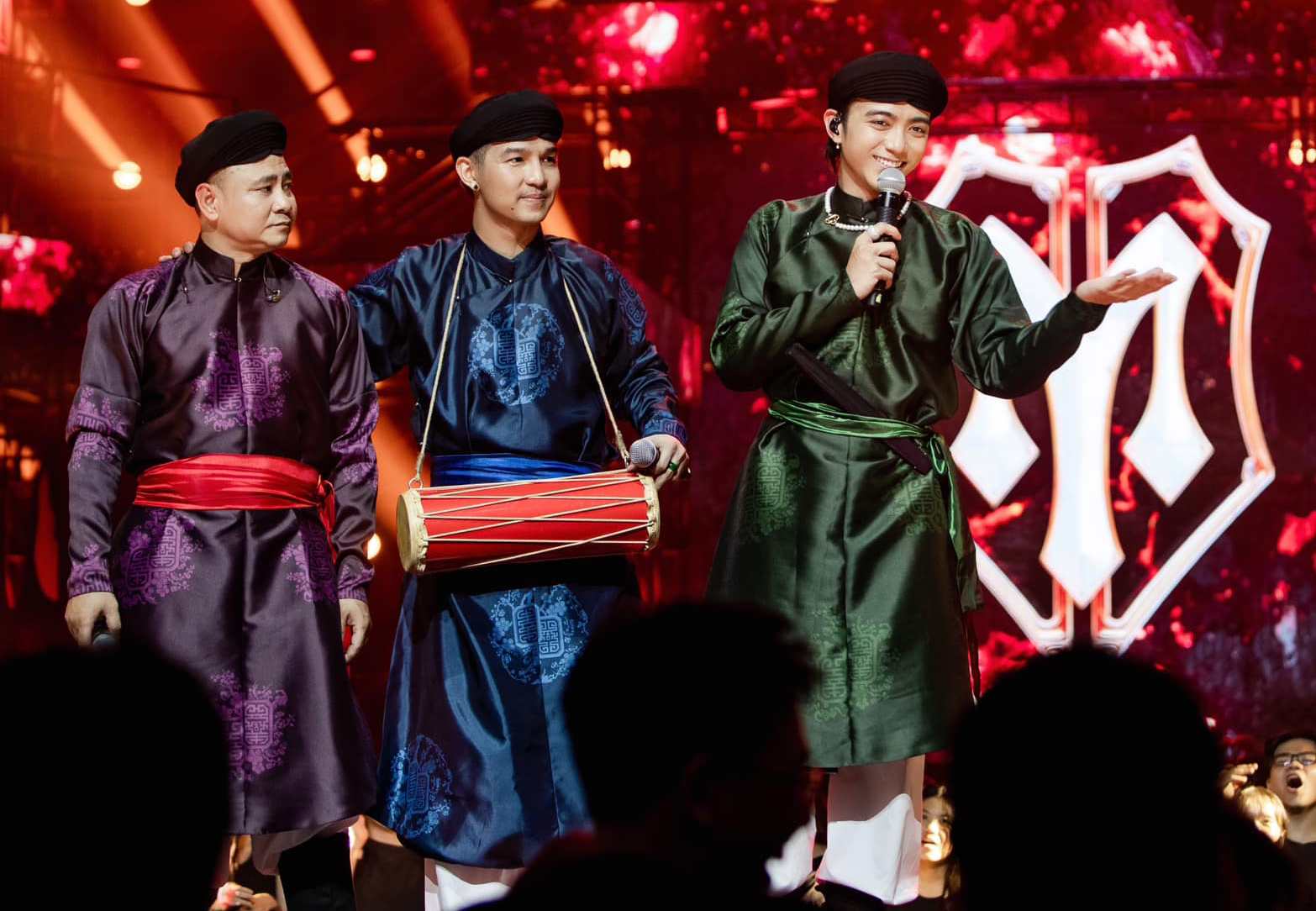
The program "Anh Trai Vuot Ngan Chong Gai" is a prominent example of this trend. In the program and concert nights, many performances such as "Trong Com", "Chiec Khan Pieu"... are refreshed with modern orchestration, dance and performance technology. Materials that are considered picky listeners have reached a large number of young audiences.
Notably, the 3rd concert of the program taking place in March 2025 in Ho Chi Minh City set a Guinness record for the event with the largest number of people wearing traditional Vietnamese costumes. This activity spreads community cohesion and national pride through Vietnamese costumes.
The value of the record is not only in the number of participants. Traditional costumes have gone beyond the performance area to appear in the audience. The public no longer stands aside to observe but directly becomes a part of the cultural space.
The appeal of programs with content about the country continues to be shown through a series of large-scale events in 2025, in which the concert "Fatherland in the Heart" caused a fever when it took place at My Dinh Stadium with more than 50,000 attendees.
Songs about homeland, history and patriotism are placed in a modern sound, lighting, and stage system. Red flags with yellow stars, ao dai, Vietnamese costumes and chorus performances create a rich community experience.
These numbers partly change the perception that young people are indifferent to national culture. The problem is not necessarily in the distance between young people and tradition, but in the way those values are conveyed. When folk music is made new selectively, the historical story is told attractively and the audience has the opportunity to participate, traditional culture still has strong competitiveness.
Similar to music, Vietnamese cinema also finds great resources from history, customs and local life. According to Box Office Vietnam data, in 2025 there are about 55 Vietnamese films released in theaters, reaching total revenue of more than 3,770 billion VND. While in 2024, about 30 Vietnamese films reached more than 1,900 billion VND. Domestic films account for over 60% of total market revenue in 2025 and about 28% of films exceed the 80 billion VND mark.
One of the biggest phenomena is the movie "Red Rain". The film is set in the 81-day and night battle to protect Quang Tri Citadel, leaving theaters with a revenue of 714 billion VND, becoming the highest-grossing Vietnamese film in domestic box office history.
The success of "Red Rain" shows that historical and war topics are not only for propaganda and commemorative occasions. When invested in large-scale and told in emotional cinematic language, history can conquer the mass market.
Previously, the film "Tunnels: Sun in the Dark" by director Bui Thac Chuyen became the first Vietnamese war film to exceed 100 billion VND in revenue.
Director Bui Thac Chuyen said that the crew values authenticity, carefully studies history, costumes and refers to real prototypes. This is an important point, because audiences not only seek pride but also require the work to respect history.
Besides war films, folk culture and local beliefs have also become "gold mines". "Nha gia tien" and "Phi phong" both exceeded revenue by 100 billion VND, of which "Nha gia tien" reached 242 billion VND.
Producer Hoang Quan said that the important advantage of fairy tales, myths and folk legends is the ability to connect with collective memories. When brought to the screen, they evoke curiosity and help audiences rediscover history and culture from a new perspective.
From local advantages to challenges in creating quality art products
The explosion of concerts and films imbued with identity shows that audiences are willing to pay for Vietnamese cultural experiences. This is an important change in the thinking of developing the cultural industry: Culture not only needs to be preserved but can be transformed into products, jobs and economic value.
In Ho Chi Minh City, the production value of the cultural industry increased from a level equivalent to 3.54% of GRDP in 2020 to 5.7% in 2025. The city identifies cinema, performing arts, fashion, advertising, cultural tourism and digital content as potential fields.
The Vietnam Association for Cultural Industry Development sets a target that by 2030, the cultural industry will contribute about 7% of GDP, while making Vietnam an attractive destination for investors, artists and international tourists.
To achieve that goal, identity is an advantage that is difficult to copy. Vietnam possesses a treasure trove of history, folk music, heritage, beliefs, architecture, cuisine and life of 54 ethnic groups. Each region can provide its own system of characters, space and stories for cinema, music, fashion as well as tourism.
However, using traditional materials does not mean that products are of course of quality. The success of some horror films has led to a wave of projects exploiting spirituality, spells, zombies and folk rituals. Without research, culture is easily simplified into shocking images or promotional tools.
Concerts also face a similar problem. Bringing musical instruments, costumes or traditional images onto the stage needs to be based on the understanding and participation of experts. Creativity can refresh the heritage, but should not distort the origin or mix arbitrarily just to create visual effects.
Identity is therefore not a short-term formula or a "shirt" that can be worn on every product. It must be the result of a serious research, investment and creative process.