
But with Tuong and Cheo, the core question is not how many troupes can "bring bells to ring in foreign lands", but how can an international audience be moved and empathize with the work, even if they do not know Vietnamese? That is a problem that goes far beyond the framework of the concept of "performing".
Decoding heritage to find ancestors
Tuong and Cheo are the two peaks of Vietnamese traditional drama stage. Both are a combination of music, language, dance, physical art and a symbolic symbol system that has been cultivated over many centuries. However, this inherent richness sometimes becomes a contextual barrier.
An international audience may be immediately attracted by the brilliant colors of costumes, the sound of battle drums or the flexible dance rhythms. But if they do not understand the storyline, classics and the hidden stage conventions, they can easily stop at visual curiosity: Seeing "strange and beautiful" but not yet able to feel and understand.
Heritage only really goes far when the indigenous characteristics reach the universality of humanity. World audiences may not know who Tran Hung Dao or Quan Am Thi Kinh are, but they understand love, loyalty, power tragedy, desire for freedom and human fate. Therefore, internationalizing Tuong and Cheo must first of all be a journey to decipher heritage, find archetypes - that is, primitive character and tragedy models that any culture encounters - to dialogue with global issues.
A Thi Kinh patiently enduring injustice in Cheo actually brings an ancient model of a wrongly accused woman, altruism and salvation, something that Western audiences were once moved to see in Desdemona of Shakespeare or Fantine in the novel "The Miserable" by writer Victor Hugo. A Khuong Linh Ta in the classic Tuong play "Son Hau" is an ancient model of a hero who sacrifices for great cause, a model that has appeared throughout from ancient Greek poetry to classical Western tragedies. When touching those ancient models, language or cultural barriers are immediately removed, giving way to deep empathy between people.
Therefore, it is time to change the approach. We often associate Tuong and Cheo with familiar words such as "traditional", "legacy", "museum". These concepts are not wrong, but if we just stop there, we unintentionally push the heritage into the position of museum artifacts frozen in the past.
In fact, the structure of these two types itself contains very "contemporary" elements. Cheo possesses sharp satire, the freedom and liberality of folk culture, along with the ability to interact directly and spontaneously with viewers, blurring the boundaries between theater and life. Tuong masters an extremely strong visual language with the art of face painting (visual spectrum), conventional - symbolic language and epic spirit approaching modern world theater.
Tuong and Cheo do not need to be "modernized" by forced mixing. The important thing is to read and interpret that traditional structure with the artistic thinking of the times.
Opening up space for creative and technological industries
Heritage does not necessarily have to appear on the international stage with an original play lasting hours. Tuong and Cheo can completely enter the flow of contemporary culture through new forms of expression: a set of artistic photos, a fashion design inspired by the spectrum, an experimental musical work, or multimedia and virtual reality (VR) exhibition spaces.
A Tuong mask can become a material for modern graphics; a Cheo song can be a dialogue with contemporary electronic music. At that time, heritage does not stand still but continuously gives birth in new creative life.
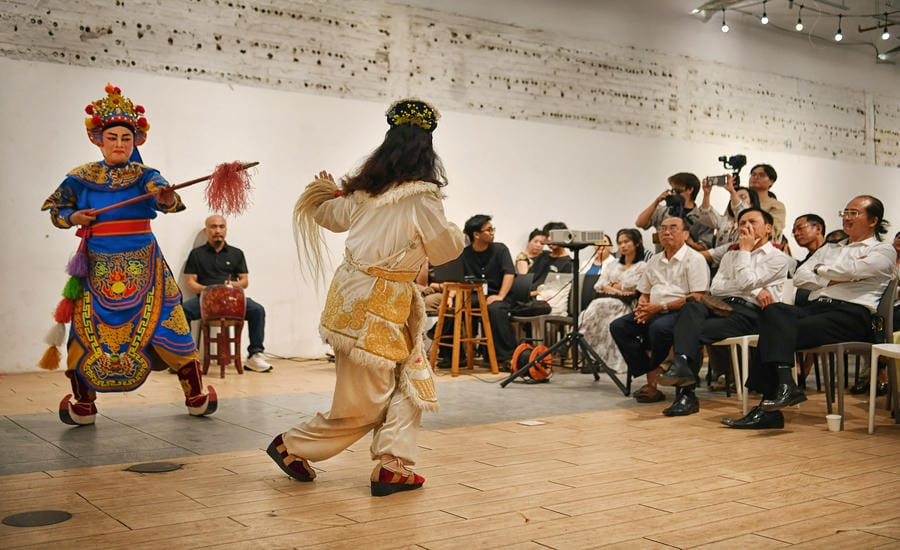
However, it is necessary to be wary of turning heritage into a "strange specialty" just to stimulate temporary curiosity. If we just stop at showing off strange features, we will only create short-term attention and cannot establish long-term artistic value.
The goal is not to make the audience admire the strangeness of Tuong and Cheo, but to make them feel the beauty and depth of it.
Need "Cultural Architects" and a synchronous Ecosystem
To go from "strange" to "good", from "good" to "understanding", and from "understanding" to "respect", we need "cultural translators" (cultural translators). It is not only veteran artists, but also the participation of contemporary directors, curators, researchers, producers and international artists, who are capable of standing at the intersection between two cultural worlds. An international curator can place Tuong next to Noh drama of Japan or Peking opera of China to point out philosophical similarities and differences.
At the same time, it is impossible to bring heritage to the world through small, spontaneous tours. Behind an internationally renowned art scene must be a cultural industrial ecosystem from training, copyright, digital media, professional tours to connecting with prestigious art festivals around the world.
Bringing Tuong and Cheo to the world is actually not about bringing an antique item to an exhibition, but about contributing a human philosophy, a unique artistic perspective of Vietnamese people to the global cultural dialogue.


