Remarkable progress
Vietnamese publishing is making remarkable progress. According to a report by the Publishing, Printing and Distribution Department (Ministry of Culture, Sports and Tourism), there are currently 52 publishing houses operating under 49 governing agencies nationwide. In 2025, the total number of publications reached 51,574, with 543,544,860 printed copies, an increase of 0.6% in the number of publications compared to the previous year.
In which, printed books reached 42,816 titles with 457,689,857 copies, a slight decrease of 1.5% in the number of titles and 8.8% in the number of copies compared to 2024. Conversely, electronic publishing recorded significant growth, with 5,218 publications and about 35 million visits, an increase of 49.3% in the number of titles and 66.7% in visits compared to the previous year.
Other publications such as maps, calendars, and tapes reached 3,892 publications with more than 50.8 million copies, an increase of 31.8% in the number of publications.
The topic structure shows that textbooks, curricula and reference materials continue to account for a large proportion with 15,139 publications, equivalent to 32% of the total number of publications, while children's books reached 9,934 publications, accounting for about 21%.
In addition, the revenue of the publishing industry in 2025 reached about 4,165 billion VND. State budget contribution reached 532.9 billion VND, an increase of 56.9%, while after-tax profit reached 542.7 billion VND, an increase of 6.95% compared to the previous year.
Looking deeper into these figures, it can be seen that if we exclude the number of textbooks published annually, the average number of book titles from 3 copies/person each year is still very modest. This also shows that the problem of publishing today is that it has not formed a higher reading demand in the community.
One of the important orientations today is to form reading culture institutions - spaces where books are not only for "keeping" but also for "living" with the community.
These can be modern public libraries, reading rooms in industrial parks, Trade Union bookshelves, digital libraries, or open reading spaces in parks, cafes, and schools.
In Dong Thap, the model of a reading room for workers with hundreds of books has become a familiar destination after work hours. In Quang Nam, the Trade Union library with thousands of diverse books serves both workers and their families.
These models show one important thing: When books are placed in the right place: close to readers, suitable for needs, reading culture will naturally form.
Modern reading culture space is not only a place to read books, but also a place for healthy exchange, learning, and entertainment. There, books compete fairly with social networks, short videos, and online games - not by coercion, but by experience.
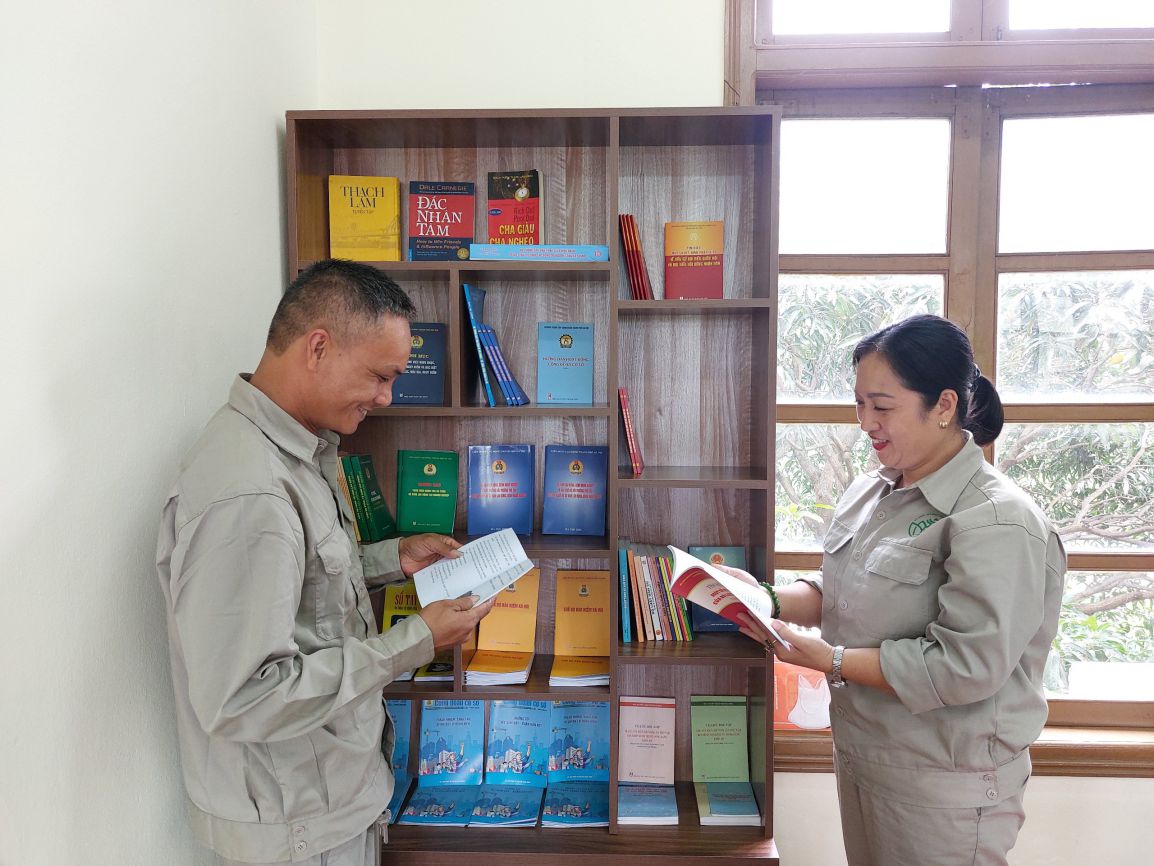
Workers' Books: From Emptiness to Potential
When talking to a reporter of Lao Dong Newspaper, writer Nguyen Binh Phuong - Standing Vice Chairman of the Vietnam Writers' Association - commented: "If you look deeper into the reader structure, you can see that there is still a paradox: There are more books but the readership is not wider, especially among the labor force. This is the largest part of society.
It is forecasted that in 2026, the national labor force (LLLĐ) will reach about 54.14 million people, an increase of more than 600,000 people compared to 2025, with a strong shift to industry, services and increased recruitment of high-quality personnel. I once directly asked a publishing business: Do you see the force of more than 50 million workers as a large and potential customer base? He just smiled and said briefly: Difficult.
The answer is also very easy to explain. After long working hours, many workers only hope to have time to rest. The living space is cramped, access to books is limited, and income must also be prioritized for essential living, making buying and reading books a luxury choice. Meanwhile, smartphones, social networks, and short entertainment videos are easier to access, faster, and less expensive.
But the reason is not only on the workers' side. The publishing market today almost does not really "look" at them as a separate group of readers. Best-selling books mainly revolve around personal development, business, life skills or entertainment, targeting the middle class, students, and office workers. Practical books for workers such as improving skills, professional skills, understanding labor laws, personal financial management skills... are still very few, not properly invested.
This leads to a vicious cycle: Without suitable books, workers do not read, but because they do not read, the market even less produces books for them.
Meanwhile, reality shows that the reading demand in this force is not small. Models of Trade Union bookshelves, reading rooms in boarding houses, small libraries in businesses in some localities have proven that. When there are suitable, free or cheap books, placed in the right place, at the right time, workers are willing to read. Books about law, life skills, parenting, family psychology or even comics and novels are welcomed.
There are many good models that have been applied such as in Dong Thap - where the city of Sa Dec (old) was once recognized by UNESCO as a global learning city. Right here, a model of reading culture with the participation of the Trade Union organization is considered a typical example learned by the Labor Federations of many localities. For example, the Reading Room for Workers in the Collective Housing Area of Dong Thap Processing and Import-Export Joint Stock Company has become an interesting destination for workers after tiring working hours. Especially, there are about 700 books of all kinds on law, cultural books, psychological books, life skills, and comics to meet the needs of updating life knowledge and entertainment for workers.
These models not only provide books, but also create a space for workers to "slow down", leave the pressure of making a living, and seek knowledge and mental balance. This shows that the problem is not that workers do not want to read, but that they do not have the conditions to read.
Another barrier that cannot be ignored is the cost of books. With limited income, spending several hundred thousand VND for a book is something that many people have to consider. Without support mechanisms from trade unions, businesses or price reduction policies for this target group, the development of reading culture among workers will be difficult to break through.
On April 1, the Vietnam General Confederation of Labor organized a Workshop to collect comments and amend the Guidance on implementing Decision 1268/QD-TTg of the Prime Minister approving the program "Promoting lifelong learning activities among workers at enterprises to 2030". At the workshop, Vice President of the Vietnam General Confederation of Labor Ngo Duy Hieu said that after 3 years of implementation, the Trade Union has launched a self-study movement, many models have appeared and organized training for many turns of trade union officials. This is the basis for the movement of self-study, regular learning, learning everywhere, all the time to help workers improve their qualifications and meet new requirements to spread.
However, if only stopping at "bringing books to" is still not enough. Another important direction is "to make workers become writers". Reality from writing contests on workers and trade unions shows great potential from the people involved. They have real experiences, real stories, real emotions. These are factors that not every author can reproduce.
When workers write books, they not only enrich literary life but also contribute to creating works that are close, accessible, and meet the needs of their own community. That is also a way to bring readers back to books, with their own stories.
Further back, the story of workers' reading culture is not only a cultural issue, but also a human resource development issue. A working force that knows how to read, has reading habits and reading skills will have better self-learning ability, adapt faster to changes, and improve productivity and quality of work.
In the context of digital transformation, green economy, and increasingly high skill requirements, learning cannot stop at schools. Workers need to learn throughout their lives, and books are the most important tool to achieve that.
But reading habits cannot be formed at adulthood if not sown early. Survey figures show that the percentage of students who do not like reading books is still high. This poses a requirement to start from schools, from regular reading sessions, from building a friendly, pressure-free reading environment.
When a child develops a reading habit, grows up to become a worker, that habit will continue to be maintained. And when millions of workers have a reading habit, then reading culture truly becomes the foundation of society.
It is also necessary to frankly recognize that, in the age of technology, books are competing with many other forms of entertainment. But technology is not a competitor to books, but can become a supporting tool. Electronic books, audiobooks, and digital libraries can help workers access knowledge more easily, more flexibly, and in a time-limited manner.
The issue is to build a modern publishing ecosystem, connecting publishers, technology businesses, libraries and readers, so that knowledge is not "framed" in paper books.
Finally, the story of workers' reading culture needs to be seen as part of a larger strategy: Building a learning society. A society in which learning is not limited by age, occupation or circumstances, but becomes a natural need of each person.
Books are not only products of the publishing industry, but the foundation of human development. And if you want to build a truly learning society, you cannot ignore the "low-lying area" named the worker - where, if filled with knowledge, it will create the strongest driving force for the sustainable development of the country.
Opening the runway for publishing
Many opinions worry that in the era of AI, social networks and short videos, reading will decline. But the reality in developed countries shows the opposite: The more technology develops, the higher the demand for reading. Books today are not just paper books. Ebooks, audiobooks, podcasts... are expanding access to knowledge. A digital library can bring thousands of books to readers with just a small device.
If invested in the right direction, technology will become a powerful tool to support reading culture to reduce access costs, increase convenience and expand the reader base. The important thing is to build a synchronous digital publishing ecosystem, connecting publishers, libraries and readers.
Many Resolutions and Directives of the Party issued recently are aimed at improving and developing culture for the people, including improving culture, creating a foundation for self-learning for workers and laborers. That is Resolution 80 on developing Vietnamese culture. The Resolution sets out the requirement: "Promote propaganda and education on culture regularly, continuously, and effectively, in which the press and publishing play a core role. Diversify communication methods, focus on modern communication forms, especially digital communication. Create and orient a healthy cultural, information, and taste environment".
Following that, the Secretariat issued Directive No. 58-CT/TW on strengthening the Party's leadership over propaganda and political, ideological, and legal education for workers in the new situation. The Directive set out the requirements: "Consider political and ideological education as the basis; legal education, cultural behavior and industrial style are fundamental; pay attention to educating civic duty, responsibility to colleagues, to trade union organizations, businesses and society; arouse the spirit of self-awareness, labor discipline, link the interests of workers with the sustainable development of businesses and the country. Apply digital technology and artificial intelligence in building and regularly updating the content of creative propaganda and educational products, which are highly interactive, widely spread, concise, visual, easy to access, associated with the actual developments of labor relations and the requirements of political tasks in each period. Flexibly combine traditional and modern, diversify methods and forms of propaganda and education to ensure practicality, persuasiveness and suitability with the awareness, working conditions, living conditions, needs, and habits of each worker group".
And recently, Directive No. 04-CT/TW dated March 17, 2026 of the Secretariat of the Party Central Committee on strengthening the Party's leadership over publishing activities in the new situation. Directive 04, although not directly mentioning the workforce and laborers, also gives directions: "Focusing investment on publishing content, becoming a core product for the development of the cultural industry; expanding genres and new topics with ideological, scientific, and aesthetic value; ordering valuable scientific works and literary and artistic works that are worthy, meeting the needs of knowledge and healthy entertainment of the people".
The Directive sets out the goal that by 2030, reading culture will be strongly promoted, cultural institutions will be formed, creating a space for reading, learning, and creativity in the community, towards building an all-people reading movement. Thus, the set goal is not qualitative but specific, which is to care for nurturing and developing reading culture in all classes of people. "Forming institutions" means putting in the political system institutions, modern and friendly reading and entertainment cultural spaces, promoting the essential role of books in social life.
These are clearly major orientations in the field of culture in general, publishing in particular, and workers will be a large force to benefit. Doing this well, we will build a learning society associated with culture. As General Secretary To Lam said in the article "Lifelong Learning": "We are living in an era where knowledge, knowledge, and understanding will help people maximize their potential to make good use of opportunities, effectively respond to challenges for sustainable development; it is also an era where the volume of human knowledge increases exponentially every day.
Only when the entire Party, the entire people, the entire army, every household, every person effectively implements lifelong learning, builds a contingent of cadres who dare to do, dare to speak, dare to take responsibility, dare to sacrifice, will we firmly move into a new era, an era of development and prosperity under the leadership of the Party.