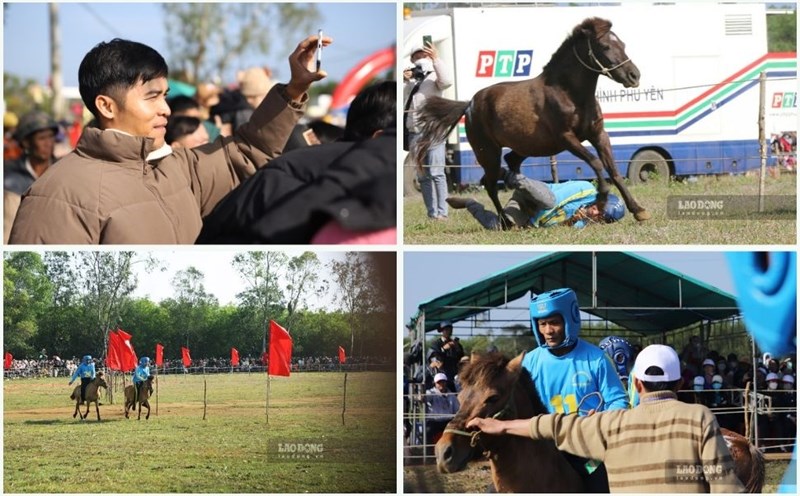
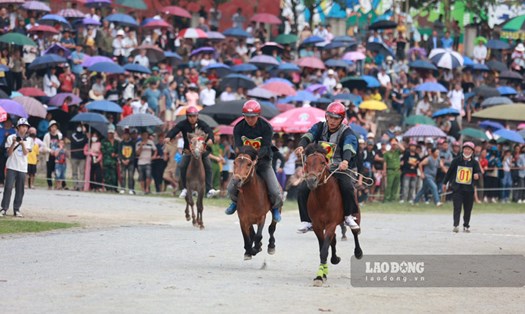
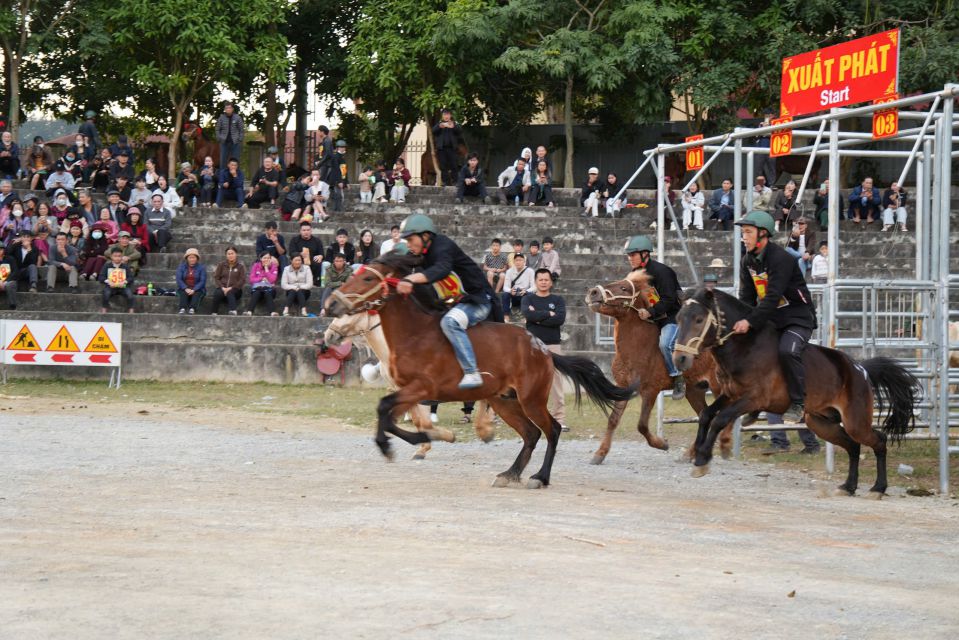
Each group of 4 racehorses brought high-speed competitions that were tense and intense at the stadium in Bac Ha commune, Lao Cai province on Saturday afternoons every week.
NOT JUST A SPORTS EVENT
A more festive than sports scene takes place in the third week of January 2026. This is the final group stage before entering the final round of the Bac Ha horse race in January. However, in the stadium, the colors of dresses of H'Mong, Tay, Nung, and Phu La girls coming to watch the horse race are brilliant.
Perhaps, watching horse racing is just an excuse, because the costumes are too gorgeous, the clanging sound from the silver jewelry attached to the skirts sounds too bustling, the baskets of mustard flowers and peach blossoms on the girls' backs are so fresh. It seems that they borrow the excuse of watching horse racing to come here to attend the Spring festival, to find the talented horseman who rides the fastest in the region to send love.
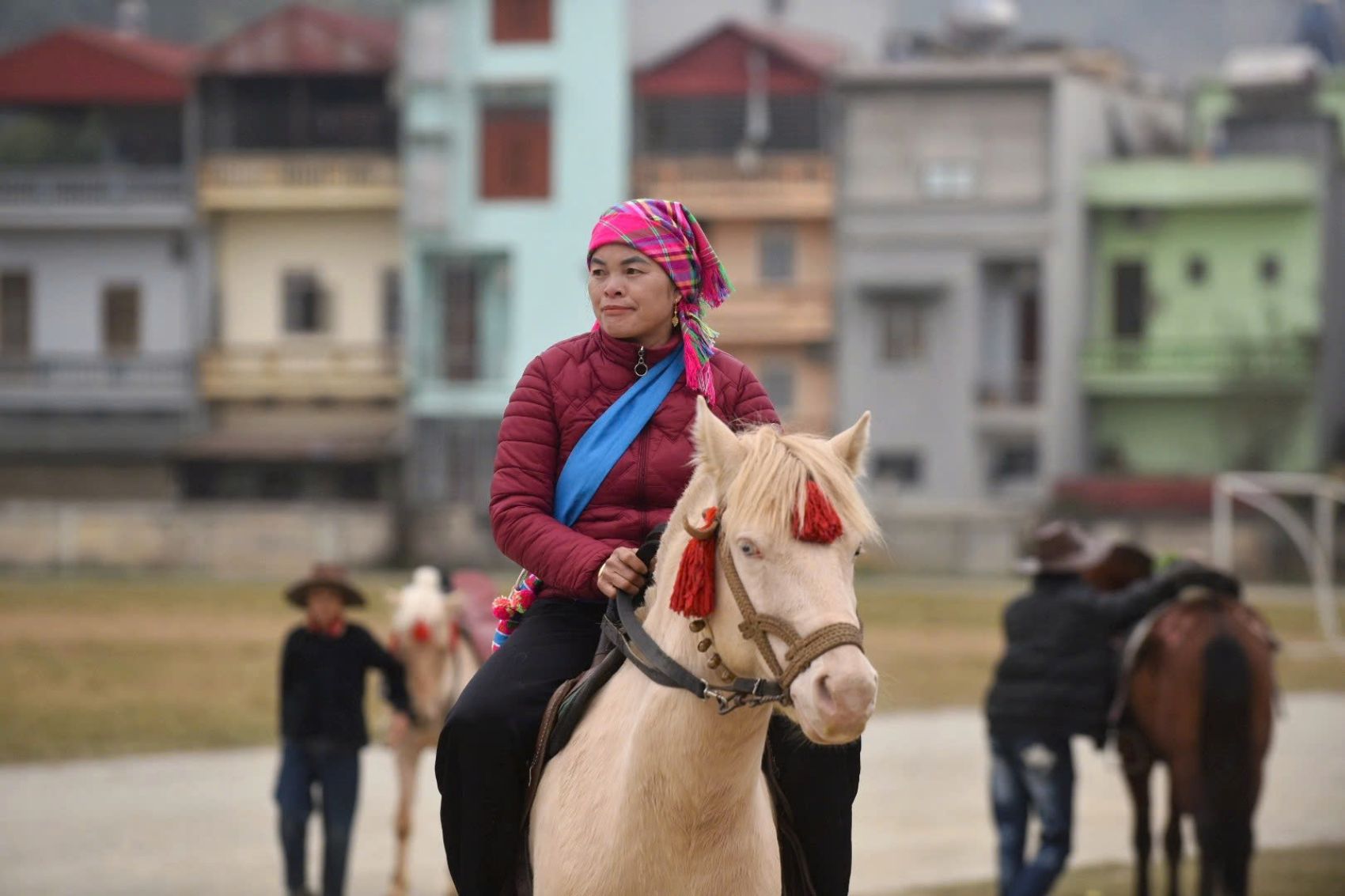
Before the horse races take place, the horse boys and girls are shimmeringly decorated with full jewelry such as fabric flowers, leather saddles, and bronze sandals have appeared according to their owners. These stylish horses are not for races but for tourism: Taking pictures with tourists or carrying tourists around the stadium.
These horses are taller and bigger than racehorses because they are hybrid horses or horses brought from other regions. And the tradition of horse racing in Bac Ha has a rule: Only purebred horses of Bac Ha are used for racing, absolutely no foreign horses are used.
How to distinguish between Bac Ha horses and horses elsewhere? It's also simple, just observe a little and you can see. The horses of the H'Mong people in Bac Ha are small, not tall, usually only about 1m3 tall and very small, very similar to the Mongolian race horse team of the Vietnamese Mobile Police Cavalry Team.
Small but martial, the Bac Ha horse breed also possesses admirable physical endurance, can climb mountains and wade through streams, go up to deep mountains, go down to deep valleys without knowing fatigue. In addition, they have quite high running speed, good sprint acceleration ability, so they are very suitable for horse racing.
Since ancient times, the H'Mong people in the Northwest mountainous region in general and in Bac Ha in particular have often spontaneously organized horse racing. They race on Spring festivals, at markets, especially at horse trading markets in Bac Ha or Can Cau to show off the qualities of good horses as well as riding skills.
Mr. Than Van Dung in Na Hoi Nung village, born in 1968, recounted: "In the old days, horse racing was a game of village men after the harvest season, whoever had a healthy horse would show off, whoever rode well would win. I have also raced horses like that many times, and also won a lot, so I got that wife.
The special feature of the race is the competition distance of 1,900m, equivalent to 4 laps of the track. This is a fairly long distance, requiring the endurance of highland horses and reasonable tactical calculations of jockeys.
Previously, the traditional Bac Ha horse race only took place in June every year and has become a major cultural event, attracting a large number of tourists. From November 2025, the commune government has implemented a weekly horse race series, associated with the activities of the Bac Ha Horse Club.
Horse racing has become a daily activity, taking place every Saturday. Each race day will consist of 32 horses, divided into 8 rounds, each round 4 horses, selecting 8 horses of the week to compete in the monthly final round. Horses must run at full distance, not break the circle (rush out of the race track), and time is counted to find the fastest horse for the purpose of qualifying for the competition.
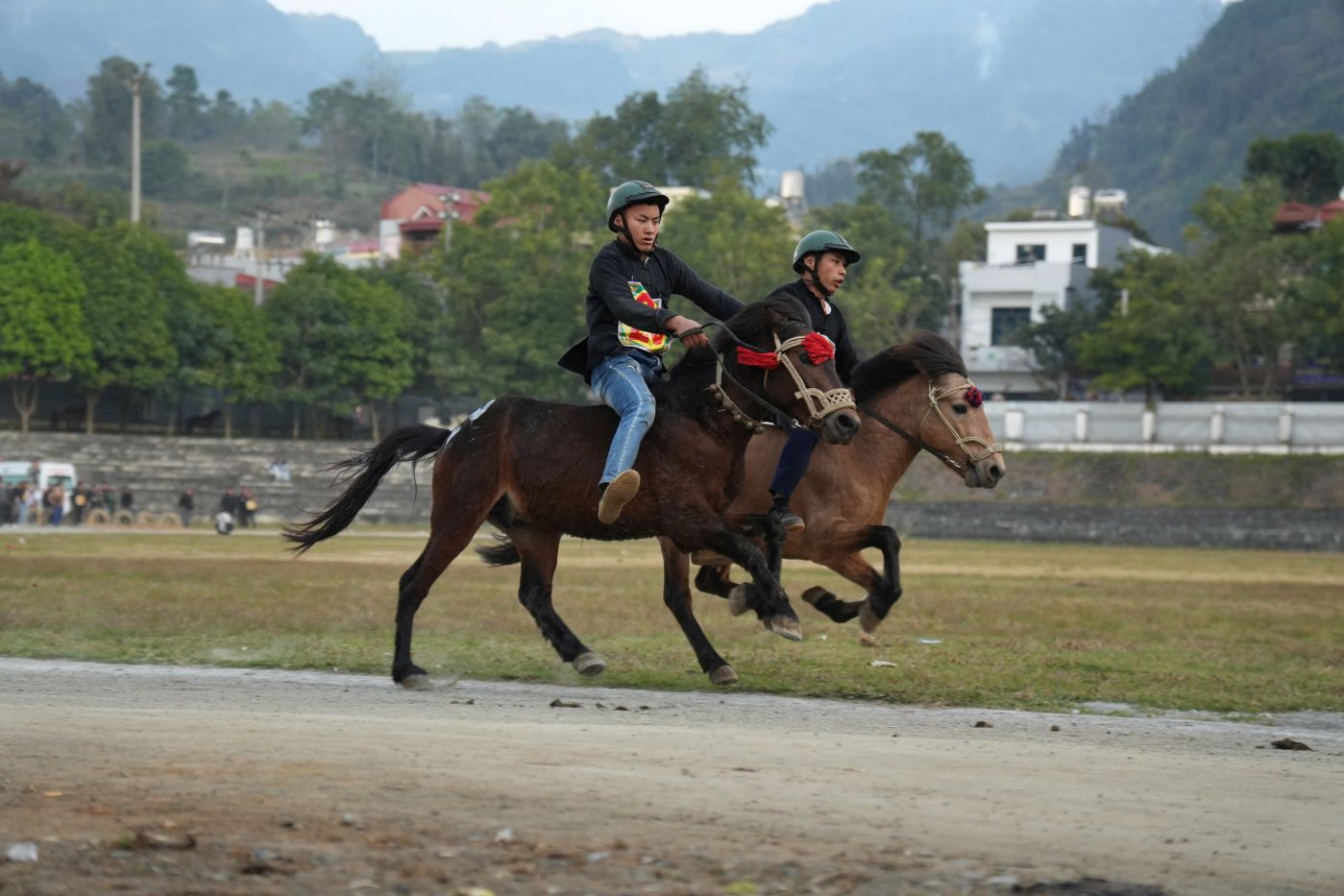
It can be said that horse racing in Bac Ha is very different from what we know about horse racing as we have seen on television. Racehorses are not equipped with saddles, no pedals, no rods to urge horses, jockeys only use a rope across the horse's neck and the ability to control by shouting, by sitting posture.
That is the horse riding technique of the H'Mong people, originating from life skills, taking the harmony between people and horses through body contact to understand commands and perform them smoothly. However, from the posture of sitting leaning back or reaching forward, the traction to both sides, the horse runs exactly according to the owner's wishes.
Horses running fast, running well is one thing, horse control skills are another. Therefore, in today's race, the audience also witnessed many "laughing to tears" scenes when horses did not listen to jockeys due to poor control skills, just rushed out to break the circle or stopped without running anymore.
But it is also thanks to this that laughter is always overflowing in the horse race, alongside the tense atmosphere of the sprint races. On the simple stands consisting only of concrete tape as seats, cheers are always echoing, especially when the horses of our village accelerate.
THE ROLE OF HORSES IN THE PEOPLE OF BAC HA
If people in the lowlands have a saying: "A buffalo is the head of the business", then for the people of Bac Ha mountainous areas, the role of the horse is even higher. Horses are not only plowing and tilling the land, but also the main force transporting goods in the family. Having a horse in the house, you can live peacefully, without worrying about anything.
The road terrain here is very difficult and dangerous, so horses are the main means of transportation, like bicycles and motorbikes in the lowlands. In the past and now, horses are still a powerful "comrade" of border guard soldiers every time they patrol the border or transport military supplies.
Going to the mountainous region of Bac Ha, Sa Pa, you often see the scene of a drunk husband lying precariously on a horse's back, next to a pile of goods, while the wife keeps clinging to the horse's tail to let the horse "follow the old path" and lead it home.
Therefore, when conditions permit, people will definitely have to buy a horse at Bac Ha market, Can Cau market, which are the two largest horse trading centers in Vietnam. And when you have to sell a horse, it means that the horse owner has already encountered great difficulties, extremely desperate and reluctant.
Now, the roads are much better, remote villages and hamlets also have concrete roads, and the prices of motorbikes and cars are cheap, so people stop using horses for those purposes. The role of horses gradually faded, until the day the horse racing custom was officially and regularly organized. The horse market now sells horses for racing.
Therefore, the racehorses in Bac Ha are also cargo horses, plowing horses, not special breeds specialized for racing. And jockeys are not professional racers but farmers, genuine village boys - people who have been attached to horses since childhood.
Horse racing revived the value of Bac Ha horses, and horses brought a new livelihood for people, which is tourism. Currently, Bac Ha has a Bac Ha Horse Club chaired by Mr. Than Van Duy. This Nung boy is the son of Mr. Than Van Dung mentioned above.
Duy has been attached to horses and knows how to ride horses since he was a child, but now, he is focusing on horse tourism. Bac Ha Horse Club consists of 50 members, who are also jockeys in horse racing performances. Every day, they take care of horses, practice horse racing, and also open horse riding classes for tourists, leading horses to take tourists on trekking to sightseeing spots.
Duy also opened a single homestay in Na Hoi Lung village that uses horses as tourism products. Guests staying here are cared for horses, trained to ride horses in the horse training ground located in the middle of the homestay, surrounded by plum trees that are blooming white, a color that has created the nickname Stone Plateau for Bac Ha.
Horses and horse racing specialties have turned Bac Ha into an attractive tourist destination, diversifying the tourism products of Lao Cai province. Now, people go to Sa Pa for relaxation, to Y Ti for mountain climbing and cloud hunting, and to Bac Ha to admire plum blossom forests, attend Bac Ha and Can Cau fairs to ride horses and watch horse racing.
As Duy shared, since his family's homestay went into operation from May 2025, the number of guests has been increasing and stable, not only on weekends but also on weekdays. Most tourists staying here experience the horse tourism products provided by homestays, not stopping at the goal of eating and resting.
Clearly, horses have brought new life to Bac Ha tourism, a place that was once just a stopover for tourists after leaving Sa Pa. The appearance of the Bac Ha Horse Club and weekly horse races have shown the seriousness of the government and people of Bac Ha in doing tourism.
The number of members including 50 people is enough to provide horses and jockeys for races, allocate race slots so that race horses are uniform, not overloaded or exhausted. Moreover, the training of horse care, riding, and horse racing skills is also done methodically to ensure the best service quality.
THE BOATS OF TRADITION AND THE NEW SPRING
In the new year Binh Ngo 2026, Bac Ha horse hooves become even more bustling. From a small community activity, Bac Ha horse racing has now become a unique cultural tourism product. Bac Ha commune authorities are trying to professionalize the organization of horse racing but are determined to preserve the soul of thousands of years of tradition.
Traditional rules such as only using Bac Ha horses, only horse racing without saddles are top criteria. Thanks to that, Bac Ha horse racing is increasingly attracting many tourists who regularly come here to watch horse racing, while also showing off the beauty and skill of Bac Ha horses and jockeys.
Thus, Bac Ha horse racing is not just a sport, but a way to preserve the soul and quintessence of indigenous culture. I have seen those things in the concrete stands, where Vietnamese and foreign tourists are excitedly cheering for each race with amazed eyes.
“It's wonderful, I can't see anywhere else besides Bac Ha racing horses like this,” excitedly described Mr. Thomas Murrilo - a Spanish tourist. “The riders are so brave, they sit on horseback without a saddle but still skillfully control the horse to run at a wind-breaking speed.
I have watched horse racing in Spain - my homeland, in England, in France, but I find horse racing in Bac Ha the most special. Wild, strong but very real horse racing scenes, including horses causing trouble. Even better when I learned that jockeys are just amateurs, and they race for national tradition, not for money.
Listening to those confidences, in fact, the prospect that one day, Bac Ha is bustling with the sound of horses neighing, the sound of hooves trampling, shaking the ground suddenly appeared before my eyes.