
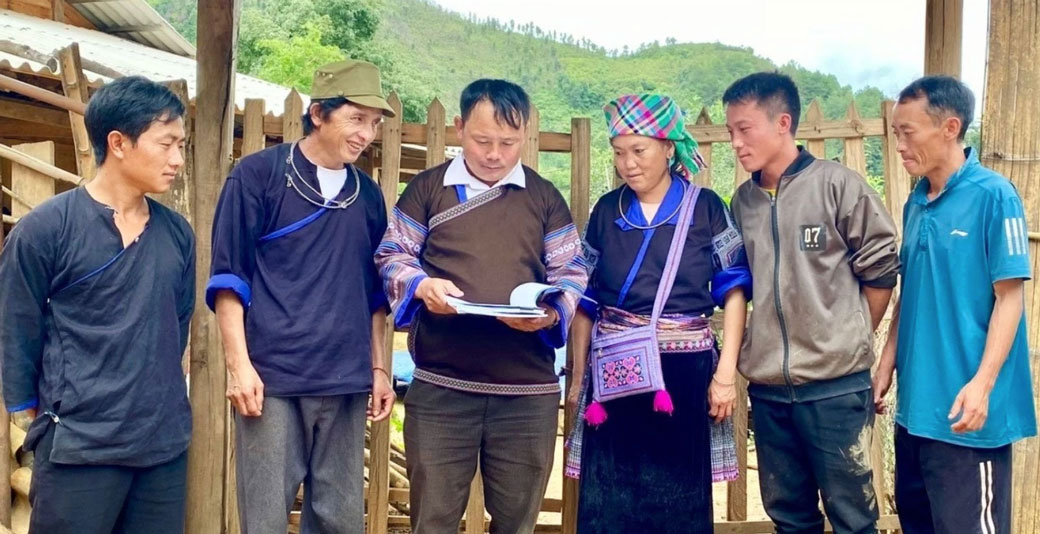
Early in the morning in the border commune of A Mu Sung, clouds still covered the mountainsides along the Red River. In a wooden house located precariously on the hillside, Mr. Sung A Chu carefully poured a cup of hot tea and slowly told about the changes in the village after many years of electricity, roads, and livelihood support programs for people in remote areas.
In the past, dirt roads were muddy, people walked all day to get to the commune center. Now with concrete roads, children going to school are more convenient, and people selling agricultural products is also much easier," Mr. Chu said.
As a reputable person in the H'Mong ethnic community, Mr. Chu said that before the 11th National Congress of the Vietnam Fatherland Front, term 2026-2031, what border people expect most is for the Front to continue to be close to the people, listen to voices from the grassroots level and become a "bridge" connecting ethnic groups in the border area.
People hope the Fatherland Front will pay more attention to the lives of people in mountainous areas, especially jobs and livelihoods for young people. When ethnic groups are united, the border will be peaceful and life will develop," Mr. Chu shared.
In Y Ty commune, where many Ha Nhi people live, Ms. Ly Mi Do is busy welcoming tourists to experience homestay. Few people know that a few years ago, her family was still in difficult circumstances, mainly living on corn fields and small-scale farming.
“Being mobilized by commune officials, the Fatherland Front and mass organizations, my family boldly develops community tourism. Now life is more stable, there is more income to raise children to study,” Ms. Do recounted.
According to Ms. Do, the most precious thing is that the movements launched by the Front have changed people's awareness of environmental protection, national cultural preservation and building a civilized life in the highlands.
People hope that the new term will have more programs to support highland youth in vocational training, tourism, and economic development. With stable jobs, young people will not leave the village," she added.
Not only in Y Ty or A Mu Sung, many border communes of Lao Cai province have now had clear changes. Border self-management models, population solidarity groups, and groups helping each other develop the economy are increasingly effective, contributing to maintaining security and order and strengthening solidarity between ethnic groups.
Along the border line of more than 180km adjacent to China, Lao Cai still has many villages far from the center, and people's living conditions are still difficult. For the people here, the Front is not only an organization to mobilize the masses but also a place to send thoughts and aspirations.
According to many grassroots officials, in the context of the border region still facing many difficulties, the role of the Fatherland Front has become even more important in gathering people's strength, creating social consensus and consolidating the "people's heart formation" in the Fatherland's fence.
Great solidarity houses, concrete roads or livelihood models supported not only help people stabilize their lives but also become evidence of solidarity and sharing among the community.


