
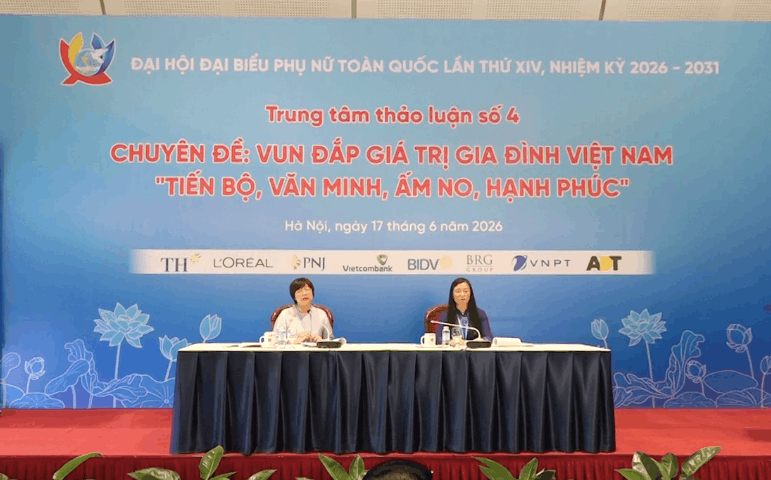
On June 17, at the 4th Discussion Center of the 14th National Congress of Women's Deputies, delegates focused on exchanging views on the topic "Building the values of progressive, civilized, prosperous, and happy Vietnamese families".
In which, the addition of the "3 safety" criterion to the "5 no, 3 clean" model is considered a suitable direction in the face of new challenges of society and the digital environment.
Supplementing the "3 safetys" criterion to adapt to new challenges
The discussion session was co-chaired by Ms. Nguyen Thi Thu Hien - Vice President of the Vietnam Women's Union and Ms. Khuc Thi Hoa Phuong - Member of the Presidium, Director - Editor-in-Chief of the Vietnam Women's Publishing House.
According to Ms. Ninh Thi Thu Huong - Director of the Department of Grassroots Culture, Family and Library (Ministry of Culture, Sports and Tourism), many models of the Vietnam Women's Union such as "5-no, 3-clean family", "Reliable address in the community" or happy family building clubs have brought positive effects in reducing domestic violence, improving the quality of life and promoting gender equality.
However, the current reality shows that the divorce rate tends to increase, domestic violence is still complicated, while the impact of social networks and the digital environment is increasingly widespread.
In that context, Ms. Huong proposed to upgrade the "5 no, 3 clean" model to "5 no, 3 clean, 3 safe", including safety, peace of mind and social security.
According to her, these will be appropriate criteria to build a family environment without violence, create a healthy living space and digital environment, and ensure care services for children, the elderly and vulnerable groups.
In addition, many opinions also expressed concern about population fluctuations that are directly affecting Vietnamese family life.
Ms. Nguyen Thi Nga - Deputy Director of the Department of Mothers and Children (Ministry of Health) said that the birth rate is decreasing below the replacement level, while the situation of late marriage, fewer births and population aging is increasingly clear, posing many new requirements for care, nurturing and education in the family.
Creating conditions for ethnic minority women to become development actors
At the discussion session, delegates also spent a lot of time discussing the role of ethnic minority women in the new development stage.
According to Ms. Nong Thi Ha - Deputy Minister of Ethnic Minorities and Religions, ethnic minority women are increasingly affirming their position in economic development, preserving cultural identity and participating in the political system.
However, many barriers to education, employment, income and access to social services still need to be removed.
Delegates believe that ethnic minority women need to be given more opportunities to become the subjects of the development process instead of just being policy beneficiaries. To do so, it is necessary to promote investment in education, illiteracy eradication, vocational training, digital skills improvement and sustainable livelihood support.
Preferential credit programs, startup support, green economic development and e-commerce are expected to create more motivation to help women in ethnic minority areas participate more deeply in the modern economy, while continuing to preserve and promote traditional cultural values.
Concluding the discussion session, Vice President of the Vietnam Women's Union Nguyen Thi Thu Hien assessed that the opinions all showed a high sense of responsibility, contributing many practical solutions for family work and supporting women.
According to the Vice President of the Vietnam Women's Union, delegates focused on analyzing the outstanding results in supporting women to build families in the past time, and pointed out the issues posed to Vietnamese families today.
Many opinions emphasize the role of parenting skills education, protecting children from the family and strengthening inter-sectoral coordination to improve the effectiveness of supporting women to build happy and sustainable families.


