From small water pockets to green on arid land

PHƯƠNG ANH |

Can Tho - Many coastal farmers proactively dig ponds to store fresh water, maintaining production even during the dry season.

In the harsh sun of March days, the sea breeze blows through the sandy strips along the coast in Mo O hamlet, Tran De commune (Can Tho city). But in this dry land, watermelon fields are still green and lush.

Few people know that to maintain that green color right next to the sea, farmers have to find many ways to store and retain water. In the middle of watermelon fields, small ponds are dug to provide a precious source of water for the entire crop season.
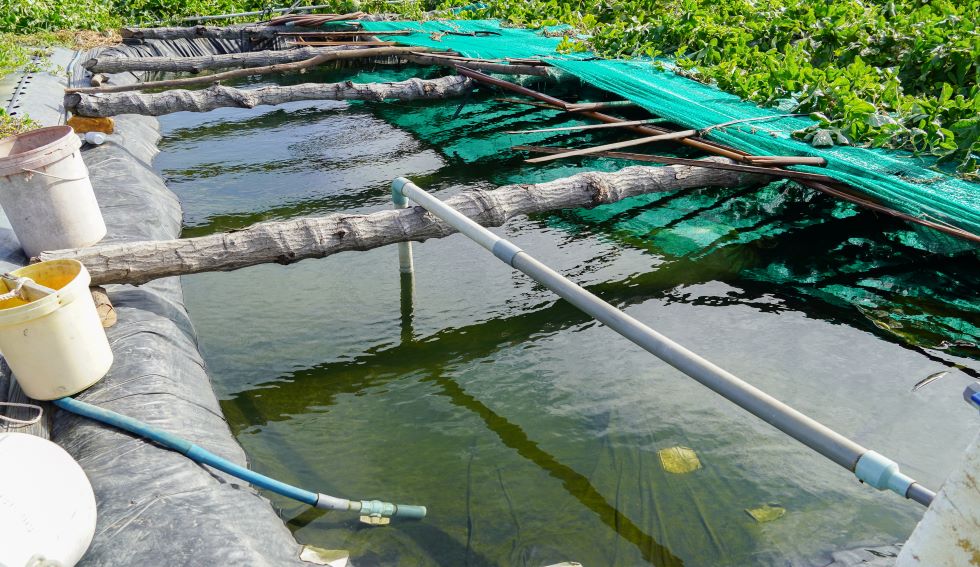
Ao lót bạt trữ nước giữa ruộng dưa ở vùng đất cát ven biển giúp nông dân chủ động tưới trong mùa khô. Ảnh: Phương Anh
Ponds with tarpaulins to store water in the middle of watermelon fields in coastal sandy land help farmers proactively irrigate in the dry season. Photo: Phuong Anh

Ms. Nguyen Thi Hieu, a farmer in Mo O hamlet (Tran De commune, Can Tho city), said that her family has been attached to the coastal melon growing profession for more than ten years. Each year, she grows about 3 melon crops, or 2 melon crops interspersed with 1 peanut crop to improve the soil.

According to her, the coastal sandy land is very difficult to retain water, while the dry season is increasingly prolonged. Therefore, to maintain production, her family and many farmers in the area have dug small ponds right in the fields, laid tarpaulins to store fresh water. When there is rainwater or water is pumped into the pond, people keep it for gradual use. In addition, many households also draw water pipes from their houses to the fields and install drip irrigation systems to save every drop of water.

“Water tap money alone costs about 2 million VND per crop. But if you don't proactively store water, watermelon plants will be uncomfortable in the coastal sun and wind,” Ms. Hieu shared.
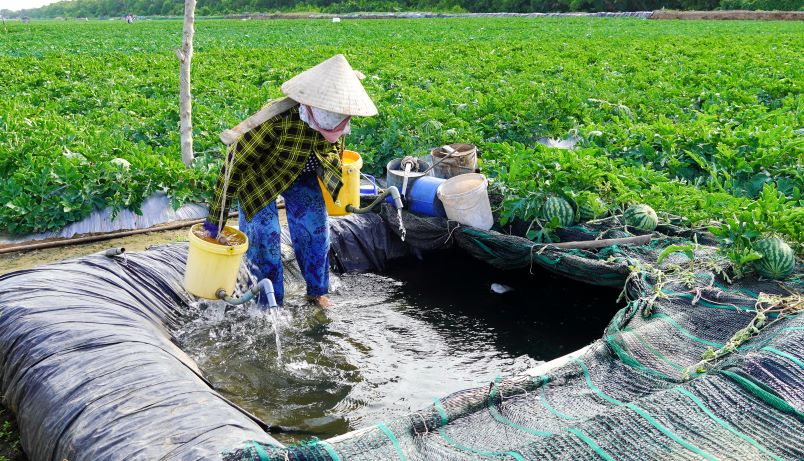
Các ao trữ nước nằm xen giữa ruộng dưa giúp bà con duy trì sản xuất trong điều kiện khô hạn. Ảnh: Phương Anh
The water storage pond is an important irrigation water source for Ms. Hieu's watermelons. Photo: Phuong Anh

In the sandy land rows in Vinh Chau area - famous for the purple onion growing profession - small ponds located next to onion fields are also familiar images.

Mr. Trieu Thanh Hung, a farmer in Vinh Chau ward (Can Tho City), said that most onion fields have at least one water storage pond. Initially, people dug ponds to get soil to build fields higher to avoid flooding. However, later, these ponds became important reserve water sources in the dry season.

According to Mr. Hung, the ponds in the fields are usually about 2–3m wide, 4–8m long and about 2m deep. The ponds both store rainwater in the rainy season and help concentrate water to pump out into the river when it rains heavily. In the dry season, water from drilled wells is pumped into the ponds and then gradually used to water onions.

The weather is more erratic now than before. With a water storage pond, we are much more proactive, both fighting drought and preventing flooding for the onion field," Mr. Hung said.
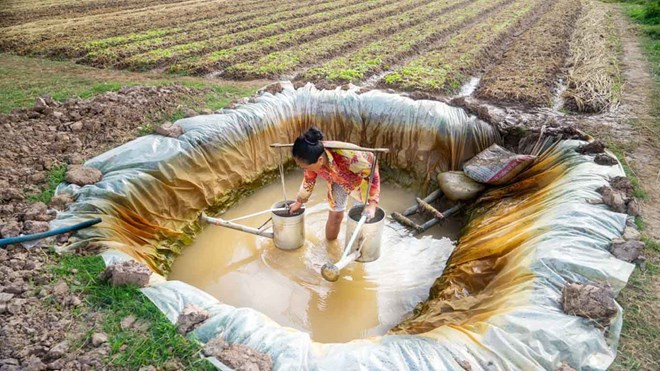
Người dân Vĩnh Châu (TP Cần Thơ) đào ao lót bạt để trữ nước phục vụ sản xuất. Ảnh: Phương Anh
Vinh Chau people (Can Tho City) dig ponds lined with tarpaulins to store water for production. Photo: Phuong Anh

Similarly, in the watermelon fields of many households in Long Phu and Tran De areas, people directly dig many small ditches to lead water from the irrigation canal to the fields.

Mr. Son Phuol in Tai Van commune (Can Tho City) said that bringing water to the fields both has fresh water for irrigation and saves effort and time because the canals are quite far from the fields. With this approach, the family always has a stable income from growing watermelons in the dry season.
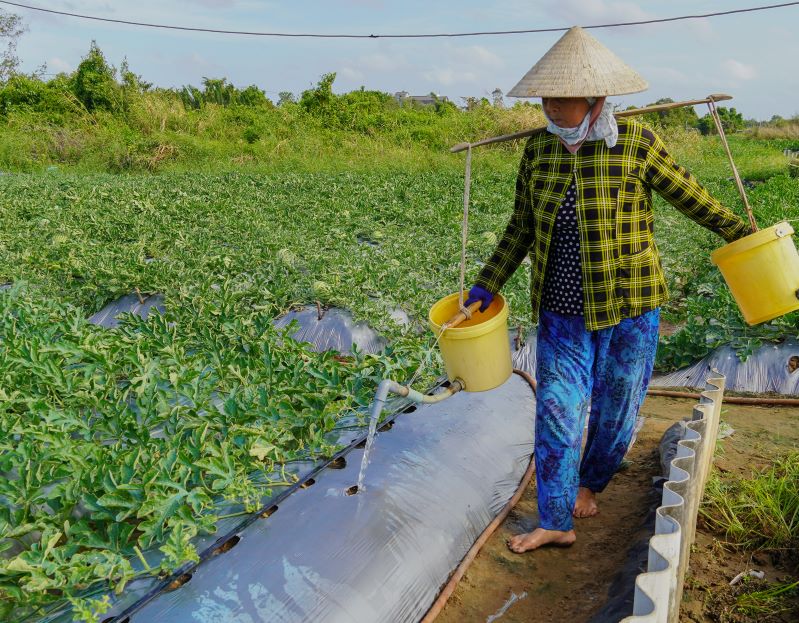
Nhờ chủ động trữ nước, nhiều ruộng dưa trên đất cát vẫn xanh tốt trong mùa nắng gắt. Ảnh: Phương Anh
Thanks to proactively storing water, many watermelon fields on sandy land are still green and lush in the harsh sunny season. Photo: Phuong Anh

According to Assoc. Prof. Dr. Le Anh Tuan - Senior Lecturer of the Faculty of Environment and Natural Resources (Can Tho University), to cope with the increasing saltwater intrusion, Mekong Delta localities need to prioritize planning and protecting raw water sources, building reservoir systems as well as inter-regional water supply networks, instead of mainly relying on small-scale water supply stations as before.

Assoc. Prof. Dr. Le Anh Tuan said that it is necessary to promote non-constructive solutions such as using water sparingly, collecting and storing rainwater, and reusing water in production. At the same time, it is necessary to strengthen communication to help people better understand the fluctuation of water sources and proactively adapt in daily life as well as production.

PHƯƠNG ANH
RELATED NEWS

Staying up all night to collect clean water during the peak dry season, saltwater intrusion

|

At the peak of the dry season and saltwater intrusion, many households in many communes in Can Tho City lack clean domestic water, have to stay up all night to collect water and use alum-deposition river water for use.

Clean water sometimes available, sometimes not, people stay up all night waiting for each drop

|

Hundreds of households in Bung Triet hamlet, Lieu Tu commune (Can Tho City) are living in a situation of clean water shortage, especially serious in the dry season and during Tet.

An Giang invests more than 1,450 billion VND in clean water service projects

|

An Giang - To ensure that the proportion of rural residents using clean water meets standards, it is necessary to have construction and non-construction solutions.

Vietnamese artists send their faith

|

As voters across the country look forward to the election day of the 16th National Assembly deputies and People's Council deputies at all levels for the 2026 - 2031 term, in the general flow of society, many artists working in the field of culture and art also expressed their feelings before holding the ballot in their hands.

The night before the election and people staying up with their votes

|

Can Tho - Security teams at the polling station quietly guarded overnight, contributing to maintaining safety for the election day.

Ho Chi Minh City builds 6 metro lines by 2030, inviting 7 ministries and sectors to support

|

Ho Chi Minh City sets a target to complete 6 metro lines before 2030, and at the same time invites 7 central ministries and sectors to participate in the appraisal team for bidding packages.

The joy of the first time going to the polls of young soldiers in Dak Lak

|

Dak Lak - Young soldiers express joy and pride when for the first time in their lives holding a ballot to fulfill the rights and responsibilities of citizens.

Ho Chi Minh City center is about to have an underground parking lot and a multi-story parking lot

|

Ho Chi Minh City - Ho Chi Minh City Center will build underground parking lots and multi-story parking lots to meet parking needs, limiting the situation of occupying roads and sidewalks.

Staying up all night to collect clean water during the peak dry season, saltwater intrusion

HẬU GIANG |

At the peak of the dry season and saltwater intrusion, many households in many communes in Can Tho City lack clean domestic water, have to stay up all night to collect water and use alum-deposition river water for use.

Clean water sometimes available, sometimes not, people stay up all night waiting for each drop

HẬU GIANG |

Hundreds of households in Bung Triet hamlet, Lieu Tu commune (Can Tho City) are living in a situation of clean water shortage, especially serious in the dry season and during Tet.

An Giang invests more than 1,450 billion VND in clean water service projects

NGUYÊN ANH |

An Giang - To ensure that the proportion of rural residents using clean water meets standards, it is necessary to have construction and non-construction solutions.