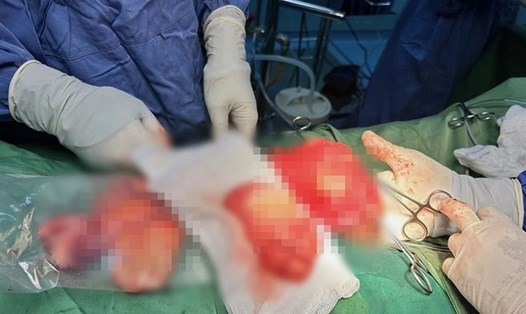
The male patient, 33 years old, was hospitalized with right scrotum pain and fever. It is worth mentioning that before that, the patient had noticed that his right scrotum was larger than normal for about 6 months, but due to no pain or discomfort, he did not go for examination.
According to the patient, the change in scrotum size occurred gradually, without obvious symptoms, so the patient thought it was just a mild abnormality, not worrying. Only when pain and fever appeared did the patient go to the hospital for examination. This is also a fairly common psychology in many young men, when the initial signs are not obvious, they are often easily overlooked.
According to MSc.BS. CK1. Tran Quoc Phong, Head of Urology Unit, An Binh Hospital, through clinical examination combined with femoral ultrasound and computed tomography, doctors recorded suspected images of tumors accounting for more than 70% of the right testicle. Faced with the risk of malignant disease, the patient was indicated for surgical removal of the right testicle according to the principle of testicular tumor treatment.
The case of the 33-year-old patient shows a noteworthy problem in the community that many people are still subjective about abnormal changes in the intimate area. Many men believe that only when they have pain do they need to be examined, while in reality, many testicular diseases, especially tumors, can develop silently without causing pain in the early stages.
Dr. Phong emphasized that the testicles are an easy organ to observe and self-examine. Regular self-examination can completely help detect abnormalities early.
An important point to understand is that testicular tumors are common in young men, aged 20 to 40. This is an age group that tends to rarely go for periodic check-ups and easily overlooks initial symptoms. As the disease progresses, patients may experience pain, swelling, or systemic signs such as fever, fatigue, but at this time treatment may have become more complicated.
According to Dr. Phong, removing the diseased testicle is a standard treatment for suspected malignant testicular tumors. This is to completely remove the tumor and prevent the risk of spreading.
The good news is that in many cases, if detected early and treated promptly, patients can still maintain normal life. The remaining testicles have the ability to perform the function of producing testosterone and sperm, helping to maintain physiology and fertility at a certain level.