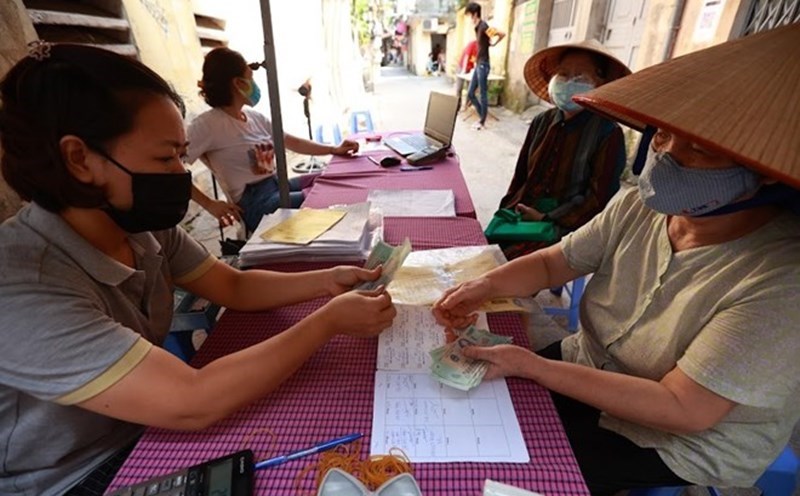
The Ministry of Health is urgently completing the impact assessment of resources from the state budget and the health insurance fund to implement specific allowance policies in the health sector, including monthly support for village and residential group health workers and village and hamlet midwives.
According to the Ministry of Health, accelerating the progress of completing the draft decree on professional preferential allowances for officials and employees at public health facilities, along with the draft decree stipulating a number of specific allowances in the field of health and monthly support for village health workers, residential groups, and village and hamlet midwives, is a step in implementing major policies of the Central Government and the Government.
The Ministry of Health requests units to continue to carefully review the draft, clearly identify the needs, sources and payment methods for each policy group, including professional allowances, on-duty regimes, surgery, procedures, as well as regimes for village and residential health workers and village and hamlet midwives according to the base salary level.
According to the Ministry of Health, the Ministry is proposing to increase the monthly support level for village, hamlet, residential group health workers and village and hamlet midwives. If approved, about 120,000 people nationwide may be eligible for this policy.
The Ministry of Health has drafted a decree related to allowances and support policies for human resources in the health sector.
According to the draft, the monthly support level for village and residential group health workers and village and hamlet midwives will be calculated according to the base salary.
A support level equal to 0.7 times the base salary will be applied to villages with 350 or more households, residential groups with 500 or more households, or difficult areas. The remaining areas are expected to receive a support level equal to 0.5 times the base salary.
Currently, there are about 120,000 village, hamlet, and residential group health workers nationwide participating in the community primary health care network. This is a force closely following the area, playing an important role in disease prevention propaganda, people's health management, vaccination support, disease prevention, maternal and child health care.
According to the drafting agency, the level of support for this force is currently low and unstable. In some localities, there has been a situation where village and hamlet health workers quit their jobs or have to concurrently perform many tasks, affecting the operational efficiency of grassroots healthcare.
Along with the proposal to support grassroots healthcare, the Ministry of Health is also drafting a decree on the regime of professional preferential allowances for civil servants and employees at public health facilities.
This policy is expected to be applied to many fields such as preventive medicine, medical examination and treatment, rehabilitation, traditional medicine, pharmaceuticals, cosmetics, food safety, medical equipment, medical examination, forensic medicine and some other fields of the health sector.
The draft decree clearly states the scope of regulation, principles of application, calculation of allowances, level of enjoyment, enjoyment time and source of funding for payment. The goal is to improve the legal basis for implementing preferential policies that are more suitable for the medical human resources in the public system.
Leaders of the Ministry of Health requested the drafting agency to fully absorb the comments, continue to improve the draft in a strict and feasible direction, and at the same time carefully review relevant regulations to ensure consistency with the current legal system before submitting it to competent authorities for consideration.