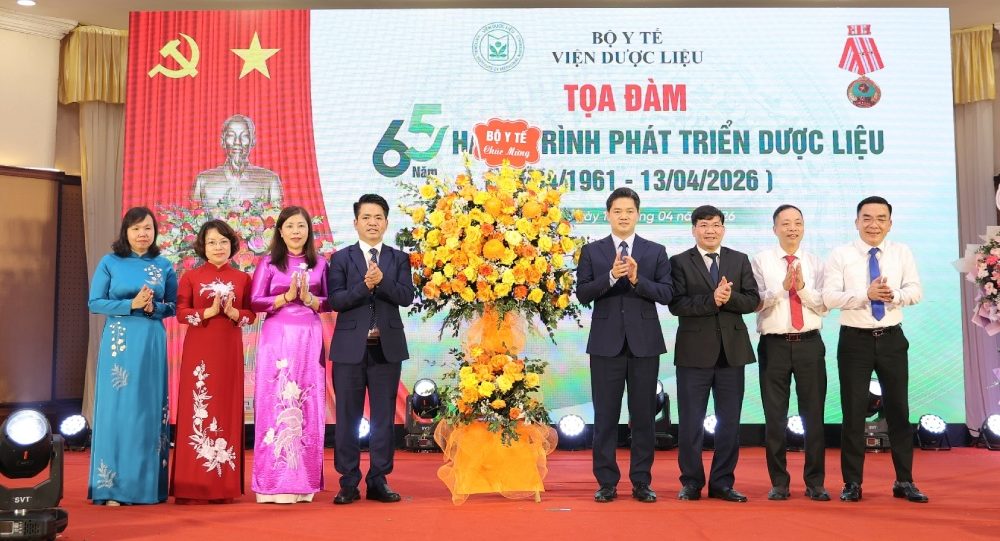
At the seminar "65 years (1961-2026) of medicinal herb development journey" of the Institute of Medicinal Materials (Ministry of Health) on April 10, Standing Deputy Minister of Health Vu Manh Ha said: Vietnam possesses abundant natural resources and a thousand-year tradition of traditional medicine knowledge. With more than 5,000 species of medicinal plants, this is considered a "golden advantage" to develop the medicinal herb industry in a modern direction, contributing to improving the quality of health care and promoting economic growth.
According to leaders of the Ministry of Health, in the context of increasing demand for medicinal herbs, promoting the existing potential efficiency not only helps reduce dependence on imports but also opens up a sustainable direction for the domestic medical and pharmaceutical industry.
Dr. Tran Minh Ngoc - Director of the Institute of Medicinal Materials - said that the value of science does not only stop at publications but must create specific effects in practice.
Accordingly, products from medicinal herbs need to be clearly proven for clinical effectiveness and safety, meeting increasingly strict standards of the health system. At the same time, the development of medicinal herbs must be linked to economic goals, transforming indigenous resources into products with high added value.
Not only bringing economic value, the medicinal herb industry also has profound social significance when creating sustainable livelihoods for people, especially in mountainous areas - where many precious resources are concentrated. This is considered an important direction to harmonize preservation and exploitation, towards long-term development.
In the context of the 4.0 Industrial Revolution, technologies such as Omics, artificial intelligence (AI) and big data are opening up new opportunities for the pharmaceutical industry. These technologies not only help improve research efficiency but also create conditions for Vietnamese pharmaceuticals to gradually access and conquer the international market.
Recognizing and congratulating the outstanding achievements that generations of officials, employees, and laborers of the Institute of Medicinal Materials have achieved throughout the journey of construction and development, the Deputy Minister of Health emphasized that in the past time, the Institute has implemented many activities to investigate, collect, conserve and develop rare medicinal material gene sources, contributing to preserving national biological resources. Many scientific and technological tasks have been effectively implemented, with research results widely applied in production and medical examination and treatment. The standardization of medicinal materials, building databases, testing and quality accreditation are increasingly focused on.
In addition, the Institute of Medicinal Materials also actively participates in building and perfecting mechanisms, policies and legal documents in the field of medicinal materials and traditional medicine; and at the same time expanding international cooperation, gradually enhancing the position of Vietnamese medicinal materials in the international arena. These results make an important contribution to the implementation of the Party and State's major policies on developing traditional medicine, developing the pharmaceutical industry and strengthening the autonomy of raw material sources for medicine.
However, according to assessments, the pharmaceutical sector is still facing many difficulties and challenges such as unstable raw material sources, scattered production scale, processing industry not developing commensurately, and limited linkages between research - production - market. The application of modern science and technology and digital transformation also needs to be further promoted.
In that context, the leaders of the Ministry of Health proposed that the Institute of Medicinal Materials focus on implementing a number of key tasks in the coming time. First of all, improve scientific research capacity, promote innovation, focus on topics with high applicability, associated with practical needs. At the same time, promote inter-sectoral research, combine traditional medicine with biotechnology and modern pharmaceutical technology, strengthen transfer and commercialization of research results.
Along with that, the Institute needs to focus on preserving and sustainably developing national medicinal material resources; building standard growing areas, associated with concentrated raw material area planning, especially in remote and isolated areas, ethnic minority areas, contributing to creating livelihoods and local socio-economic development.
Another important task is to promote the development of the medicinal material industry in a modern direction, forming a closed value chain from research, cultivation, processing to product consumption; improving testing capacity, quality standardization and building Vietnamese medicinal material brands in the domestic and international markets.
In addition, the Institute needs to promote the application of science and technology, innovation and digital transformation; build a digital database on medicinal herbs; apply biotechnology and artificial intelligence in research and quality management. The work of developing high-quality human resources is also emphasized, with the requirement to focus on training successors, attracting and retaining talents, creating a professional and creative working environment.