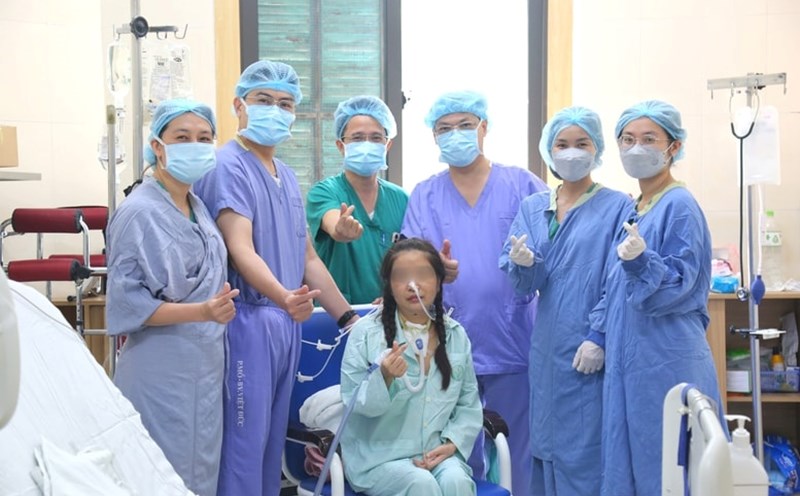
Patient P.V.S (52 years old, Lam Dong province) has had hepatitis B for 20 years but has not received treatment. In October 2025, the patient went for a health check-up and discovered a right liver tumor. To stabilize his health, the patient was fortunate to have a relative donate his liver.
After checking health indicators to fully meet the strict requirements for liver donation and transplantation, on November 7, at the Vietnam Organ Transplant Conference (VSOT 2025), Military Hospital 175 successfully performed two consecutive patients with surgical procedures to remove organs from living donors using endoscopy in the same program. And patient S. was one of two lucky patients who received intervention.
Accordingly, with the direct support of experts from the 108 Central Military Hospital, the team of the 175 Military Hospital took a piece of mustard liver completely endoscoped from a living donor to transplant to a patient with liver disease. The surgery lasted about three hours, requiring careful detailed peeling skills, controlling blood vessels and gallbladder absolutely accurately to ensure optimal piece quality.
This is an endoscopic organ retrieval technique, currently deployed in some leading centers in the US, Europe, Japan and South Korea. In Vietnam, there are three medical facilities that master this technique.
On the same day, November 7, the team of Military Hospital 175 performed an endoscopy of the kidney from a living donor, marking the 87th case performed using the endoscopy method at the unit.
opting for endoscopic surgery instead of open surgery helps reduce inflammation, less pain, reduce the risk of complications, shorten recovery time and increase patient satisfaction. The surgical patch is small, ensuring aesthetics but still maintaining optimal placement efficiency.
Dr. Nguyen Viet Cuong - Deputy Director of Military Hospital 175 - said: "This is the 11th liver transplant of Military Hospital 175, but it is the first time we have performed surgery using endoscopic technique, a difficult technique that requires high accuracy and coordination. In the coming time, we aim to apply surgical support robots, not only in liver or kidney removal, but also to serve organ transplant surgery at recipients. This will be a big step forward, requiring great effort and investment from our team.