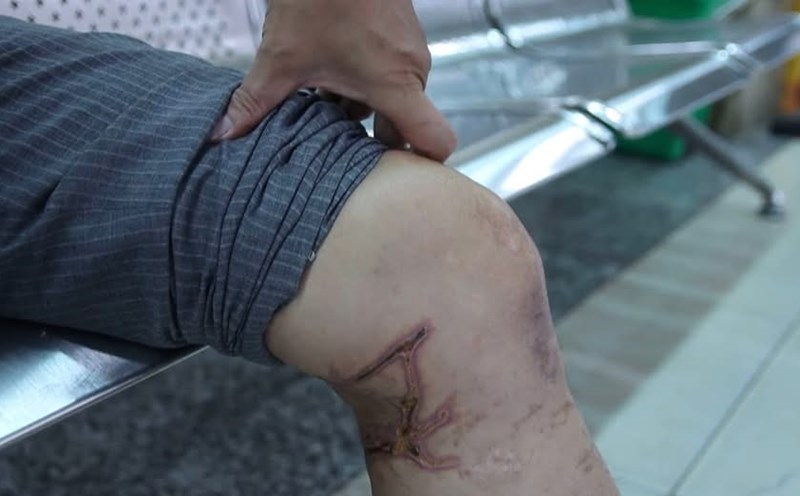
According to MSc. BSCKII. Quach Thi Ha Giang, Head of the Department of Men's Skin Disease Treatment, Central Dermatology Hospital, young children and adults come for examination and treatment with signs of lesions being red plaques and papules about 1-2mm in size, raised above the skin surface, and small blisters at the tip of the papule.
Typically, in the case of a 20-year-old young man, the disease progression showed red papules, papules with blisters, and severe itching on his hands and feet. The patient was bathed in leaves and applied leaves, the lesions did not decrease, new lesions appeared, and some lesions had blisters on the red papules.
Another case is a female patient, 50 years old, whose condition progressed for 2 weeks, with patches and red papules appearing, some papules with blisters on the surface, gradually increasing lesions, severe itching in the forearms, legs and scattered in the lower back and abdomen. Taking a history of raising 2 dogs. The patient went to the pharmacy to buy topical medicine of unknown type, the lesions did not decrease, itchyness increased, and new skin lesions were added.
Or another case is a 7-year-old child, the disease progressed for 7 days, lesions with red papules, papules with many blisters on hands, feet, buttocks, scattered in the body. The family self-applied medicine, the lesions reduced itching, but new lesions still appeared. The family has dogs and cats.
In cases with strong reactions, the skin around the papules can become inflamed and red, even forming blisters on the red skin surface. Burns are common in exposed skin areas such as hands and feet, sometimes spreading throughout the body in severe cases. People with the disease often feel very itchy, tingling, affecting daily life and quality of life.
Some patients said they had observed fleas of very small size, black or slightly reddish-brown, without wings, capable of jumping very quickly on the skin and surrounding environment such as floors, bed sheets, carpets and in pets. However, most patients and their families do not recognize the cause of the disease, and cannot rule out the cause that prevents the disease from curing, causing more and more injuries.
In addition, self-treatment with drugs of unknown origin or applying inappropriate folk methods can increase the risk of localized or spreading skin infections, making the disease condition more complicated.
Skin lesion characteristics
Fleas bite people, to suck blood causing itchy papules, dog fleas and cat fleas are common in Vietnam. The lesions are serum papules, 1-2mm in size, raised above the skin surface, the tip of the papule has small blisters, very itchy. In cases of strong reactions, it can be seen that the phenomenon of inflammation and redness spreads around the papules.
Common lesions are in exposed skin or in areas of skin that are in direct contact with animals when people hug or hold them such as: Neck area, face, arms, legs, around the back. In addition, fleas can be intermediate hosts that transmit some diseases. Eastern fleas (Xenopsylla cheopis) transmit some epidemics, fevers that last from mice to humans. Cat and dog fleas transmit tapeworm diseases from one host to another...
Characteristics of fleas
Understanding fleas is very important, helping us grasp their distribution in the world, density, disease-causing and disease-transmitting ability. Cell fleas include many species such as: Cat fleas (Ctenocephalides felis), dog fleas (Ctenocephalides canis), human fleas (Pulex irrtans), Northern rat fleas (Nosospsyllus fasciatus), Eastern fleas (Xenopsylla cheopis)... among which dog and cat fleas are the most common in our country.
Adult fleas are small in size, about 1.5-3.3mm long, dark red or black, the hind legs are variable, long, large and fat to jump. Adult fleas can jump up to 18 cm high and up to 33 cm far. Their bodies are flat on both sides, their backs have spines pointing backwards, making their activities only move forward, piercing into the host's fur and hair and helping. Adult fleas survive in the cocoon until they meet a suitable host.
Fleas are wingsless parasites, completely degenerate. The life cycle of fleas is about 20 to 35 days depending on the temperature and humidity of the environment. Fleas develop in hot and humid conditions, suitable for temperatures of 21-35 degrees Celsius and humidity of 70 - 85%. In unfavorable conditions, when the temperature suddenly drops, fleas stop developing and survive for several months to a year.
Indoor environments, fleas reproduce all year round, outdoors only develop in warm months. In the North of our country, fleas develop a lot in February and March when the weather changes from winter to spring and summer.
Doctor's advice
For people, when one of the symptoms of severe itching, red papules, papules with blisters, blisters, especially on hands, feet, exposed skin areas and the disease tends to last, new lesions appear... should go to a medical facility or dermatology specialist for examination, diagnosis and proper treatment. Do not self-treat or apply folk remedies such as self-applying medicine of unknown origin, using corticosteroids for a long time, or bathing in leaves, applying leaves without a doctor's prescription. Incorrect treatment can prolong the disease, spread it, increase the risk of skin infection, leaving scars or dark skin.
In hot and humid weather conditions, people need to pay more attention to living environment hygiene and animal care.
Rash dermatitis caused by fleas can be completely treated stably if detected early and the cause thoroughly eliminated. Treatment is only sustainable when combining proper medical care and flea control in the living environment.