Prolonged bloody stools – cancer warning sign
The patient was diagnosed with stage II rectal cancer by doctors at K Hospital after experiencing prolonged bloody stools for about a month. Thanks to intervention with modern robotic laparoscopic surgery, the surgery was successful, helping the patient recover quickly, reduce postoperative pain and ensure aesthetics as well as maximize the preservation of important nerve-vascular structures.
The patient began to experience diarrhea mixed with blood accompanied by fecal pattern disorders for about a month. However, due to subjective psychology, the patient did not go to the doctor immediately.
As the symptoms lengthened and showed no signs of improvement, the patient came to K Hospital for examination. Here, through digestive endoscopy, doctors discovered a tumor-like lesion in the high rectal, accounting for about 1/3 of the circumference of the rectal lumen. Biopsy results determined that this was rectal cancer.
Subsequent diagnostic imaging tests showed that the tumor had no signs of distant metastasis. MRI results identified the disease at stage cT3N0M0.
Consultation and indication for robot surgery
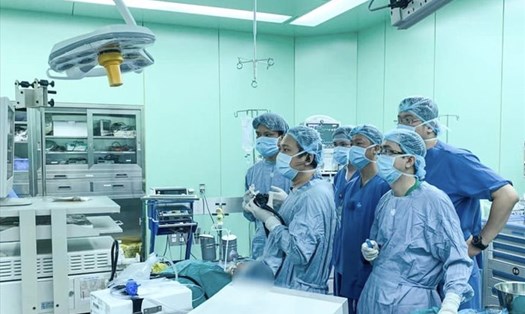
After a general consultation under the chairmanship of Assoc. Prof. Kim Van Vu - Head of Department of Gastrointestinal Surgery 1, K Hospital, doctors agreed to indicate robot-assisted rectal resection surgery, combined with lymph node dissection to ensure treatment effectiveness and optimize postoperative recovery.
The robotic surgery method is assessed to have many advantages such as precise operation, minimal invasiveness, postoperative pain reduction, limiting blood loss and helping to better preserve the neural - vascular function of the pelvic region.
MSc.BS Tran Dinh Tan - Deputy Head of Department of Gastrointestinal Surgery 1 commented: This is a case of a young male patient with a narrow pelvis, robot surgery brings many outstanding advantages compared to traditional surgery or conventional endoscopy such as: removing all cancer cells while still preserving maximum healthy cells such as large blood vessels, nerves, especially the genitourinary nerves, controlling blood loss during surgery better, patients recover faster.
The surgical team performed surgery to remove the entire rectal tumor combined with lymph node dissection.
Thanks to the support of a modern robot system, the surgery took place smoothly, ensuring high accuracy in operation, and at the same time helping to minimize trauma for patients.
After surgery, the patient has a good recovery prognosis, less pain and is likely to return to normal activities soon.