
On the morning of June 2nd, the Ho Chi Minh City People's Council organized a workshop "Overall Planning of Ho Chi Minh City - 100-year vision" to gather opinions from experts, scientists, managers and the business community for the long-term development orientation of the city.
Speaking at the conference, Member of the Party Central Committee, Deputy Secretary of the City Party Committee, Chairman of the Ho Chi Minh City People's Council Vo Van Minh said that after merging Ho Chi Minh City, Binh Duong and Ba Ria - Vung Tau, the new city has an area of more than 6,700km2 and a population of over 14 million people, becoming one of the largest megacities in Southeast Asia.
Ho Chi Minh City continues to play the role of economic locomotive of the country, contributing more than 23% of the national GDP and over 30% of total state budget revenue.
According to Mr. Vo Van Minh, the development of the Ho Chi Minh City Master Plan has particularly important strategic significance, aiming to shape an integrated and synchronous development model in terms of space, infrastructure and socio-economy; optimize resources; improve the quality of life of people; increase the ability to adapt to climate change and affirm the city's position in the region.
The workshop focused on discussing four key groups of issues to build a scientific and practical basis for planning.
In which, the city orients its development based on five breakthrough economic pillars including high-tech industry; logistics associated with seaports, aviation and free trade zones; international financial center; tourism and cultural industry; education, health, science and technology.
Delegates also focused on contributing opinions on the multi-polar megacity model, restructuring the development space after the merger; developing transportation infrastructure, energy, water supply and drainage and digital infrastructure; and proposing solutions for resource management, environmental protection and climate change response.
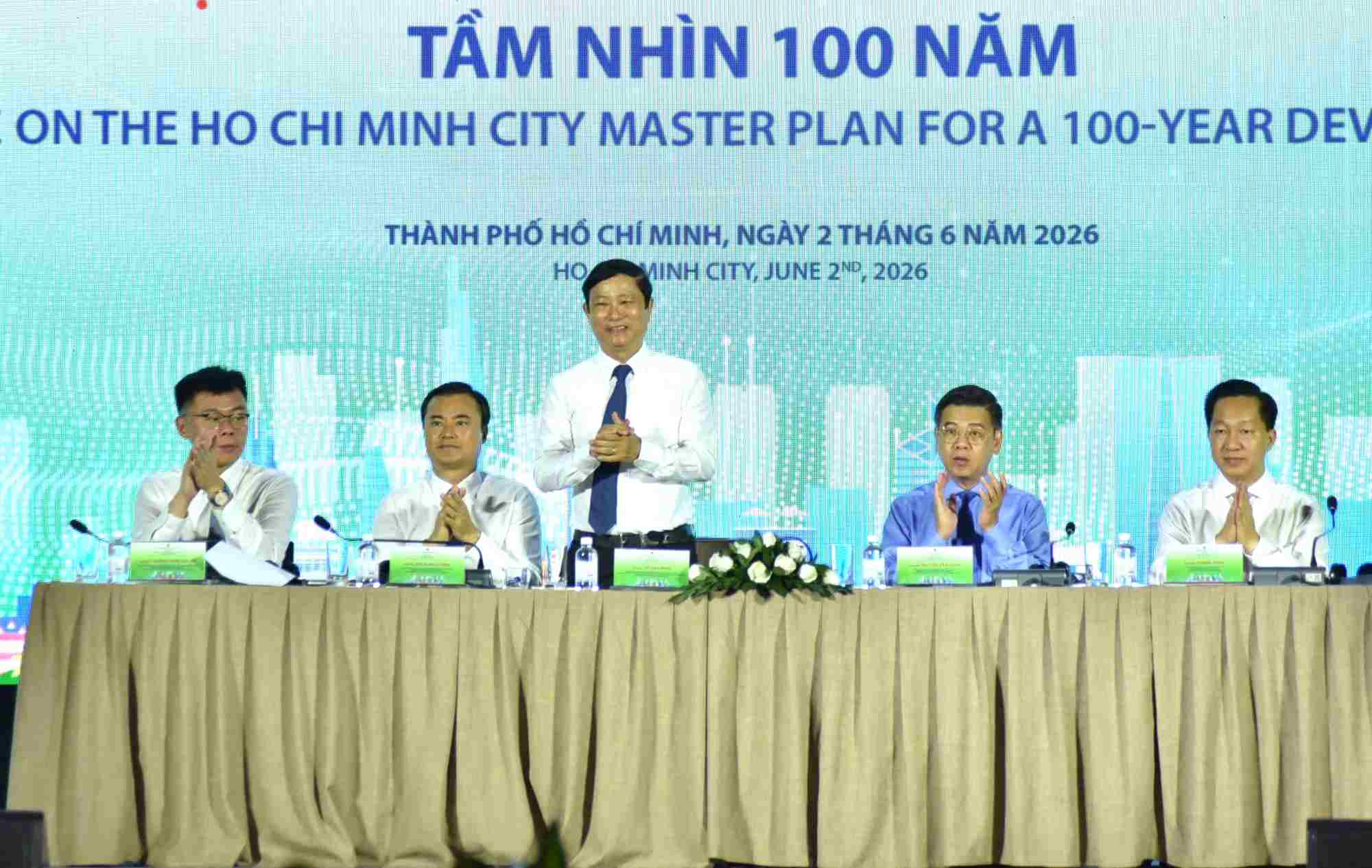
According to the outline of the Ho Chi Minh City Master Plan for the period 2025 - 2050, 100-year vision, the research scope is not only limited to the boundaries of Ho Chi Minh City but also expands to neighboring provinces including Dong Nai, Tay Ninh, Dong Thap, Lam Dong and related sea spaces.
According to the orientation to 2050, Ho Chi Minh City will be in the group of 100 cities with the best quality of life in the world, becoming an important economic, financial, commercial, logistics, tourism, education, health, science - technology and innovation center of the Asia-Pacific region.
The planning outline sets out many ambitious targets such as an average GRDP growth rate of at least 10% per year; urban construction land area of about 290,000 - 320,000ha; population from 20 - 22 million people; total economic scale reaching about 1,200 billion USD by 2050.
Ho Chi Minh City will transform its growth model from a economy based on cheap labor and processing to an economy based on science and technology, innovation, digital economy and knowledge economy.
One of the prominent contents of the plan is the restructuring of the development space according to the "three regions - three corridors" model.
Accordingly, the old Ho Chi Minh City area will focus on developing an international financial center, high-quality services and high technology; the old Binh Duong area becomes a high-tech industrial center; while the old Ba Ria - Vung Tau area develops marine economy, logistics, clean energy and marine tourism.
Three strategic corridors include the North-South corridor along the Saigon River facing the sea; the East corridor connecting Ba Ria - Vung Tau with Can Gio; and the East-West corridor connecting Dong Nai - Tay Ninh through National Highway 1A and Xuyen A road...
According to the plan, the Ho Chi Minh City People's Committee is expected to approve the overall plan on October 30 and officially announce it on November 10.


